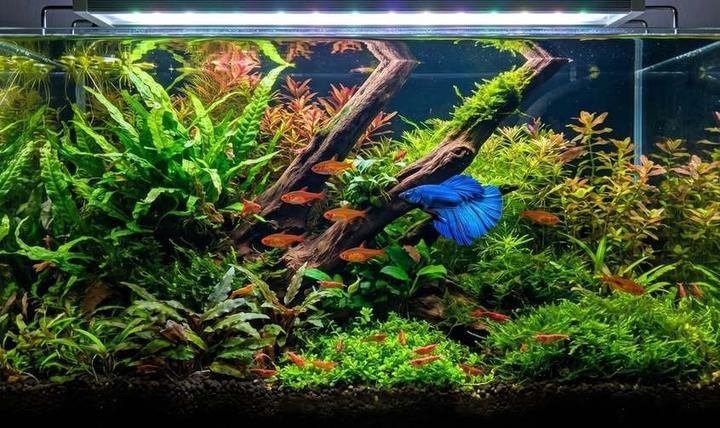
Short answer: a 10-gallon tank (38 L) holds one betta on its own, or a single school of six to ten fish that top out near 1 inch (2.5 cm), or a shrimp colony. That is the ceiling. The tank holds about 8 gallons (30 L) of real water once gravel and gear go in, and you can check the true figure for any tank with our aquarium volume calculator. It tips from safe to toxic in about two days when you overstock it.
The number matters less than knowing how it was reached. Get the reasoning and you can stock any tank you ever own, instead of trusting a chart that guessed at your fish. If you would rather have the arithmetic done for you, our aquarium stocking calculator sizes a tank to any fish list in seconds.
The inch-per-gallon rule fails, and here is where
One inch of fish per gallon. Store staff still repeat it, so a 10-gallon tank supposedly fits ten inches of fish. The math is clean and the answer is wrong, because length has almost nothing to do with the load a fish puts on the water.
Counterexample one. Ten inches of fish could mean one common goldfish (Carassius auratus) at 10 inches (25 cm). A goldfish that size has the body mass of a small potato and eats like a dog. It produces so much ammonia that even 8 gallons (30 L) reads toxic within a day or two. The rule says it fits. Reality says it poisons the tank by the weekend.
Counterexample two. Those same ten inches could mean ten ember tetras (Hyphessobrycon amandae) at roughly 1 inch (2.5 cm) each. Ten of them weigh a fraction of the goldfish and produce a fraction of the waste. But now you have a different failure: ten fish in 8 gallons is a crowd, the school never settles, and the smallest fish get bullied off the food. The rule said both stockings were identical. One is a waste-bomb, the other is a social pressure cooker, and the tape measure saw neither coming.
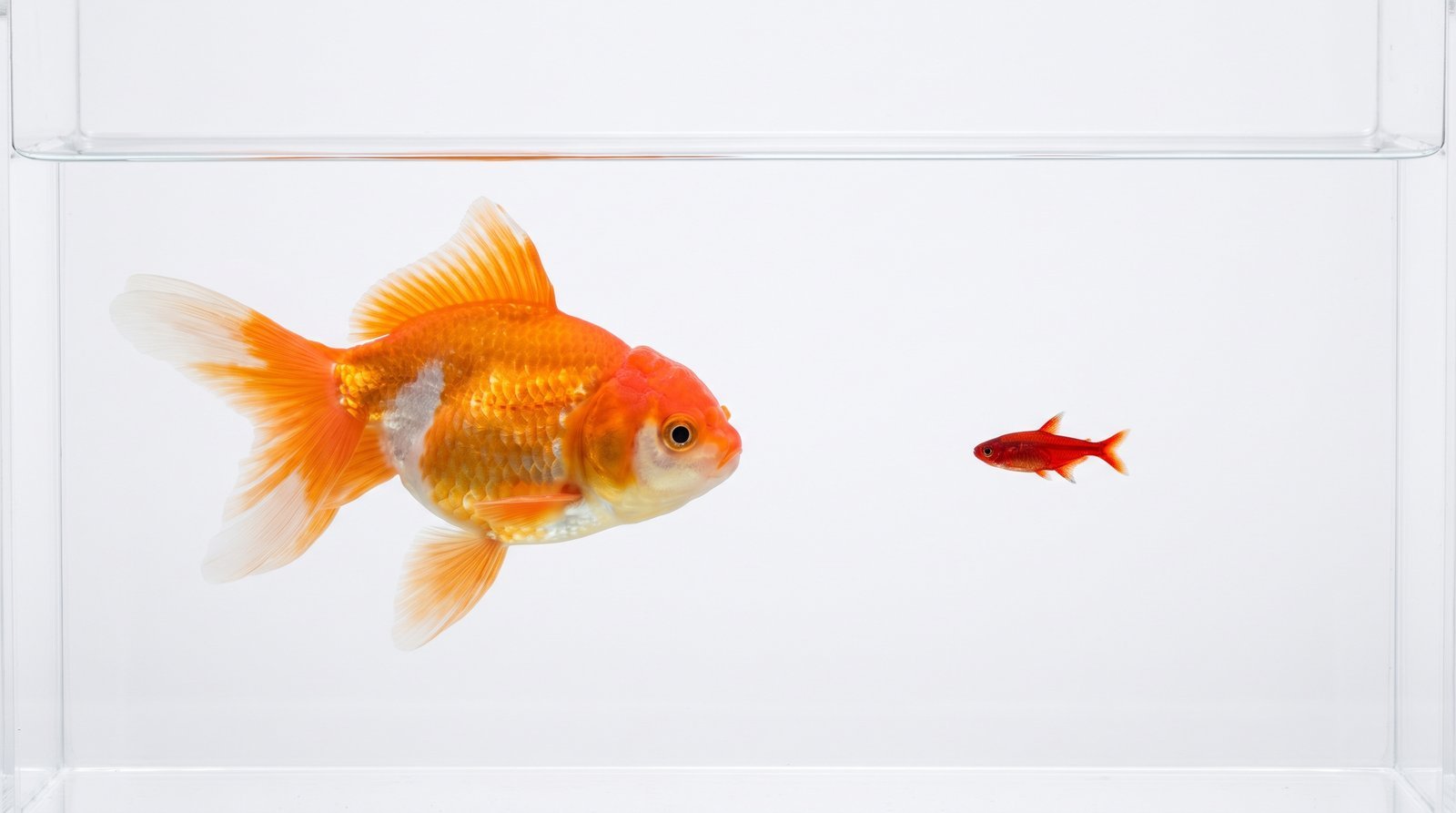
Body mass, waste output, and behavior decide stocking. A tape measure reads none of them.
What actually limits how many fish fit
Six things set the real ceiling. Run any potential fish through all six before you buy it.
Bioload. This is the amount of waste, and therefore ammonia, a fish adds to the water. A chunky, hungry fish carries a heavy bioload; a slim nano fish carries a light one. Your filter’s bacteria can only process so much ammonia per day, so bioload, not fish count, is the true limit. Keep ammonia and nitrite reading 0 ppm at all times; the moment they do not, you are over the line. Reading those numbers is covered in the guide on how to read and lower your water parameters.
Adult size. Stock for the fish the animal becomes, not the juvenile in the bag. A fish sold at 2 inches (5 cm) that matures at 12 inches (30 cm) was never a 10-gallon fish; the store just sold it before it grew.
Swimming style. An active, open-water swimmer like a danio needs horizontal room to cruise. A slow, structure-hugging fish like a pygmy cory does not care about length nearly as much. A 10-gallon tank is 20 inches (50 cm) long, which is a short runway for anything built to move.
Territory. Some fish defend a patch of the tank and attack intruders. A male betta (Betta splendens) treats the whole 10 gallons as his. Put two males in and one dies. Territorial fish lower your stocking number regardless of their size.
Schooling minimums. Tetras, rasboras, danios, and cories are shoaling fish that feel safe only in a group. Keep fewer than six and they live stressed, hide constantly, and often nip each other. Six is the floor; eight to ten is where the behavior actually relaxes. That minimum means a schooling species eats a big slice of an 8-gallon budget in one purchase.
Filter turnover. Aim to move four to six times the tank’s water volume through the filter every hour. For 8 gallons (30 L) of real water, that is a filter rated around 40 to 50 gallons per hour. Buy one rated for 20 gallons (76 L), not 10, because ratings assume an empty tank with no fish and no media resistance. More filter surface means more room for bacteria, which raises the bioload the tank can safely carry. Bettas are the exception: they hate current, so a gentle sponge filter suits them better than a strong hang-on-back.
Eight stocking plans that work
Pick one plan and run it. Do not blend two. The fastest way to wreck an 8-gallon tank is to buy two of this and three of that until you own six species and no real group of anything.
| Plan | Species and count | Temp | pH | Difficulty |
|---|---|---|---|---|
| Solo betta | 1 male betta (Betta splendens) | 78 to 80°F (25 to 27°C) | 6.5 to 7.5 | Easy |
| Ember school | 8 to 10 ember tetras (Hyphessobrycon amandae) | 73 to 82°F (23 to 28°C) | 5.5 to 7.0 | Easy |
| Chili nano, planted | 10 to 12 chili rasboras (Boraras brigittae) | 76 to 82°F (24 to 28°C) | 5.0 to 7.0 | Medium |
| Galaxy nano | 8 celestial pearl danios (Danio margaritatus) | 73 to 79°F (23 to 26°C) | 6.5 to 7.5 | Medium |
| Two-layer | 6 pygmy cory (Corydoras pygmaeus) plus 8 chili rasboras (Boraras brigittae) | 74 to 79°F (23 to 26°C) | 6.0 to 7.5 | Medium |
| Shrimp species, planted | 15 or more cherry shrimp (Neocaridina davidi) plus 3 nerite snails (Neritina natalensis) | 68 to 78°F (20 to 26°C) | 6.5 to 7.8 | Easy |
| Endler colony | 6 male Endler’s livebearers (Poecilia wingei) | 72 to 80°F (22 to 27°C) | 7.0 to 8.0 | Easy |
| Scarlet badis species | 1 male plus 3 female scarlet badis (Dario dario) | 72 to 79°F (22 to 26°C) | 6.5 to 7.5 | Medium |
A few notes that the table cannot hold.
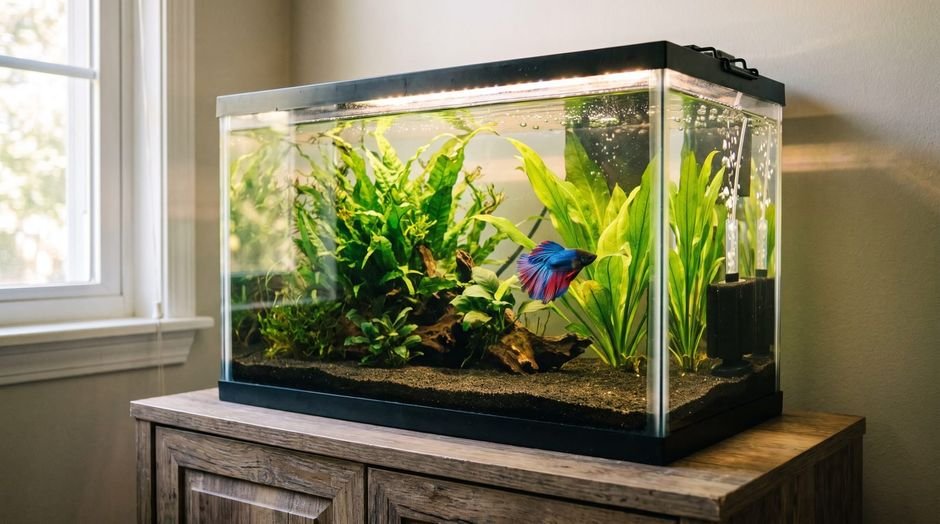
The solo betta is the easiest first tank in the hobby. One male, alone, with a gentle filter and a few live or silk plants. Add three nerite snails if you want algae help. Skip plastic plants; their hard edges tear betta fins.
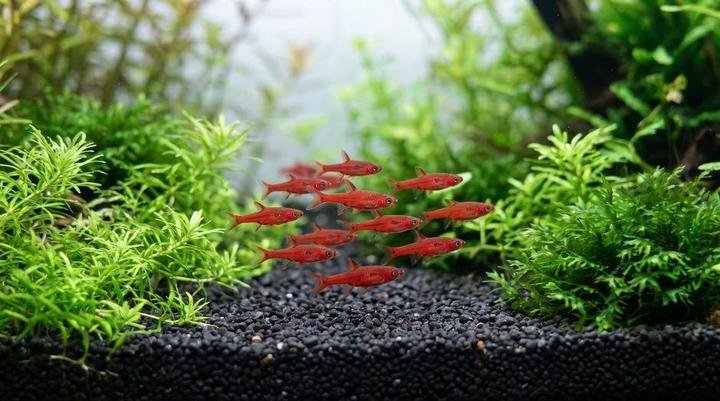
The ember school and the chili nano are the planted-friendly picks. Both fish stay under 1 inch (2.5 cm): the ember tetra at 0.8 inch (2 cm), the chili rasbora at 0.7 inch (1.7 cm). Chili rasboras want soft, acidic water and their color only comes out in a planted tank with dark substrate, which is why they rate Medium.
The galaxy nano uses celestial pearl danios, also sold as galaxy rasboras, at about 0.8 inch (2 cm). Stunning fish, a little shy, best in a group of eight.
The two-layer plan is the one that uses the tank’s height and floor at once: pygmy cory (1 inch, 2.5 cm) working the bottom, chili rasboras up top. This is the busiest a 10-gallon should ever get. Add nothing else.
The shrimp species tank is the lightest bioload of all. Cherry shrimp (Neocaridina davidi) reach 1.2 to 1.5 inches (3 to 4 cm) and breed on their own in clean, planted water. Start with fifteen. Nerite snails (Neritina natalensis, about 1 inch shell) graze algae and never breed in fresh water.
The Endler colony keeps six males only. Male Endler’s livebearers hit about 1 inch (2.5 cm); the females reach nearly 1.8 inches (4.5 cm) and breed relentlessly, so a mixed group overruns 8 gallons in months. Males only keeps the color and skips the population problem.
The scarlet badis tank is for someone ready to feed live or frozen food. The male Dario dario is a jewel at 0.8 inch (2 cm), the female nearer 0.6 inch (1.5 cm). They often ignore dry food, which is the whole reason for the Medium rating.
Fish the store will sell you that do not belong in 10 gallons
None of these fit at any age. The store tank shows you a juvenile; the adult size is the disqualifier.
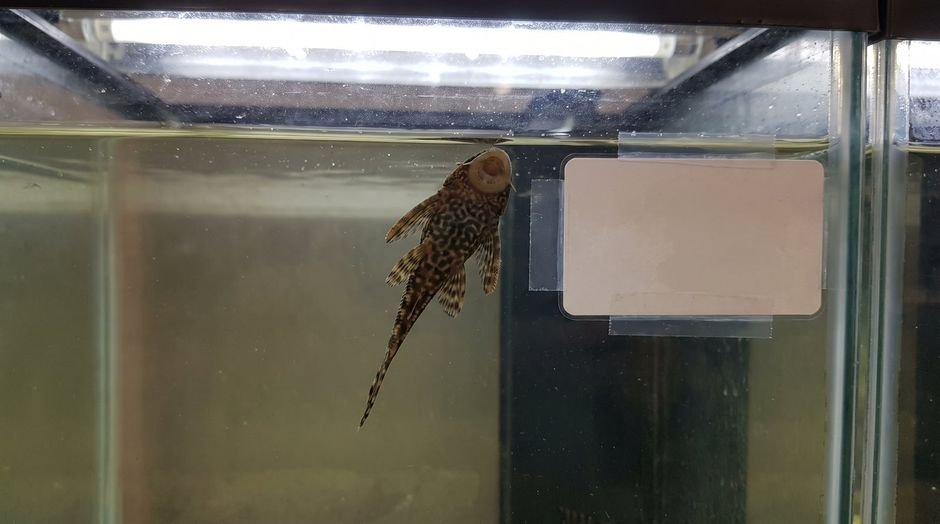
Common pleco (Hypostomus plecostomus). Sold at 2 inches (5 cm), matures at 12 to 24 inches (30 to 60 cm). It also produces more waste than any fish its size in the trade. There is no version of this animal that belongs in a 10-gallon tank.
Goldfish (Carassius auratus). A common or comet goldfish reaches 10 to 12 inches (25 to 30 cm) and belongs in a pond. Even a fancy goldfish, rounder and slower, hits 6 to 8 inches (15 to 20 cm) and needs 20 gallons (76 L) to start, more per extra fish, because of the ammonia load.
Bala shark (Balantiocheilos melanopterus). Reaches 12 to 14 inches (30 to 35 cm), swims fast, and needs a group and a tank measured in feet, not inches. The 2-inch juvenile in the store is a trap.
Angelfish (Pterophyllum scalare). Grows to 6 inches (15 cm) long and taller than that fin-to-fin. A 10-gallon tank stands 12 inches (30 cm) tall, so a grown angelfish cannot even turn comfortably. Angelfish want a tall 29-gallon (110 L) or larger.
While you are walking the aisle, the same size test disqualifies the oscar (Astronotus ocellatus, 12 to 14 inches / 30 to 35 cm), the silver dollar (Metynnis argenteus, 6 inches / 15 cm), and the iridescent shark (Pangasianodon hypophthalmus, 3 to 4 feet / 90 to 120 cm). Neon tetras (Paracheirodon innesi) sit in a gray zone: six will survive a 10-gallon, but at 1.5 inches (4 cm) and built to cruise, they swim far better in a 20-gallon (76 L).
Scale the reasoning to 20 and 29 gallons
The method never changes: find the real water volume, then think in one centerpiece plus one or two schools sized to the footprint, checking every fish against the six limits above.
A 20-gallon (76 L) tank comes in two shapes. The “20 long” (30 by 12 by 12 inches / 76 by 30 by 30 cm) gives more floor and suits bottom dwellers; the “20 high” trades floor for height. Real volume lands near 17 gallons (64 L). A 20 long comfortably holds a betta plus a school of ten small fish, or a group of eight cories plus a twelve-fish school, or a pair of honey gourami (Trichogaster chuna, 2 inches / 5 cm) over a single school.
A 29-gallon (110 L) tank (30 by 12 by 18 inches / 76 by 30 by 45 cm) holds about 25 gallons (95 L) of water and, more useful, adds height. That vertical room is what finally opens the door to a pair of angelfish (Pterophyllum scalare) over a school of larger tetras, or a modest community of three or four species instead of one or two.
Notice the pattern: doubling the tank size does not double the fish. Each step up buys you either one more species group or a larger single fish, because bioload and swimming room, not gallons alone, set the ceiling. A 29-gallon is a far easier tank to keep stable than a 10, since more water dilutes mistakes and swings temperature and pH more slowly.
Stocking order and how long to wait
Cycle the tank before a single fish goes in. Growing the filter bacteria takes four to six weeks, and skipping it is the most common way beginners kill their first fish. The full method is in the guide on fishless cycling a new tank, and it pairs with the wider setup steps in how to set up a fish tank.
Once the tank reads 0 ppm ammonia and 0 ppm nitrite on the same day, add fish in two trips, never all at once. Your bacteria colony is sized to the waste it currently receives; dump a full stock in and ammonia climbs for a week while the colony scrambles to catch up.
Buy half your final stock on the first trip. Wait two to three weeks. Test ammonia and nitrite, and only when both hold at 0 ppm do you buy the rest. In a community with a territorial fish, add that fish last, so it cannot claim the entire tank before its tankmates arrive. For a betta community, the betta goes in after everyone else has settled.
Float each bag for 15 minutes to match temperature, then net the fish into the tank and pour the bag water down the sink. Store water carries whatever was in the shop tank, and none of it belongs in yours.
Signs you overstocked, in behavior and in numbers
Your fish show it before the test kit confirms it. Watch for fish hanging at the surface and gulping, or crowding the filter outflow where oxygen is highest. Clamped fins, constant hiding, and fish that normally ignore each other suddenly chasing all point the same way. Algae creeping across the glass faster than it used to is a slower tell that waste is outrunning the tank.
The numbers make it certain. Test nitrate right before your weekly water change:
- Under 20 ppm: your stock level is fine.
- 20 to 40 ppm: you are at the ceiling, so add nothing more.
- Over 40 ppm week after week: too many fish, too much food, or both.
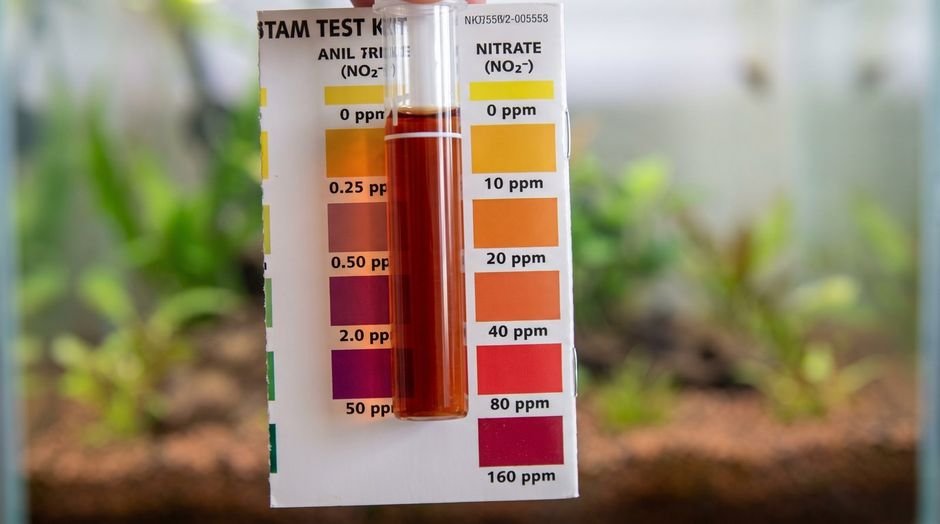
Two other readings seal it. Any ammonia or nitrite above 0 ppm between water changes means the bioload has passed what your filter can process. And if you have to change more than 25 percent of the water more than once a week just to hold nitrate down, the tank is carrying more fish than it should. More stocking questions get answered in the beginner stocking questions in our FAQ.
Feed less than feels right, because more first tanks crash from food than from fish count. One small feeding a day, only what the fish clear within two minutes, and one fasting day a week keeps the waste load honest.
Stock a 10-gallon for eight gallons of water and one group of small fish, and it runs for years. Push it toward that mythical ten inches of fish, and you spend your first month scrubbing algae and replacing the dead.
Sources
- Adult sizes, temperature and pH ranges, from the species profiles: ember tetra, chili rasbora and neon tetra at Seriously Fish; goldfish and iridescent shark at FishBase.
- Nitrogen cycle and bioload limits: Ammonia in Aquatic Systems (University of Florida IFAS Extension) and Nitrite in Fish Ponds (Southern Regional Aquaculture Center, PDF).
- Schooling minimums and behavior: the Seriously Fish profiles above list minimum group sizes for each shoaling species.