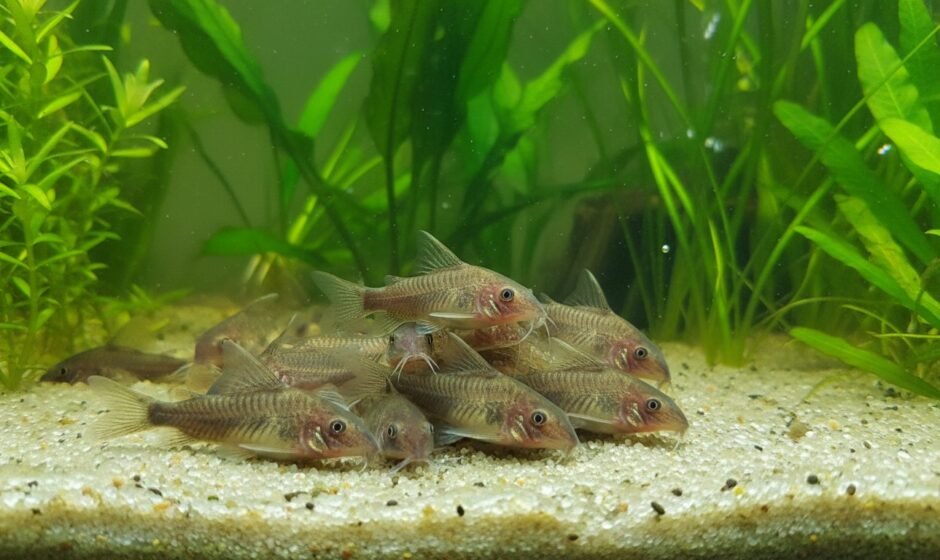
Cory catfish need three things most beginner setups get wrong: a sand or smooth substrate to protect their barbels, a group of at least six of their own kind, and sinking food that actually reaches them. Cover those three and a cory is a peaceful, comic, decade-long pet that thrives at 72-78°F in almost any community. Miss them and you get the sad store-tank version, a lone cory on sharp gravel with worn-off whiskers, slowly starving under fish that eat everything first.
The barbel check
The barbels are the whiskers around a cory’s mouth, and they are working equipment: the fish tastes and locates food with them while sifting the substrate. Healthy barbels are full length, pointed, and intact. Barbels worn down to stubs mean one of two things, and usually both: sharp gravel grinding them away, or a dirty substrate breeding the bacteria that infect the abraded skin. Once a month, watch your corys head-on for a few seconds and check. It is the fastest health readout the species offers, because a cory that cannot feel food cannot find food, and barbel wounds are an open door for infection. Fix the cause early and barbels regrow slowly; leave it and they often never come back.
Sand is the right floor

Corys feed by taking mouthfuls of substrate, sifting out the edible bits, and passing the rest out through their gill covers. Sand lets them do this all day without damage; pool filter sand or any fine aquarium sand works, and smooth rounded fine gravel is an acceptable second place. Sharp or coarse gravel fails the barbel check within months. The substrate also has to stay clean: vacuum it with every weekly water change, because mulm rotting in the layer where corys press their faces is the other half of barbel erosion. If you are choosing a substrate for a tank that will ever hold corys, choose sand and the question is settled.
Cory catfish care at a glance
| Stat | Cory catfish |
|---|---|
| Adult size | 1-3″ by species; bronze about 2.5″, panda about 2″ |
| Lifespan | 5-10 years |
| Temperature | 72-78°F; hold 76-78°F in a tropical community |
| Water | pH 6.5-7.5, flexible if held steady |
| Tank floor | 20 gallons for standard species |
| Diet | Sinking wafers and pellets, frozen bloodworms; food must reach the bottom |
| Temperament | Peaceful bottom-dweller; bothers nothing |
| Group size | 6 or more of the same species |
Groups of six or more
Corys are shoaling fish, and a lone cory is a hiding cory: it tucks behind the filter, eats poorly, and shows none of the synchronized sifting and play that make the species worth keeping. Six of the same species is the minimum, and more is better. Mixing species (three pandas plus three bronzes) is half a fix at best, since corys shoal most tightly with their own kind. Six small catfish need floor space more than volume, which is one of several reasons a 20-gallon works so well as a first tank; the 20-gallon stocking plans build a cory school into the community plan for exactly this reason.
Which cory to buy
There are well over a hundred Corydoras species, and for a first school the choice comes down to four. Bronze and albino corys (the same species in two colors) are the workhorses: hardy, cheap, widely available, and the most forgiving of beginner water. Peppered corys match them for toughness and prefer the cooler half of the range, which suits unheated-basement tanks. Panda corys are the cute ones, and the honesty is that farmed pandas run more delicate; treat them like neons and add them to a mature tank, never a new one. Pygmy corys are a different project, a 1-inch mid-water schooler that works in a 10-gallon where the standard species do not, in groups of eight or more. Whichever you pick, buy the whole school at once from one tank; corys settle faster together than in dribs.
Corys are not a cleanup crew
The janitor myth kills more corys than any disease. Yes, they eat food the other fish miss; that is scavenging, and it is nowhere near a diet. Corys do not eat algae at all, they do not eat fish waste (nothing does), and they add waste of their own. If algae is the problem you are hiring for, the algae eater guide covers which animals actually do that work. Feed corys deliberately: sinking wafers or pellets dropped after the lights dim, when the faster mid-water fish have stopped hunting, plus frozen bloodworms or similar once or twice a week. A cory school that only gets leftovers is a cory school on a slow starvation schedule.
The surface dash, and what corys are sensitive to
Every cory keeper eventually watches a fish rocket to the surface, gulp, and dart back down, and half of them assume something is wrong. Nothing is. Corys have a modified intestine that absorbs oxygen from swallowed air, and the occasional surface dash is normal equipment use. Constant, repeated dashing is different; that pattern says the water is low on oxygen or high in ammonia or nitrite, so test before assuming quirk.
Which points at the species’ real weakness. Corys ride near the bottom, where waste concentrates, and they handle ammonia and nitrite poorly; never add them to an uncycled tank, and run the full fishless cycle before any catfish goes in. They also react badly to salt and to some medications, so read labels and dose a cory tank on the cautious end. A stable, clean, cycled tank sidesteps all of it.
A happy side effect of good cory keeping: eggs. A well-fed school often spawns after a cool water change, which mimics the rainy season, and you will find neat rows of sticky eggs on the glass one morning. In a community the eggs mostly get eaten, so treat a spawn as a compliment on your care rather than a project, unless you want to move eggs to a hatching box and raise a second generation on purpose.
Cory catfish FAQ
Do cory catfish clean the tank?
No. They scavenge missed food, which tidies the substrate slightly, but they do not eat algae or waste and they produce waste themselves. Corys need their own sinking food every day. Buy them because they are charming, long-lived fish, never as maintenance equipment.
Can I keep just one cory catfish?
You can, and it will spend its life hiding and stressed. Corys are shoaling fish that need a group of six or more of the same species to behave normally. If the tank cannot hold six corys plus its other fish, it is the wrong tank for corys.
Why does my cory dart to the surface?
To gulp air. Corys absorb oxygen through a modified intestine, and an occasional surface dash is completely normal. Frequent, repeated dashing is a warning sign of low oxygen or rising ammonia or nitrite, so run a water test when the behavior changes from occasional to constant.
