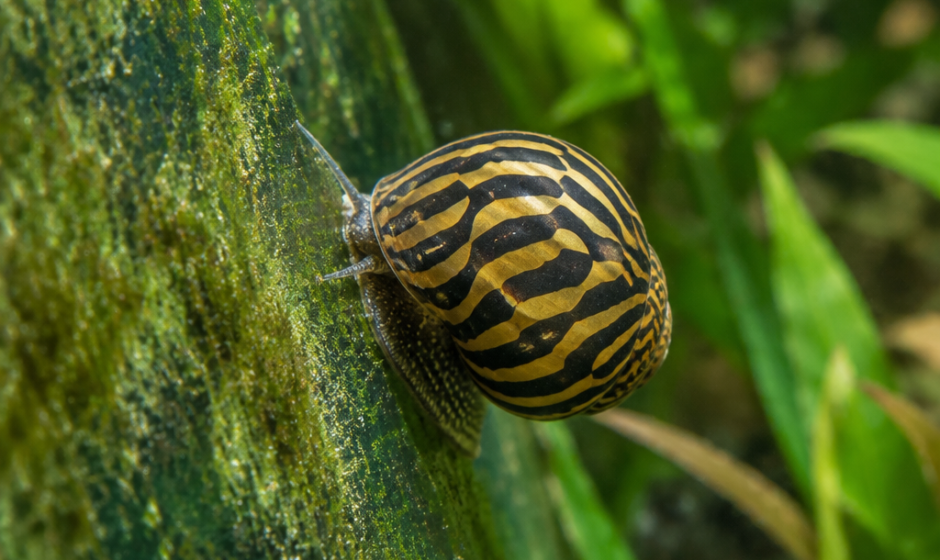
Short answer: nerite snails are the best algae-eating snail in the hobby, and the only one that cannot overrun your tank, because they will not breed in freshwater. They graze film, diatoms and green-spot algae off glass and hardscape better than any other snail, come in striking patterns, and ask only for hard enough water to keep their shells solid. The one quirk: they lay tiny white eggs that never hatch.
| Stat | Nerite snail |
|---|---|
| Adult size | About 1 inch |
| Lifespan | 1 to 2 years |
| Temperature | 72 to 78°F |
| Water | pH 7 to 8, harder water for the shell |
| Tank floor | 5 gallons |
| Diet | Film, diatom and green-spot algae; supplement when it runs low |
| Temperament | Harmless to everything |
| Breeding | Will not hatch in freshwater; lays hard white eggs |
| Extras | A tight lid; they climb out |
The best glass cleaner in the hobby
Nerites graze the film, brown diatoms and stubborn green-spot algae off glass, rocks and wood better than any other snail, which is why they top the algae-eater rankings for a small appetite. They will not touch hair algae or cyanobacteria, so they are a polish for a basically healthy tank, not a cure for a green one. When the algae runs low, feed an algae wafer or a slice of blanched vegetable, because a nerite in a spotless tank slowly starves.
The egg quirk
A nerite’s one downside is cosmetic. The females cement tiny, hard, white eggs that look like sesame seeds onto driftwood, glass and hardscape, and in freshwater they never hatch, because nerite larvae need brackish water. They are harmless and stubborn, and a razor blade barely shifts them. Scrape them or learn to like them; those are the options. The snail egg guide covers how to tell them from the clutches that do hatch.
Shell health and the great escape
Nerites build their shells from calcium, so soft water leaves them thin and pitted at the tip; the pH, KH and GH guide covers raising hardness with crushed coral or a cuttlebone. The other quirk is climbing: a nerite that runs out of algae will scale the glass and leave the tank entirely, so keep a tight lid and feed it before it goes looking. They mix peacefully with everything, including mystery snails and shrimp.
How many, and tankmates
One nerite handles the algae in roughly 5 to 10 gallons, so a single snail suits a nano tank and two or three suit a standard community tank; add more only if the glass greens up faster than they can graze. They are peaceful with everything and bother no fish, shrimp or other snail.
That makes a nerite a safe addition to almost any freshwater tank, including a betta tank, where it gives the betta company without the fin-nipping risk of a second fish. The one tankmate to watch is an assassin snail or a loach, either of which will eventually eat a nerite. Give them hardscape to graze, keep the water hard for their shells, and remember the lid, because a well-fed nerite still wanders and a gap at the top is an invitation.
Nerite snail FAQ
Do nerite snails eat algae?
Yes, they are the best algae-eating snail for glass film, diatoms and green-spot algae. They do not eat hair algae or cyanobacteria, so pair them with a fix for those rather than expecting a nerite to clear them.
Why does my nerite snail lay white eggs?
A female nerite lays hard white eggs whether or not a male is present, and in freshwater they never hatch, since the larvae need brackish water. They are harmless but hard to remove, so scrape them off or leave them.
Why is my nerite snail not moving?
Nerites rest sealed to the glass for a day or two, which is normal. Worry only if it falls off, stays shut for days, or smells rotten when lifted out. A snail flipped onto its back on the substrate can get stuck, so turn it upright.
