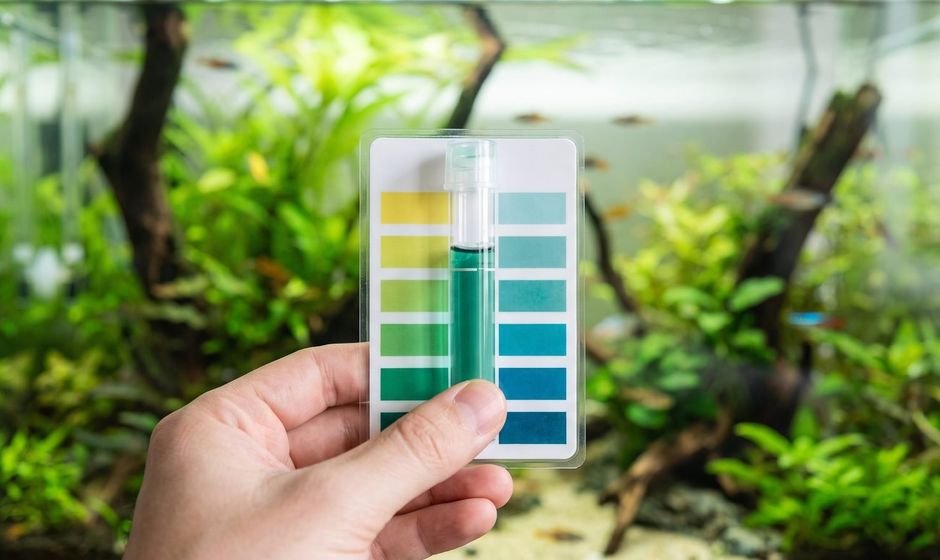
Short answer: pH measures how acidic your water is, KH measures how well it resists pH swings, and GH measures the dissolved minerals your fish and plants actually use. For most community tanks the targets are simple: a steady pH anywhere between 6.5 and 7.5, KH held above about 4 dKH so the pH cannot crash, and moderate GH for healthy fish and molting shrimp. A stable wrong number beats a perfect number that swings.
What the three numbers actually measure
| Parameter | What it measures | Unit | Beginner target |
|---|---|---|---|
| pH | How acidic or alkaline the water is | 0 to 14 scale; 7 is neutral | 6.5 to 7.5, held steady |
| KH (carbonate hardness) | Buffering: the water’s resistance to pH drops | dKH (1 dKH is roughly 17.9 ppm) | 4 dKH or higher |
| GH (general hardness) | Dissolved calcium and magnesium | dGH | 4 to 12 dGH for most community fish |
One thing about pH that catches almost everyone: the scale is logarithmic. Water at pH 6.0 is ten times more acidic than water at 7.0, and a hundred times more acidic than water at 8.0. A change that looks small on paper is a large change to a fish’s gills, which is why speed of change matters more than the number itself.
Stability beats the number
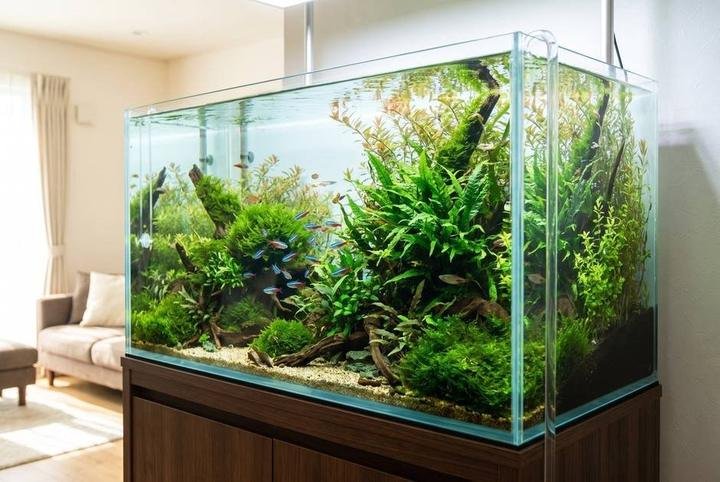
Most community fish sold today are tank-bred generations removed from the wild, and they adapt to a steady pH anywhere in the 6.5 to 7.5 band. What they do not adapt to is movement. A fish held at a stable 7.8 is better off than a fish riding a pH that bounces between 6.8 and 7.4, even though every number in the second range looks better on paper.
That is the reasoning behind a rule that appears throughout this site: never chase pH with chemicals. A bottle of pH-down drops the number within the hour, the KH pushes it back up overnight, you dose again, and the fish live on a chemical see-saw. The swings do the damage the “wrong” number never would have.
KH is your fuel gauge
Here is the part almost no beginner guide explains: your pH does not fail randomly. It fails when the KH runs out, and the KH is being burned constantly.
The bacteria in your filter produce acid as they process ammonia, and that acid is neutralized by the water’s carbonate hardness. The filter runs 24 hours a day, so the KH drains like a fuel tank. While there is fuel left, the pH barely moves and everything looks fine. When the tank hits empty, the pH falls fast, sometimes a full point in a day. Fishkeepers call this a pH crash, and it is why a tank that was rock-stable for months can go wrong in a week. Below a pH of about 6.5 your filter bacteria slow hard, and below 6.0 they nearly stop, which is how a crash can stall an otherwise healthy nitrogen cycle and let ammonia return.
So read KH the way you read a fuel gauge:
| KH reading | What it means | Crash risk | What to do |
|---|---|---|---|
| 0 to 2 dKH | Tank nearly empty; pH can drop any day | High | Water change now to bring in fresh buffering. Add a small amount of crushed coral to the filter, or a pinch of baking soda, and retest in 24 hours. |
| 3 to 4 dKH | Minimum working buffer | Moderate | Test KH weekly. Keep the water changes regular. |
| 5 to 8 dKH | Comfortable reserve | Low | Test KH monthly, or whenever pH looks lower than usual. |
| 9 dKH or more | Heavily buffered, very stable pH | Very low | Nothing. Note that your water is on the harder, more alkaline side when choosing species. |
The goal is to hold KH above about 4 dKH (roughly 70 ppm). A routine water change of about 25 percent weekly usually does this on its own, because tap water brings its buffering with it. Tanks that crash are almost always tanks that skipped water changes for weeks while the filter quietly burned through the reserve.
pH changes what ammonia does
pH is not only a comfort parameter. It decides how dangerous an ammonia reading is. A test kit reports total ammonia, but only the free fraction does the damage, and warm, high-pH water pushes far more of the total into that toxic form. The same 1 ppm reading is a slow-motion problem at pH 6.8 and a same-day emergency at pH 8.2. The full breakdown, including the emergency steps, is in how to lower ammonia in a fish tank. Whatever your pH, the safe ammonia reading is the same: any reading above 0 ppm needs action.
GH: the minerals your livestock actually uses
GH is the calcium and magnesium dissolved in the water, and unlike pH it is a nutrient, not a hazard. Fish draw on it for bone and scale growth. Shrimp need it to build shell after every molt, which is why shrimp react so badly to sudden hardness shifts: a molt in the wrong water is how keepers lose them. Plants use the same minerals as trace nutrients.
For stocking, the practical rules are short. Livebearers such as guppies and platies do best in moderately hard water. Most small tetras and rasboras come from soft water but tank-bred stock handles moderate hardness without complaint. Only wild-caught or notoriously delicate species justify engineering your water, and the tool for that is reverse osmosis water blended with tap, not bottles of adjuster.
If your GH is very low and you dose a remineralizer, add one product at a time. Dosing a buffer, a remineralizer, and a clarifier together is a classic cause of the sudden white mineral haze that appears within hours and leaves you unable to tell which bottle did it.
The 24-hour glass test: find your true tap pH
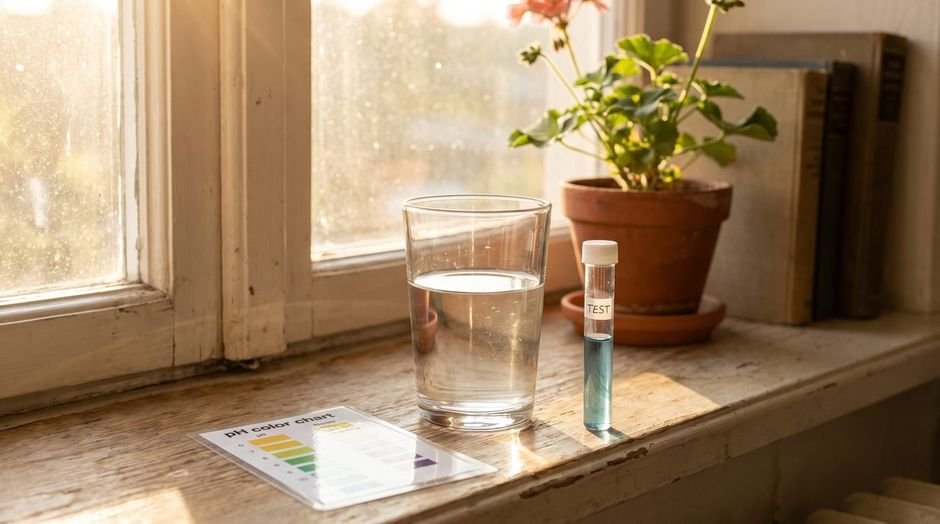
Before you compare your tank to your tap, you need to know what your tap water actually is, and the number straight from the faucet lies. Pressurized pipes hold extra dissolved CO2, which temporarily lowers pH. Test it fresh and you might see 7.0; let the CO2 escape and the same water reads 7.6. The aquarium CO2 calculator estimates dissolved CO2 from that pH and your KH.
- Fill a clean glass from the tap and test the pH immediately. Write it down.
- Leave the glass on the counter, uncovered, for 24 hours.
- Test the same water again. This second number is your true baseline pH, the value your tank water will drift toward after every water change.
A gap of 0.4 to 0.8 between the two readings is common. Every comparison you make from now on, tank against tap, should use the 24-hour number. This one test explains most “my pH keeps rising after water changes” mysteries, and it costs nothing but a glass and a day.
Why the tank drifts away from the tap
Even with a known baseline, an aquarium is not a sealed jar of tap water. The filter’s acid production nudges pH down. Driftwood and leaf litter release tannins that do the same. Evaporation removes pure water and leaves the minerals behind, concentrating GH. Give it a few months of light maintenance and the tank can sit meaningfully softer and more acidic than the tap it was filled from.
That drift is why the size of a water change matters after neglect. A huge change snaps the water back to tap values in an hour, and the fish absorb the whole shift at once. If a tank has gone unmaintained for a long stretch, work back with small daily changes rather than one heroic one. The reasoning and the schedule are in how often to change aquarium water.
The myth: a community tank should sit at exactly pH 7.0
7.0 is neutral chemistry, not ideal biology. No common aquarium fish requires it, and plenty of thriving tanks run at 6.6 or 7.8 for years. The myth does real harm because the products sold to reach 7.0 are the same pH adjusters that create the see-saw described above. If your steady reading falls anywhere between 6.5 and 7.5, the correct dose of pH chemicals is zero. If it sits outside that band and stays put, most community fish will still adapt; choose species that suit your water rather than reshaping your water around species.
When to buy KH and GH test kits
They are not day-one purchases. Your first money goes on a liquid kit for ammonia, nitrite, nitrate, and pH. Add KH and GH tests when one of these becomes true: you keep shrimp, you run a planted tank and dose fertilizer, your pH reads lower each week without explanation, or a cycle has stalled. At that point the KH number usually tells you in thirty seconds what weeks of guessing could not.
Frequently asked questions
What is a pH crash and how do I fix it?
A pH crash is a sudden fall in pH, often a full point or more, caused by the KH running out. Fix it gently: a partial water change brings in fresh buffering, and a small amount of crushed coral in the filter or a pinch of baking soda holds KH above about 4 dKH while you find the cause. Do not slam the pH back up in one move; a fast rise is as hard on fish as the fall, and it also makes any ammonia present more toxic.
Will driftwood and botanicals lower my pH?
They release tannic acids that push pH down, but the effect depends entirely on your KH. In well-buffered water the KH absorbs the acid and the pH barely moves; the water just turns tea-colored. In soft, low-KH water the same wood can pull pH down noticeably. Neither outcome is a problem by itself; just know which kind of water you have before you add a large piece.
Do I need to match the pet store’s water?
No. You need to bridge the gap slowly, once. Float the bag, then add a half cup of tank water every five minutes for 20 to 30 minutes so the fish adjusts to your pH and hardness by degrees. After that the fish lives in your water, and your steady numbers matter far more than whatever the store’s were.
Can I top up evaporation with distilled or RO water?
Yes, and for top-ups pure water is actually the correct choice. Evaporation leaves minerals behind, so topping up with tap water ratchets GH and KH upward over time, while pure water simply replaces what left. The rule flips for water changes: replacement water should carry minerals, so changes use treated tap unless you are deliberately blending RO for a soft-water species.
Sources
- The chemistry of pH, alkalinity (KH) and hardness (GH) and how they interact: Interactions of pH, Carbon Dioxide, Alkalinity and Hardness in Fish Ponds (PDF), Southern Regional Aquaculture Center, publication 464.
- How pH and temperature shift ammonia into its toxic free form: Ammonia in Aquatic Systems, University of Florida IFAS Extension, publication FA031.
- Species pH and hardness ranges referenced for stocking guidance: the species profiles at Seriously Fish.