Short answer: Cloudy aquarium water almost always comes down to one of three things: a bacterial bloom, suspended dust from substrate or debris, or green water from free-floating algae. Only one situation needs you to act today, and it usually is not the one beginners panic about. If the water is cloudy and ammonia reads above 0 ppm, that is the urgent one.
Start with color. A milky white or gray haze spread evenly through the tank is nearly always a bacterial bloom, and it clears on its own. A gritty beige haze that drops to the bottom once the filter is off is physical debris. A green tint that deepens over several days is algae growing in the water column.
The exception: if the water is cloudy and your test kit reads ammonia above 0 ppm, or fish are hanging at the surface gulping, treat it as an emergency and go straight to the urgent section below.
Match what you see to the cause
Switch the filter and lights off for ten minutes, then look at the tank from the side with a flashlight. Where the haze sits, and whether it settles, tells you more than color alone.
| What you see | Extra clues | Likely cause | What to do |
|---|---|---|---|
| Milky white or gray, even throughout | Tank under 4 weeks old, or you overfed, lost a fish, or replaced filter media | Bacterial bloom | Aerate, feed lightly, wait 3 to 10 days. Test ammonia daily. |
| Fine gray or brown grit, worst near the substrate, settles overnight | You just added or stirred sand or gravel, or a fish digs | Suspended substrate dust or detritus | Add filter floss or a polishing pad. |
| Green tint, faint to pea soup, worse each day | Direct sun, lights on over 8 hours, or heavy feeding | Green water | Cut the photoperiod, run a 3 to 4 day blackout, fix light and nutrients. |
| Brown or yellow tint but the water is clear, not hazy | New driftwood, leaves, or botanicals | Tannins staining the water | Nothing. Carbon or water changes will fade it. |
| White haze within hours of dosing something | New buffer, remineralizer, crushed coral, limestone | Mineral precipitate | Stop dosing. Usually clears in a day or two. |
| Any cloudiness with ammonia above 0 ppm, or fish gasping | Filter off, media replaced, new fish added, or a fish died unseen | Failing or overloaded biological filter | Urgent. Partial water change now. |
Bacterial bloom: milky, harmless, self-correcting
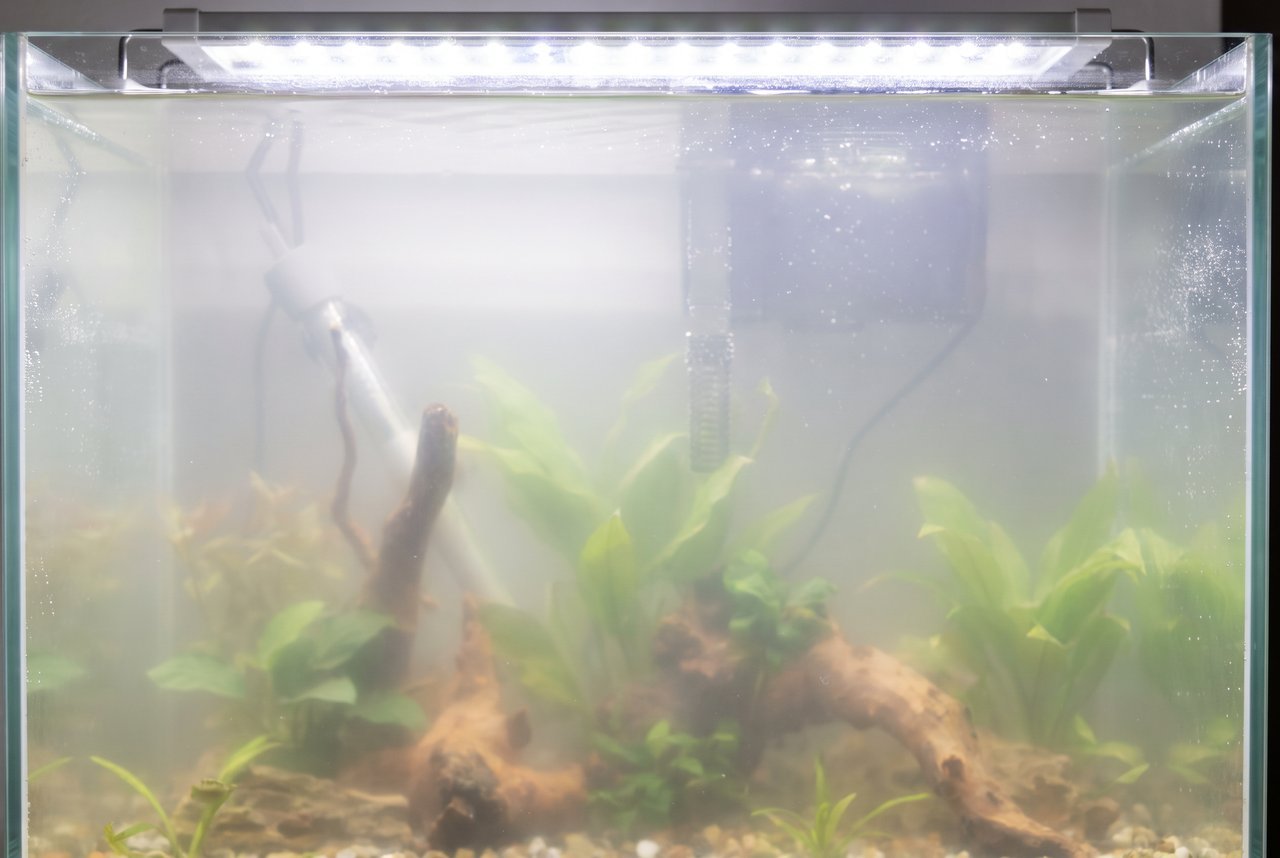
A bloom is a population explosion of heterotrophic bacteria, the ones that break down dissolved organic waste. They are not the nitrifying bacteria that run your biological filter. When a sudden supply of food appears in the water, they multiply fast enough to become visible, which is what you are looking at.
Triggers are usually a new tank in its first two to four weeks, a heavy feed the fish did not finish, a dead fish or snail behind the hardscape, or filter media rinsed too aggressively. The bloom fades once the food runs out, which takes three days to two weeks. In a brand-new setup it is part of the new-tank ammonia spike settling out, so test rather than panic.
The counter-intuitive part: do not do large or repeated water changes to clear it. Fresh water dilutes the bacteria you can see but removes nothing that limits them, and the bloom typically returns within a day. You stress the fish with repeated parameter swings for a cosmetic result.
What actually helps a bloom
- More surface agitation. Bacteria consume oxygen, and a dense bloom lowers what is left for the fish. Angle the filter outflow at the surface or run an air stone.
- Feed less. Skip a day, then go back to a single small pinch, erring on the light side.
- Find the source. Check behind decor for a dead fish or rotting food.
- Test ammonia and nitrite daily. A bloom in a cycled, lightly stocked tank is cosmetic. A bloom alongside an ammonia reading is not.
Clarifiers that clump particles for the filter to catch do work, but they treat the symptom. In a new tank the bloom is part of fishless cycling settling in, and time is the honest answer. The getting started guides cover what to expect week by week.
Substrate dust and fine debris: a mechanical problem
This is the easiest to fix because nothing is wrong biologically. Sand and some gravels carry a load of fine powder from the bag, and once it is in the water the filter recirculates it until something physically traps it.
Fine floss, a polishing pad, or a micron pad clears it in 24 to 48 hours. Put it in the last stage the water passes through, after the coarse sponge, so it does not clog immediately. When adding new substrate, rinse it in a bucket until the runoff is nearly clear, which takes several goes with sand.
Persistent fine haze in an established tank is usually detritus rather than dust. Undersized filtration, a filter overdue for service, or a clogged intake sponge all let fine waste stay in suspension. Rinse mechanical media in tank water, never tap water.
Green water: light and nutrients, not dirt
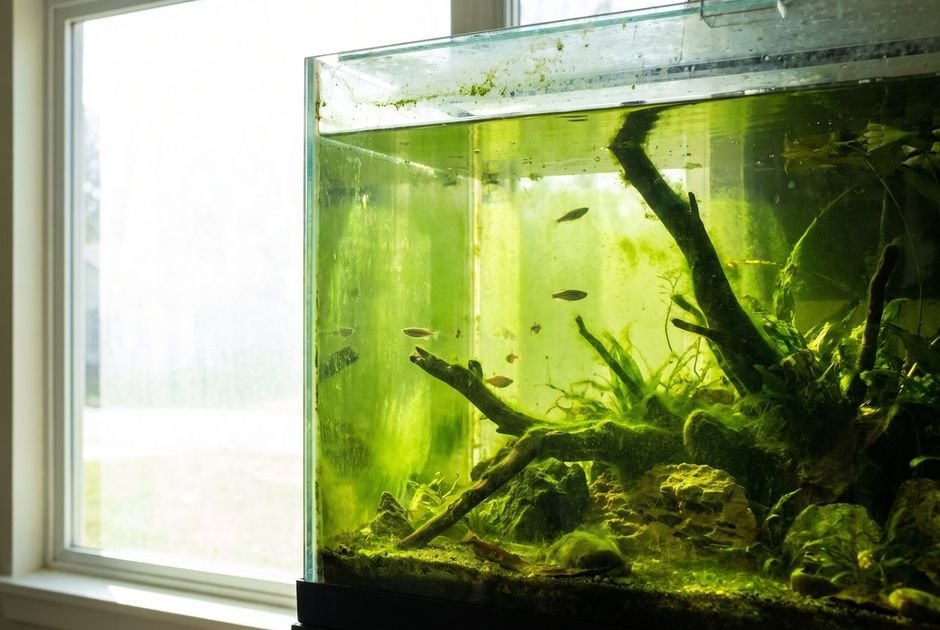
Green water is a bloom of single-celled algae suspended in the water column, driven by the same balance that drives every algae problem: light, available nutrients, and CO2. A green tank is not a dirty tank by definition. Plenty of outbreaks happen in tanks that get frequent water changes but sit next to a sunny window. It rarely harms fish directly, but it blocks your view and at high density swings dissolved oxygen overnight.
- Remove the light. Switch the aquarium light off and cover the tank with a blanket for three to four days. Do not feed, or feed one tiny amount. Fish handle this fine, and so do most plants, though fast-growing stems may drop a few leaves.
- Uncover and clean up. Do a 25 to 30 percent water change, vacuum the substrate lightly, and rinse the mechanical media.
- Change what caused it. Drop the photoperiod to 6 to 8 hours on a timer, move the tank out of direct sun, and cut feeding back. If nitrate is over 40 ppm, increase water change volume until it is not.
- Only then consider hardware. A UV clarifier keeps green water away by killing the free-floating cells as they pass through, but a tank with too much light will find another algae to grow.
If green water returns after a blackout, the light schedule or the sunlight is still the problem. There is a full method in how to get rid of algae without chemicals, and the algae and problems section works through the balance in detail.
The one case that is genuinely urgent
Cloudiness by itself is not an emergency. Cloudiness with either of these signs is:
- Ammonia or nitrite above 0 ppm. Any reading at all means the biological filter is not keeping up. Use a liquid test kit rather than strips, which read poorly at the low end.
- Fish at the surface gulping air, gills working hard, or sitting on the bottom with clamped fins. Gasping means oxygen is low or their gills are damaged.
In that case, change 25 to 50 percent of the water with dechlorinated water matched to tank temperature, stop feeding for 24 hours, add surface agitation, and confirm the filter is running with clear flow. Then work out what changed. Usual causes: a filter unplugged or over-cleaned, a batch of new fish added at once, a dead fish out of sight, or a heater failure. If the reading is high, follow how to bring ammonia down and test daily until ammonia and nitrite both read 0 ppm.
Mistakes that make cloudy water worse
- Draining and refilling the whole tank. It resets nothing useful and shocks the fish with sudden changes in temperature, pH, and hardness.
- Replacing all the filter media at once. Most of your nitrifying bacteria live on it. Swap one part at a time, weeks apart.
- Stacking chemicals. Clarifier plus bacterial supplement plus pH adjuster leaves you unable to tell which one did what.
- Scrubbing everything. Hard disturbance of substrate and hardscape releases the organic load that feeds a bloom.
Keeping the water clear
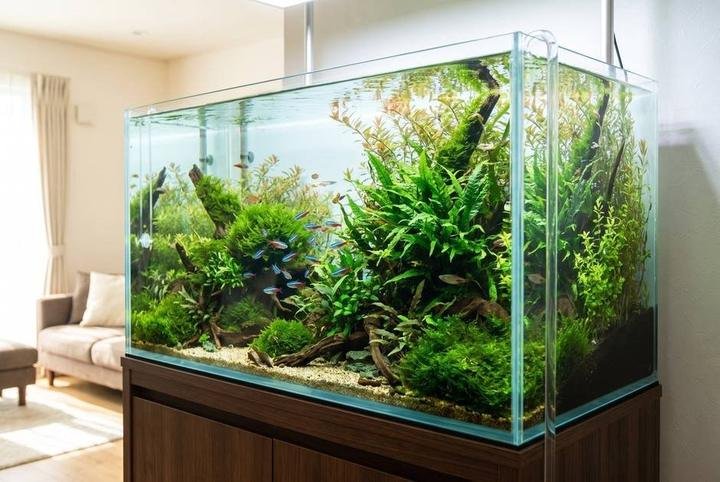
Clear water follows from habits rather than products. Feed what the fish finish in about two minutes. Stick to a weekly change of about 25 percent. Rinse mechanical media in a bucket of tank water every two to four weeks. Put the light on a timer at 6 to 8 hours, and add new fish a few at a time. New tanks often go cloudy, clear, then cloudy again in the first month while bacterial populations find their level, which is why setting up a new tank the right way matters more than the clarity on any single day.
Frequently asked questions
How long does cloudy aquarium water take to clear?
Substrate dust clears in 24 to 48 hours once you add fine filter floss. A bacterial bloom takes 3 days to 2 weeks and clears on its own. Green water clears in 3 to 5 days with a blackout, but returns unless you cut the light and nutrients.
Is cloudy water harmful to fish?
Not in itself. Blooms and substrate dust do not poison fish, though a dense bloom lowers dissolved oxygen, so extra aeration is sensible. The danger is what sometimes accompanies cloudiness: ammonia or nitrite above 0 ppm. Test rather than guess.
Should I do a water change if my tank is cloudy?
Only if you have an ammonia or nitrite reading, if fish look distressed or go off their food, or as part of clearing green water. For a plain bacterial bloom, extra changes usually prolong the problem. Keep your normal weekly change and wait.
Why did my tank go cloudy after a water change?
Usually because you stirred the substrate and released fine particles and organic waste. That either settles within a day or feeds a short bloom. If it happens every time, vacuum more gently and check whether your mechanical media needs rinsing.