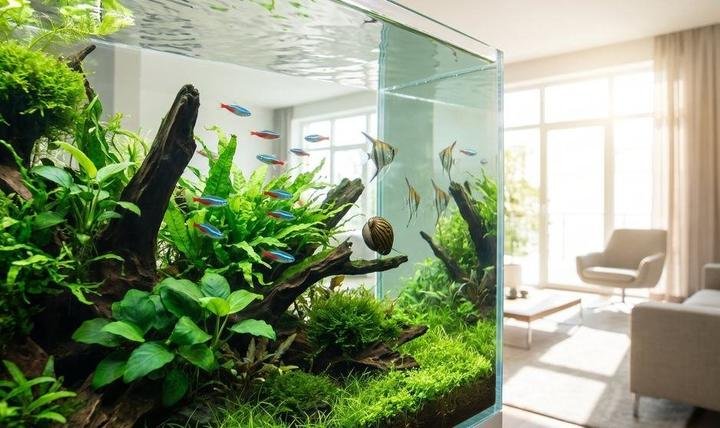
Short answer: Algae grows when there is more light than the plants and bacteria in your tank can use. Cut the lighting to 6 to 7 hours a day, feed once a day, change about 25 percent of the water weekly, and scrub and siphon out what is already there. Most tanks look noticeably better in two to three weeks, with no bottled treatment.
Four steps, in order: identify which algae you have, shorten the lighting period, tighten feeding and water changes, then scrub and siphon out the existing growth.
Skip the algaecide. It kills the algae without touching the reason it grew, so it returns within a month. Worse, a large amount of algae dying at once rots, driving ammonia up and oxygen down at the same time, which can wipe out a tank of fish in a night. Use a chemical after the light and nutrient problems are fixed, not instead of fixing them.
Step 1: work out which algae you have
Different algae point at different causes, and a couple need no intervention. Match what you are seeing before changing anything.
| What it looks like | What it is | What it’s telling you |
|---|---|---|
| Hard green dots on glass, need a scraper | Green spot algae | Strong or long lighting, often with low phosphate |
| Fine green film on the glass within days, wipes off easily | Green dust algae | Young or unsettled tank with plenty of light. Usually self-limiting |
| Brown dust on glass, plants and substrate, tank under three months old | Diatoms | Normal in a new setup. Passes on its own |
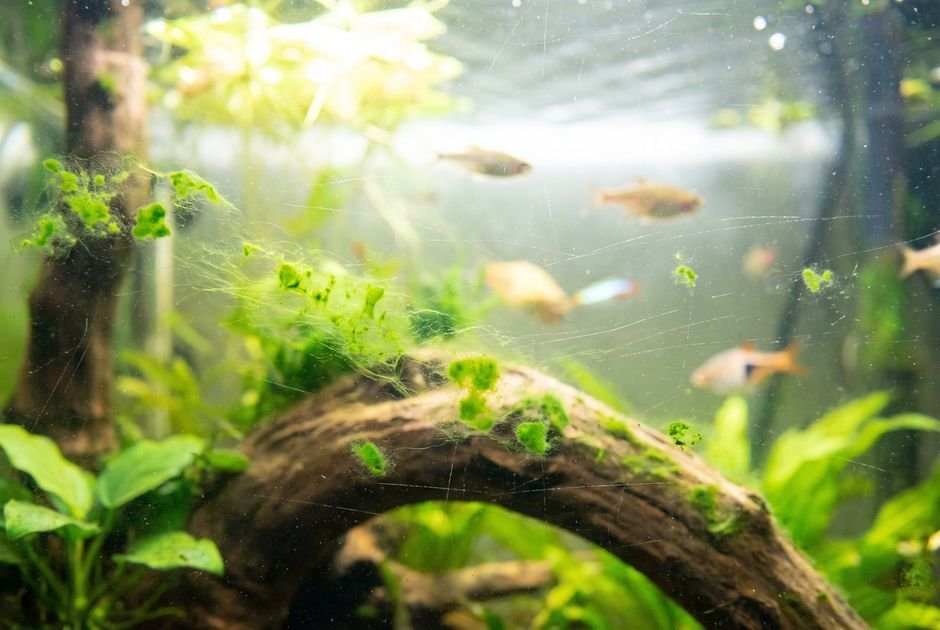
| Green strands and threads tangled in plants and hardscape | Hair or thread algae | Too much light for the available CO2, often with traces of ammonia |
| Tough black tufts like a shaving brush on leaf edges and equipment | Black beard algae | Unstable CO2 and strong light, usually in slow-flow spots |
| Water green and cloudy while the glass stays clean | Green water (free-floating algae) | Excess light, often direct sunlight, plus surplus nutrients |
| Slimy blue-green sheets that peel off in mats and smell musty | Cyanobacteria, not an algae | Poor flow, organic waste in the substrate, often very low nitrate |
Two of those deserve emphasis. Brown diatoms in a month-old tank are part of it settling in: wipe the glass when it bothers you and wait. They fade within a few weeks and nothing you buy speeds that up much.
Cyanobacteria is a bacterium, so algae eaters ignore it and cutting light alone rarely clears it. Siphon the mats out, vacuum the substrate beneath, raise flow in the dead spot where it started, and run a three-day blackout with the tank wrapped.
Step 2: shorten the lighting period
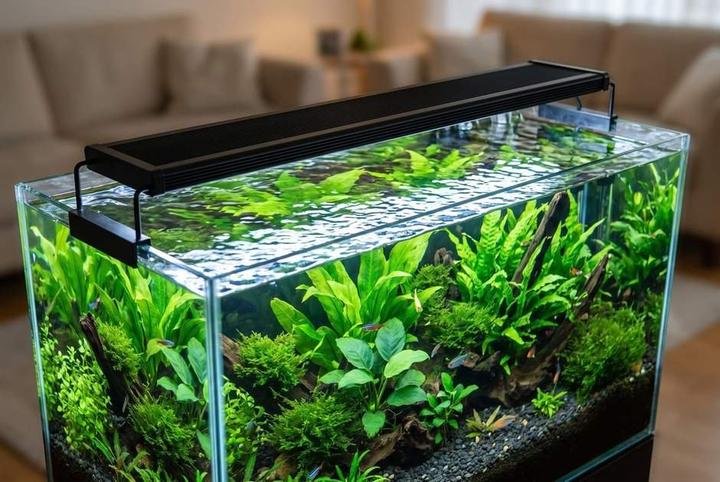
Lighting duration is the lever that matters most, and it is free. Six to seven hours a day on a plug-in timer suits most beginner tanks. Our planted aquarium lighting calculator sets the target output and photoperiod for your plants. Ten hours, because the tank light doubles as living room lighting, is what most algae outbreaks are made of.
Cut the hours rather than dimming the intensity. Plants need a certain brightness to photosynthesize, and a weak light run for a long stretch favors algae. If your light is dimmable and plants look poor, keep it near 60 to 70 percent and hold the duration at six hours.
Direct sunlight is a separate problem and no timer fixes it. A tank in a patch of afternoon sun gets far more light than any aquarium fixture, at unpredictable intensity. Move the tank if you can; if not, block the window side with a blind or a background.
Step 3: control the nutrients
Algae feeds on nitrogen and phosphorus, most of which enters the tank as fish food. Cutting the supply is a matter of habit:
- Feed once a day, only what’s cleared in two minutes. Uneaten food is pure algae fertilizer. Most beginner tanks get twice what they need.
- Change about 25 percent of the water weekly, dechlorinated and temperature-matched. Keep nitrate below 40 ppm, and never replace all the water at once.
- Vacuum the substrate as you siphon. Trapped waste and dead leaves break down into exactly what algae wants.
- Rinse filter sponges monthly in a bucket of old tank water, never under the tap. A clogged filter means poor flow, and poor flow creates the still corners where algae settles.
- Stock lightly and slowly. More fish means more waste, and a tank still cycling leaks the ammonia hair algae thrives on.
Starving a planted tank backfires. Plants that run out of nitrate or phosphate stop growing, and the light and nutrients they are not using go to algae instead. Green spot on the glass of a planted tank often means too little phosphate, not too much. The nitrate to phosphate calculator compares your NO3 and PO4 against the balanced range.
Step 4: remove what’s there and let plants take over
Algae already attached will not vanish when conditions change; it only stops spreading. Take it out by hand.
Use a blade scraper on green spot, a magnet cleaner or cloth on film algae. Twirl hair algae onto an old toothbrush like spaghetti. Cut off badly affected leaves rather than cleaning them; a leaf coated in black beard algae will not recover. Siphon the loose material out during the water change instead of letting it resettle. Scrub ornaments in a bucket, a few at a time rather than stripping the tank at once.
Then give the plants the advantage. Fast-growing stems and floating plants take up nutrients quickly and shade the tank at the same time. Hornwort, water sprite, elodea and Amazon frogbit all grow without extra equipment. Actively growing plants are the most reliable algae control there is, which is why the plants and aquascaping guides lean on easy species. Check that flow reaches every corner too; the guides on filter sizing and outflow cover placement.
Algae eaters that actually earn their place
Livestock is a maintenance crew, not a fix. Adding fish to an unbalanced tank means more waste and more algae. Only add animals the tank can house.
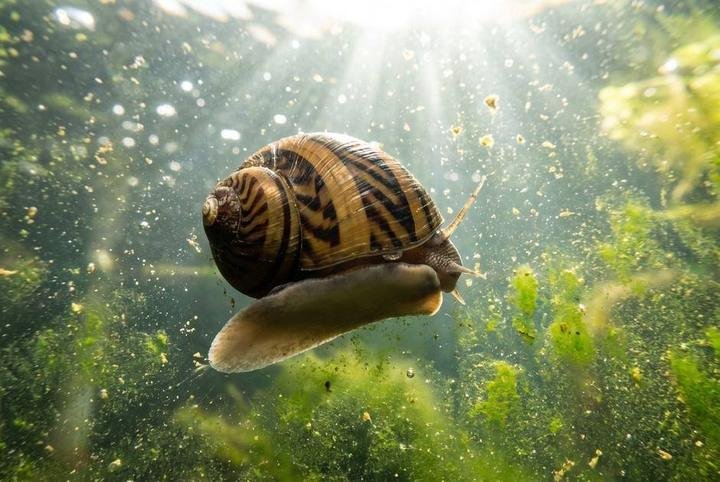
- Nerite snails. The best glass cleaners for green spot, green dust and diatoms. They lay hard white eggs that will not hatch in fresh water but stick to hardscape.
- Amano shrimp. Effective on hair and thread algae. Keep several, and expect larger fish to eat them.
- Otocinclus. Good on diatoms and green film, but they need a mature tank with algae still growing, in a group of at least four. They often starve once a tank is clean.
- Siamese algae eater. One of few fish that eats black beard algae, mainly while young. Reaches about 5.5 inches, needs a 25-gallon tank or more.
- Bristlenose pleco. Tops out around 5 to 6 inches, so it suits a 20-gallon tank. Give it driftwood to rasp.
Do not buy a common pleco. The juveniles sold in general pet shops reach 16 to 20 inches, produce a startling volume of waste, largely stop eating algae as they mature, and can damage plants and the slime coats of flat-sided fish. No standard home aquarium houses one. If you want a pleco, buy a bristlenose and check the species on the label.
How long the fix takes
Light and feeding changes take two to four weeks to show, since existing algae has to run out of resources first. Diatoms in a new tank clear in roughly four to eight weeks unaided. Cyanobacteria responds within days of a blackout plus manual removal, but returns if the flow problem stays unfixed. Black beard algae is the slow one; expect to keep trimming leaves for a couple of months.
Change one thing at a time and give it two weeks. Adjusting light, feeding and fertilizer at once leaves you unsure which worked.
Common questions
Will a three-day blackout kill my plants?
Most established plants tolerate three days of darkness and recover. Past four days you start losing leaves. Keep the filter and heater running, and do not feed for the first two days.
Is algae actually harmful to fish?
Ordinary algae is harmless and grazing fish eat it. Green water can drop oxygen overnight, and some cyanobacteria produce compounds that irritate fish, so those two are worth clearing.
Should I do bigger water changes to fight algae?
Weekly changes of about 25 percent are enough once light and feeding are controlled. Very large or frequent changes swing the chemistry around and stress fish more than the nitrate you removed. See the water quality basics.
Do I need CO2 injection to beat algae?
No. CO2 helps a heavily planted, brightly lit tank stay ahead, but the simpler answer in a low-tech tank is less light. Check where your tank sits with the aquarium CO2 calculator. There is more algae troubleshooting by type.