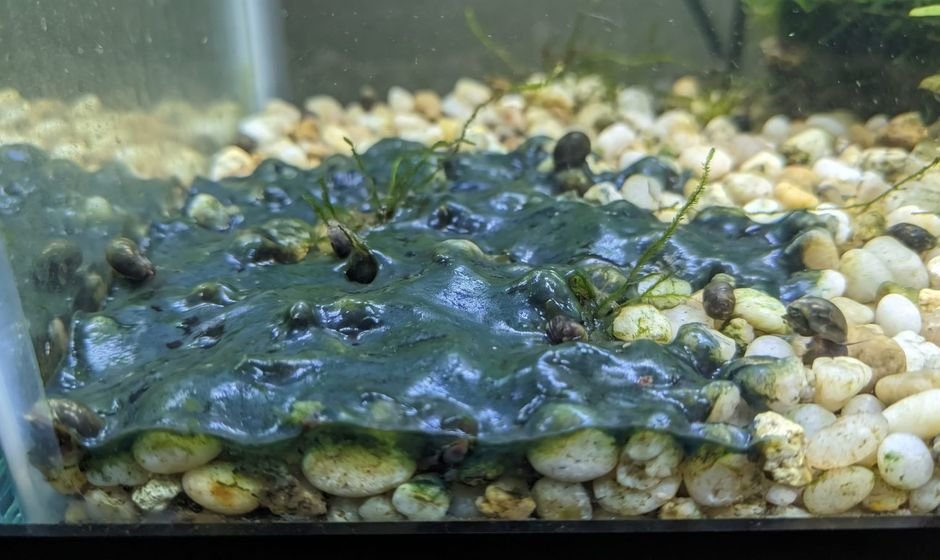
A blue-green slime spreading across your substrate in sheets, back again two days after you scrape it off, and completely ignored by every algae eater in the tank. If that is what you are looking at, here is the twist that explains all of it: what you have is not algae at all. It is cyanobacteria, a photosynthetic bacterium, and the moment you stop treating it like a plant and start treating it like a bacterial colony, the fight gets much shorter. Confirmation takes one sniff.
The smell test: confirm it with one sniff
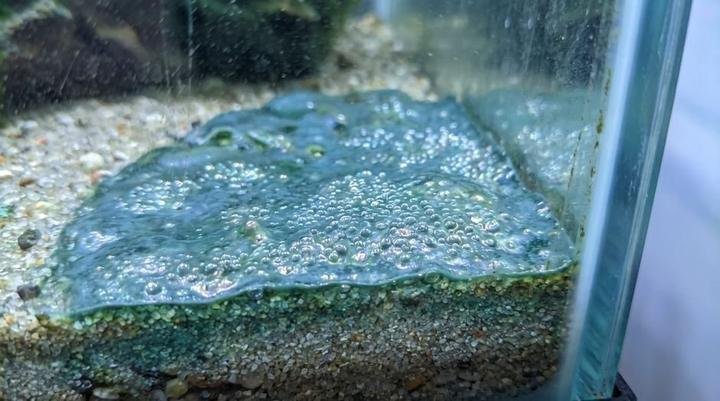
Pull a small patch out of the tank and smell it. Cyanobacteria has an unmistakable musty, earthy odor, like a stagnant pond or damp soil, that no true algae produces. Two more tells seal the diagnosis: it peels off in intact, slimy sheets rather than scraping off as film or pulling away as threads, and its color runs blue-green through deep green to almost black, often with a faint metallic sheen. Smell plus sheets is conclusive. If your growth scrapes, wipes, or winds instead, you are in ordinary algae territory. The algae identification guide takes it from there.
Why “not algae” changes everything
Cyanobacteria are bacteria that learned photosynthesis. An ancient lineage, not a plant. Three practical consequences follow. First, it spreads at bacterial speed: a scraped patch of glass or substrate can film over again within a day or two, which is why manual removal alone always seems to lose. Second, nothing in your tank will eat it for you: the mats taste foul to grazers, and many cyanobacteria strains produce toxins. The same family of compounds behind harmful pond and lake blooms tracked by the EPA, so snails, shrimp, and algae-eating fish all refuse it. Third, and this is the good news: because it is a light-hungry organism with no roots and no reserves, it collapses fast when its conditions are taken away.
The zero-nitrate clue
Here is the counterintuitive reading that separates cyano from every other green problem: it often blooms in tanks where nitrate tests at or near zero. That looks like a paradox, spotless water, filthy substrate line, until you know one more fact: many cyanobacteria can fix nitrogen straight from the gas dissolved in the water, the way legumes do in soil. So when nitrate runs empty, plants and ordinary algae starve, but cyano keeps eating, and inherits the whole tank’s light without competition. A nitrate reading of zero in a planted tank plus spreading slime is that story in numbers. The fix in that case is not “cleaner water”; it is restoring the competition (healthy plant growth) while cutting the organic waste and light the cyano actually depends on. Nitrate has a healthy lane. The nitrate guide covers both ends of it.
Where it starts, and why there
Cyano’s beachheads are predictable: the substrate line along the front glass (light from two sides, organics settling from above), still corners behind hardscape where flow never reaches, and the surface of dirty substrate under strong light. The pattern is light plus settled organic waste plus dead water. Every fix below attacks one of those three legs.
The fix ladder
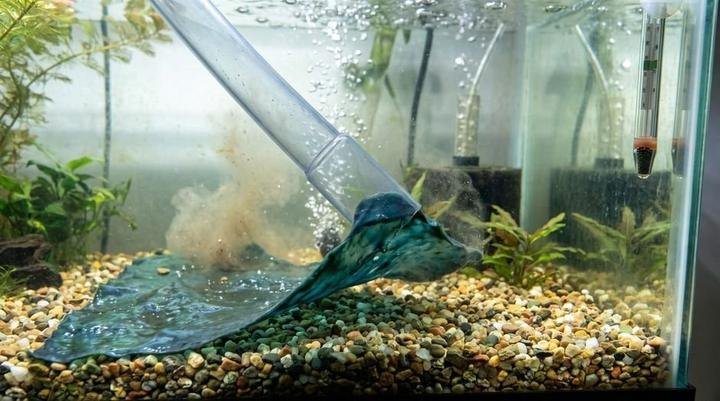
- Siphon the sheets out whole. Their one mercy: they peel. Lead every session with the siphon so removed material actually leaves the tank.
- Attack the organics. Vacuum the substrate thoroughly, especially under and around every patch, and hold feeding to what the fish finish in about two minutes. Settled waste is cyano’s pantry.
- Kill the dead spots. Re-aim the filter outlet so gentle flow reaches the corners it colonizes; if the filter cannot reach the whole tank, check it against the turnover numbers.
- Black out the tank for three days. Cyanobacteria crashes even harder in darkness than green water does. The full wrap-and-wait protocol lives in the green water guide. Run it exactly, total darkness included, with steps 1 to 3 done as the Day 0 prep.
- Last resort, with eyes open. The antibiotic erythromycin does kill cyanobacteria, but it is an antibiotic in a box that runs on bacteria. Your filter’s nitrifiers can be hit too, and a tank that trades a slime problem for an ammonia spike has traded up in danger. If you go this route after everything above fails, test daily for ammonia and nitrite throughout and be ready with the ammonia playbook. Most tanks never need to take this step.
Cyanobacteria FAQ
Is it dangerous to my fish?
Treat it as a real hazard, not a cosmetic one. Some strains produce toxins, and a thick mat also swings oxygen, producing by day, consuming by night, so a heavy bloom can leave fish gasping at dawn. Cyano is the one growth in this cluster that earns a same-week response rather than a someday one.
Can I just do more water changes?
Water changes help with the organics leg but do not kill the mats, and because cyano can fix its own nitrogen, “cleaner water” alone starves its competitors more than it starves the cyano. Pair every water change with physical sheet removal and the flow fix, or the ground you gain regrows.
Why did it appear in my clean, well-kept tank?
Usually one hidden leg of the tripod: a dead-flow corner you cannot see behind hardscape, organics accumulating inside a rarely vacuumed patch of substrate, or nitrate bottomed out at zero in a heavily planted tank. The zero-nitrate clue above is worth checking first, “too clean” is a real cause here.
Will it come back after the blackout?
The blackout kills the standing colony; the tripod grows the next one. If sheets return within weeks, one leg is still standing, recheck flow coverage first, then substrate cleanliness, then light hours. Tanks that fix all three rarely see it twice.
Sources
- US EPA, Harmful Algal Blooms and Cyanobacteria (CyanoHABs): background on cyanobacteria and cyanotoxins in freshwater systems.