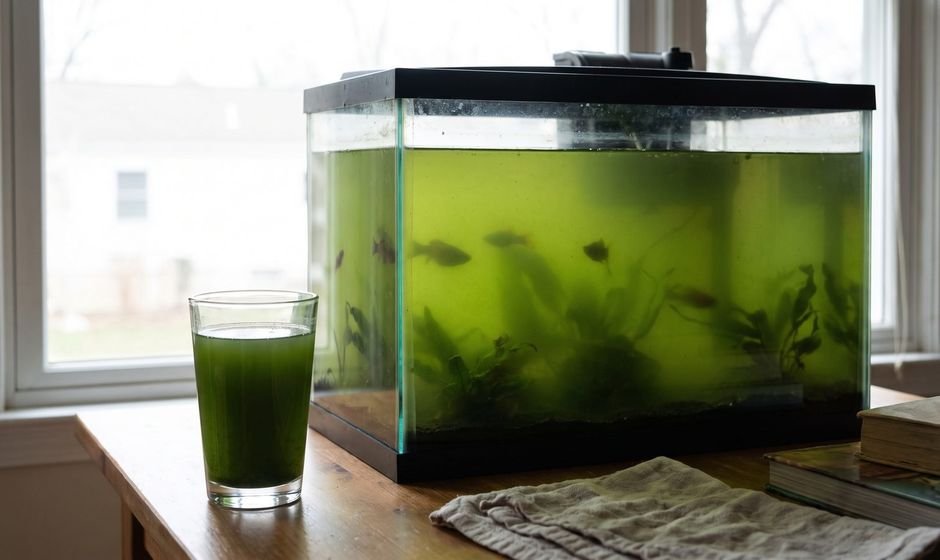
Green aquarium water is the one algae problem where the tank itself turns against you: the water goes pea-soup green while the fish, somewhere in there, are usually fine. It is also the problem where the standard advice, change more water, clean the filter, reliably fails, for a reason worth understanding before you waste a week on it. The fix that works costs nothing and takes three days of darkness. Here is the whole picture: why blooms start, why your filter cannot catch one, and the three-day blackout step by step.
Green water or green glass? Two different problems
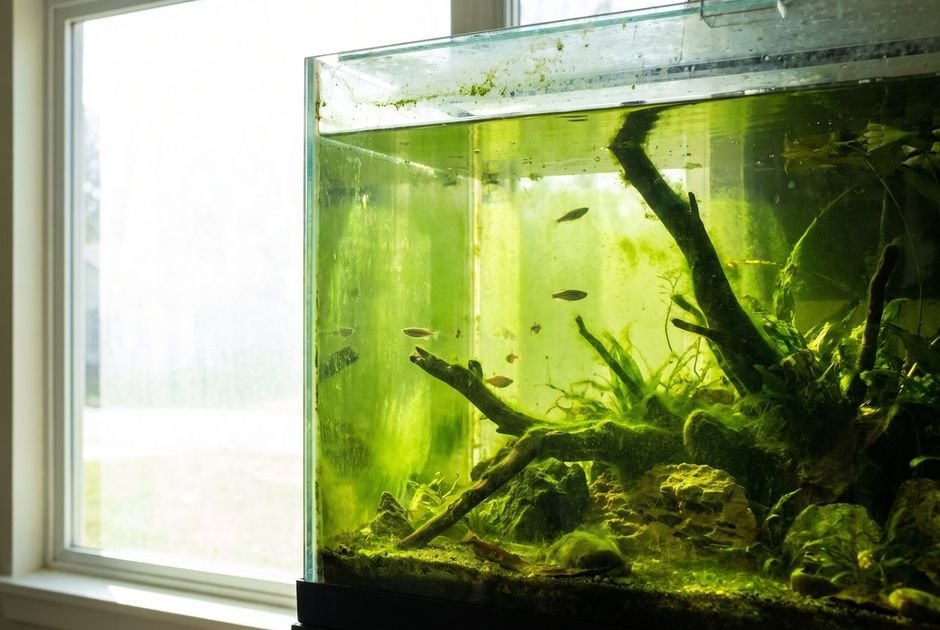
First, split the diagnosis. If the green is on surfaces, glass, rocks, leaves, and the water between them is clear, you have ordinary green algae; that path starts at the algae identification guide. This article is about green water: fill a white cup from the tank and the water itself is tinted green. That tint is millions of free-floating single-celled algae. A bloom of suspended plankton, not a coating. The distinction matters because everything that works on attached algae fails on a bloom, and vice versa.
Why your filter cannot catch it
The bloom cells are a few microns across, far smaller than the pores in sponge or floss, so they ride straight through mechanical media and back into the tank. And water changes lose a race you cannot see: a 50 percent change removes half the cells, but a bloom in good light regrows toward full strength within days, so the tank is just as green by the weekend and you are exhausted. This is the key insight of the whole problem: you cannot remove a bloom faster than it reproduces. You have to stop it reproducing. Bloom cells run on light. Cut the light completely and the population crashes on its own, which is exactly what the blackout does.
What set it off
- Direct sunlight. The number-one trigger. Even an hour of sun crossing the tank each afternoon delivers more energy than an aquarium light does all day.
- An ammonia blip in a young tank. Suspended algae feed greedily on ammonia; blooms in a tank under three months old usually mean the biofilter briefly fell behind. The same territory as new tank syndrome.
- Lights running too long. A generous photoperiod plus few live plants leaves surplus light with nothing legitimate to spend it on.
- Heavy feeding and rising nutrients. Uneaten food is dissolved fertilizer. The two-minute rule applies: feed what is finished in about two minutes.
The three-day blackout, step by step
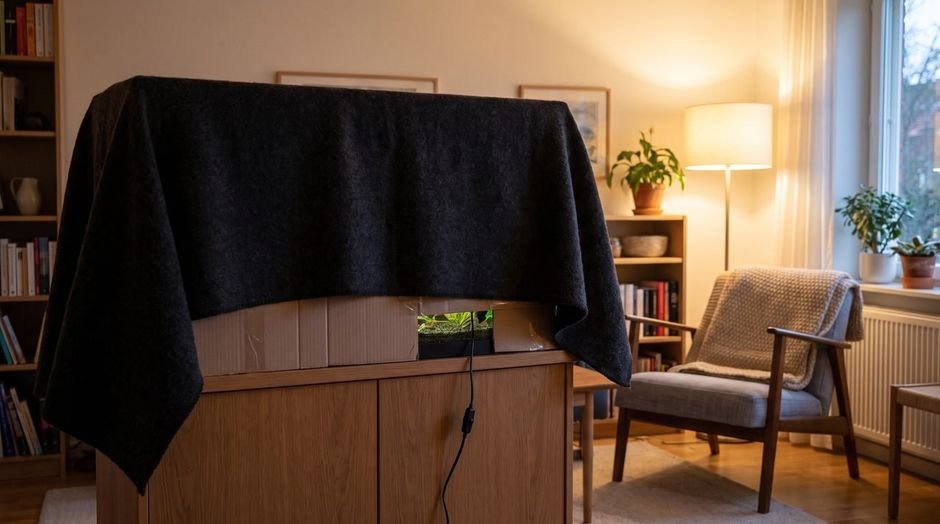
The blackout starves the bloom of light while your fish carry on in the dark, which they handle far better than the algae does. Total darkness is the entire trick. A towel that lets lamplight leak through the back panel is the usual reason a blackout “didn’t work.”
| When | What to do | Why |
|---|---|---|
| Day 0, evening | Wipe surfaces, vacuum the substrate, and do a 25 to 50 percent water change. Add extra surface agitation, tilt the filter outlet or add an air stone. Then wrap the tank completely: blankets or cardboard on all four sides and the top, lights unplugged. | You remove the easy fraction first; the agitation covers oxygen, because with no light nothing in the tank produces any |
| Days 1 to 3 | Total darkness. No peeking beyond a daily lift of one corner to drop in a small pinch of food, or skip feeding entirely, healthy fish handle three lean days without any trouble. | Every hour of light lets the bloom recover ground; the seal is the treatment |
| Day 3, evening | Unwrap. The water should be clear or grey-tinged. Do another 25 to 50 percent change to export the dead cells. | Dead algae decays into ammonia if left in the water, removing it is part of the cure |
| Day 4 onward | Lights back on a reduced schedule, tank open as normal. Fix the trigger (next section) the same week. | The bloom died but its cause did not; unfixed, it re-blooms within weeks |
Keeping it gone
A blackout wins the battle; the trigger list above decides the war. Walk the room at different times of day and check whether sun ever strikes the glass, if it does, block that window or move the tank, because no light schedule can compensate for the sun. Put the light on a timer with a modest photoperiod (the algae guide covers light-hour tuning). Keep nitrate in its lane, under about 20 ppm before a water change, with the routine from the nitrate guide, and hold the feeding line at about two minutes. In a young tank, test for ammonia: a bloom is sometimes the first visible symptom of an invisible spike, and if ammonia reads above zero, treat that first with the ammonia playbook.
The gadget that actually works (and what it does not fix)
One piece of hardware genuinely kills green water: a UV sterilizer, which pumps water past a UV bulb and destroys suspended cells on each pass. It clears a bloom in days and it is not snake oil. But it is a standing subscription to symptom control, bulbs cost money and dim with age, and the sunlight or nutrient surplus that caused the bloom is still there, expressing itself in other ways. For a persistent sun-struck tank that cannot be moved, a UV unit is a fair purchase. For everyone else, the blackout is free and fixing the trigger is permanent.
Green water FAQ
Is green water dangerous to fish?
The cells themselves are harmless, green water is actually cultivated on purpose as food for fry. The danger is indirect: a dense bloom produces oxygen by day but consumes it all night, so fish gasping at the surface at dawn is the warning sign that a bloom has grown heavy enough to act on urgently. Surface agitation buys safety while you run the blackout.
Why does my green water come back after every water change?
Because a water change removes cells but not the growing conditions, and the surviving half regrows in days. Worse, fresh tap water can deliver a nutrient top-up. Dilution is the right tool for nitrate; it is the wrong tool for an organism that reproduces faster than you can siphon.
Can I just leave the lights off but not cover the tank?
Usually not enough. Room daylight through the glass sustains a bloom at low level, and the moment lights return it surges back. The wrap is what makes three days sufficient; half-dark just stretches the problem over weeks.
Will the blackout hurt my plants?
Hardy plants shrug off three dark days; some stem plants drop a few leaves and regrow. Delicate carpets suffer more, weigh that against the certainty that an unfixed bloom will out-shade the plants anyway. The low-maintenance plant lineup tolerates a blackout without drama.