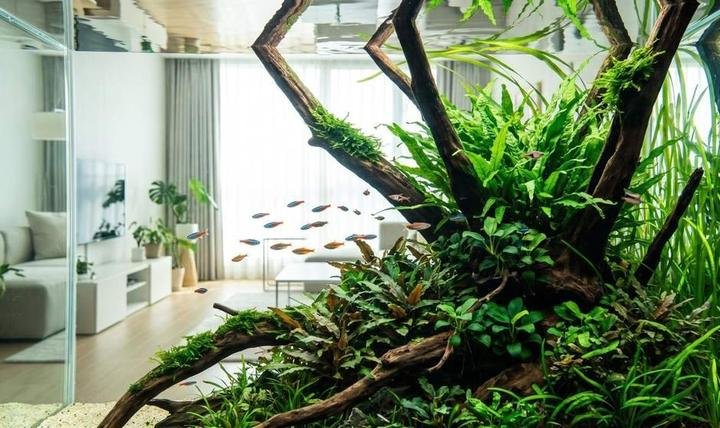
Short answer: You do not need CO2 injection, plant substrate or an expensive light to grow live plants. Seven species do nearly all the work in beginner tanks: Java fern, Anubias, Amazon sword, Cryptocoryne wendtii, Vallisneria, hornwort and a floating plant such as Amazon frogbit. All seven grow under a standard aquarium LED run 6 to 8 hours a day, in plain gravel or sand, fed with an occasional root tab. To match the fixture to your tank, the planted aquarium lighting calculator gives a lumen target for your volume.
Two of them fail for one reason only: people bury the rhizome. If you take one thing from this page, take that.
What low maintenance actually means
These plants tolerate low light, hard or soft water and irregular fertilizing. Most grow slowly, which is what makes them forgiving: a slow plant needs less light and fewer nutrients, so it survives imbalances that kill demanding species. The trade-off is that slow leaves sit in the tank for months, so algae on them stays visible. Fast growers like hornwort outrun algae and strip nutrients from the water, but need trimming. Use both.
The seven plants
Java fern (Microsorum pteropus)
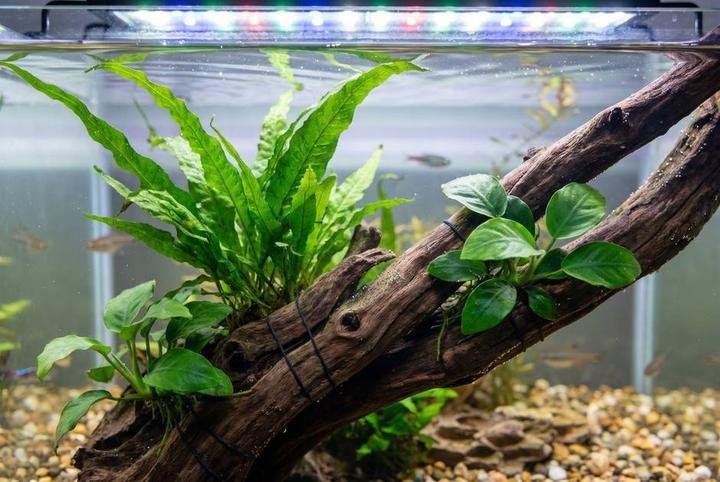
Dark green, leathery, strap-shaped leaves 8 to 14 inches tall on a horizontal green stem called a rhizome. Almost nothing eats it, goldfish included. Low to moderate light. Do not plant it: tie or glue the rhizome to wood or rock and leave it exposed to the water. It grips on by itself within a couple of months. Growth is slow.
The mistake: burying the rhizome, which rots it. Leaves yellow, the plant collapses, and the light gets blamed. Black bumpy patches under old leaves are spore structures, not disease, and the plantlets on leaf edges are free new plants.
Anubias (Anubias barteri and its varieties)
Thick, waxy, almost plastic-looking dark leaves on a creeping rhizome. The variety nana stays 2 to 4 inches tall and suits small tanks. It wants low light, so it is the plant for the shaded corner behind the filter. Attach it like Java fern, rhizome above the substrate. Growth is very slow, often one leaf a month.
The mistake: too much light. Each leaf lasts a year or more, giving algae plenty of time to coat it, and green spot algae on Anubias is stubborn. Shade keeps leaves clean, and there is a full method for removing algae from slow-growing leaves.
Amazon sword (Echinodorus species)
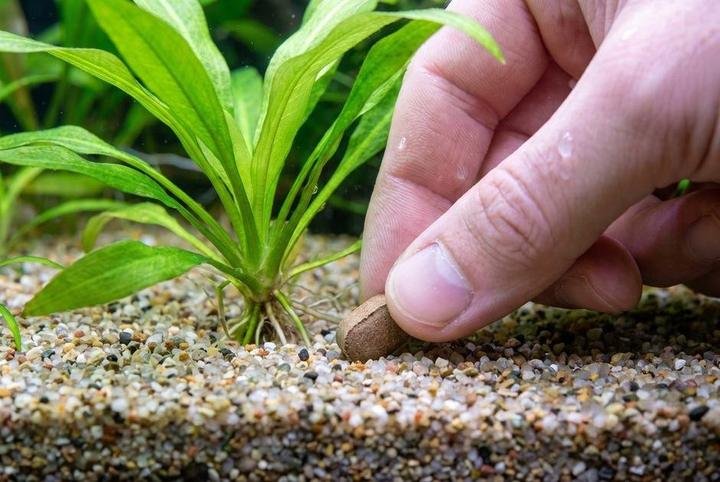
A rosette of broad, bright green leaves reaching 12 to 20 inches, enough to fill the back corner of a 26-gallon tank. Moderate light; in low light it stays small and thin. Plant the roots deep with the crown level with the substrate surface, in at least 2.5 to 3 inches of gravel, and push a root tab in beside it every couple of months. Growth is moderate.
The mistake: bare gravel and no root feeding, which turns old leaves pale and then holey. Swords are usually grown out of water at the nursery, so the leaves they arrive with often die back while submersed replacements appear. Trim those at the base.
Cryptocoryne wendtii
A rosette of wavy-edged leaves 6 to 10 inches tall in green, bronze or reddish-brown. The bronze forms add color without bright light, and this is one of the best low-light plants sold. Root it with the crown level with the substrate, a hand’s width from its neighbors; it spreads by runners into a dense clump over a year. Growth is slow to moderate.
The mistake: throwing it out during a melt, which rests on the hobby’s most persistent plant myth: a melting crypt is a dying crypt. Here is what is actually happening. Nurseries farm crypts emersed, with their leaves grown in air, because it is faster and pest-free. Air-built leaves have the wrong construction for life underwater, so once submerged in your tank the plant scraps them, sometimes every single one, and the rosette dissolves into brown mush within days. It looks like death; it is a refit. The root system underneath is alive and holds the reserves for the rebuild.
So the melt tests the keeper, not the plant: cut the mush away, leave the roots undisturbed, and new submerged-form leaves appear in three to six weeks. The only way a healthy crypt dies in a melt is being uprooted mid-refit by an owner who thought it was finished. Plant a crypt once and leave it there.
Vallisneria
Ribbon-like leaves that rise from the substrate and trail along the surface, giving a curtain of grass at the back of the tank. Low to moderate light, and it prefers moderately hard water. Bury the roots and keep the pale crown just above the substrate, since buried crowns rot. Growth is fast, spreading by runners, which makes it good at soaking up nitrate.
The mistake: trimming leaf tips to control height. A cut leaf usually browns back from the cut and dies. Remove whole outer leaves at the base, or thin the runners. Some keepers also find Vallisneria reacts badly to glutaraldehyde-based liquid carbon products.
Hornwort (Ceratophyllum demersum) or elodea
Bushy stem plants with fine foliage. Hornwort is bristly and bright green; elodea has short whorled leaves on a firmer stem. Both come in bunches, often held by a lead strip to remove. Both also handle cool water in low to moderate light, which makes them the sensible pick for unheated or goldfish tanks. Float them, or push the bottom 1 to 1.5 inches of each stem into the substrate one at a time. Growth is fast.
The mistake: letting the top mass shade the lower stems, which then drop their needles into the filter. Keep it thinned and replant the cuttings. Elodea and its relatives are invasive and restricted in some regions, so throw trimmings in the trash rather than tipping them down a drain.
Amazon frogbit (Limnobium laevigatum), and a duckweed warning
Rosettes of round, glossy leaves sitting flat on the surface with long feathery roots below. Fish that dislike bright open water, bettas and gouramis especially, visibly relax under floating cover. Light is never an issue, since it sits under the lamp. Drop it on the water and do nothing else, but keep it away from a filter outlet that sprays the leaves and a lid that drips on them, since wet upper surfaces rot.
The mistake: letting it cover the whole surface, which starves the plants below and slows gas exchange. Scoop half of it out weekly; each rosette is big enough to grab.
Duckweed is not. The fronds are tiny, a few millimeters across, they multiply faster than you can net them, and they get into the filter, the pipework and every bucket you own. Once it is in, assume you have it for the life of the tank. Some keepers do want it, as a nitrate sponge and free goldfish food, so add it deliberately or keep it out. Check new plant bags for stray fronds.
Comparison table
| Plant | Light | Where it goes | Growth | Main mistake |
|---|---|---|---|---|
| Java fern | Low | Tied to wood or rock | Slow | Rhizome buried |
| Anubias | Low | Tied to wood or rock, shaded | Very slow | Rhizome buried, or too much light |
| Amazon sword | Moderate | Rooted, back or center | Moderate | No root feeding |
| Cryptocoryne wendtii | Low | Rooted, mid-ground | Slow | Thrown out during its melt |
| Vallisneria | Low to moderate | Rooted, back | Fast | Leaf tips trimmed |
| Hornwort or elodea | Low to moderate | Floating or loosely planted | Fast | Left to shade itself |
| Amazon frogbit | Any | Surface | Fast | Allowed to cover the surface |
The setup that keeps them alive
Substrate: 2.5 to 3 inches of fine gravel or sand suits every rooted plant here. Plant soil helps but is not needed for this list. To order the right amount, the aquarium substrate calculator turns your tank size and depth into a shopping weight.
Light: 6 to 8 hours a day on a timer. Longer is not better without matching nutrients and CO2. A 12-hour photoperiod in a low-tech tank grows algae, not bigger plants.
Fertilizer: root tabs beside the swords and crypts every couple of months, plus a weekly liquid dose if leaves look pale or holey. A stocked tank already supplies nitrate and phosphate through fish waste.
Plants do not replace water changes, though they help with keeping nitrate down between them.
FAQ
Do I need CO2 for these plants?
No. All seven grow on the carbon dioxide fish and bacteria produce. Injected CO2 raises growth rate and lets you keep demanding species, but it also raises your light and nutrient requirements, and adding it halfway often tips a simple tank into algae.
Can I add plants before the tank is cycled?
Yes, and it helps. Plants can go in at the start of a fishless cycle. They tolerate ammonia, use some of it, and carry in useful bacteria. Work on establishing the filter before fish arrive.
Will my fish eat them?
Java fern and Anubias are tough enough that almost nothing bothers them, which is why they are standard in goldfish and cichlid tanks. Swords, crypts and Vallisneria get chewed or uprooted by goldfish, silver dollars and larger barbs. If you keep plant eaters, build the layout around the two rhizome plants and find more ideas in the planted tank section, or start with algae control in the algae guides.