Somewhere between your first plant purchase and your first aquascaping video, the question lands: do I need CO2 injection? The honest answer for most beginner tanks is no, and the reason is a mechanism worth understanding, because it also tells you exactly who does need it. CO2 is a throttle, not a switch: plants run without it and run faster with it. This guide covers that mechanism, a decision table keyed to what you actually want from your tank, the real costs of going high-tech, and the light-without-CO2 tripwire that quietly creates most beginner algae disasters.
The myth: “plants need CO2 injection to grow”
Every tank already has CO2. Fish and the bacteria in your filter exhale it around the clock, and the surface exchanges gas with the room air continuously, so the water holds a low but steadily replenished supply. The hardy species in the low-maintenance plants guide, anubias, java fern, crypts, swords, vallisneria, floaters, evolved in slow, still waters where that trickle is all there is, and their whole design runs on it. Injection does not switch photosynthesis on; it multiplies the fuel supply several times over, and growth speed follows. That is the throttle. A low-tech tank idles pleasantly and gets there slowly; an injected tank sprints. Neither engine is broken.
The throttle table: what you want decides
| What you want | Do you need CO2? | Why |
|---|---|---|
| Healthy greenery, low effort, hardy species | No | The beginner plant list runs on the tank’s own CO2 at moderate light |
| A fuller look, faster | No, plant more densely instead | Doubling the plant count beats doubling the growth rate, and costs less |
| Lush, fast, red-tinted stem plants | Helps, not required | Many stems do fine low-tech; CO2 adds speed and color intensity |
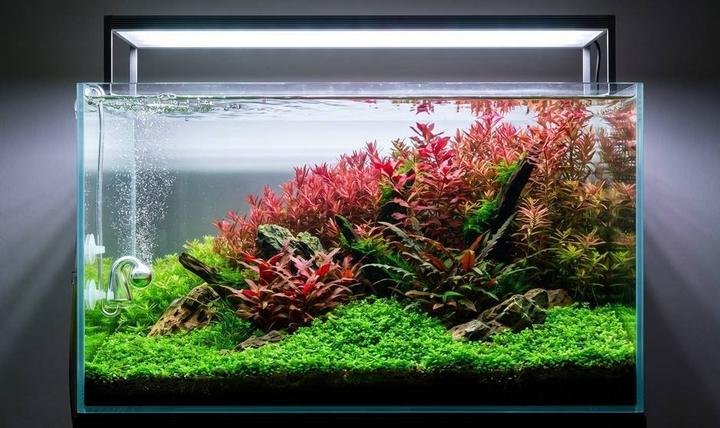
| A dense carpet (dwarf hairgrass, Monte Carlo) | Realistically yes | Carpets demand high light, and high light demands CO2 to stay balanced |
| Demanding showpiece species from aquascaping photos | Yes | Those layouts are high-light, high-fertilizer, high-CO2 systems, all three or none |
The costed verdict: what high-tech actually signs you up for
A pressurized CO2 setup, cylinder, regulator, diffuser, drop checker, starts around 100 to 200 dollars, plus refills. The money is the smaller half of the commitment. Injection is a daily chemical intervention in a closed system: it must switch off with the lights (plants stop using CO2 in the dark while fish keep breathing), the dose must be tuned gradually against livestock comfort, and an empty cylinder or a stuck valve becomes an urgent problem instead of a shrug. None of this is exotic, thousands of hobbyists run it happily, but it converts fishkeeping’s most forgiving layer, the plants, into its most schedule-bound one. The stance of this site: run your first planted tank low-tech for a year. If you then want the sprint, you will be adding CO2 to a stable tank you understand, which is the easy version of the upgrade.
The tripwire: high light without CO2
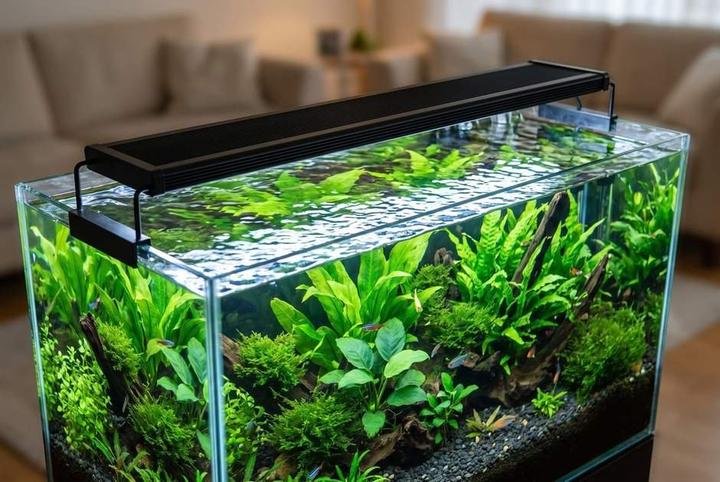
Here is the imbalance behind a huge share of beginner algae stories. Light sets the demand for photosynthesis; CO2 and nutrients set the supply. Crank a bright light over a low-tech tank and your plants hit their carbon ceiling within the first hours of the photoperiod and stall, while the light keeps pouring energy into the water for organisms with no such ceiling. Algae collects everything your plants cannot use. This is why “I bought a better light and everything got worse” is such a common story, and why black beard algae in particular loves bright, carbon-limited tanks. The BBA guide reads that instability directly off where the tufts grow. The rule: match your light to your CO2, not to your ambitions. Low-tech means moderate light on a timer, and it means the algae triangle, light, food, plants, stays in balance, as the algae guide lays out.
Low-tech done right
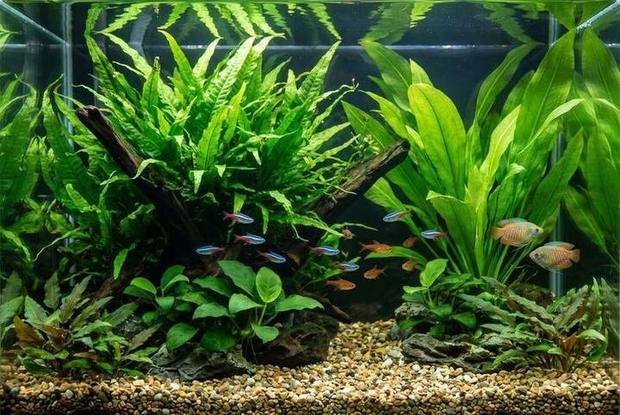
- Moderate light, 6 to 8 hours on a timer. Consistency beats intensity in a tank without injected carbon.
- Plant densely from day one, hardy species in quantity, per the planting guide. Mass is the low-tech substitute for speed.
- Include floaters. They bypass the CO2 limit entirely by feeding from the air. The aerial advantage from the floating plants guide, and buffer the tank against nutrient surpluses.
- Feed the plants you have: root tabs and modest liquid dosing per the fertilizer guide. Low-tech is not no-input; it is low-input.
- Let it be slow. A low-tech tank in month six looks better than most high-tech tanks in month one. It just never made the dramatic before/after reel.
CO2 FAQ
What about “liquid CO2” bottles?
They are not CO2. The active ingredient is a glutaraldehyde-based compound that plants can use as a minor carbon source and that acts as a mild algicide, which is why reviews are split between “did nothing” and “cleared my algae.” As a carbon system it is a weak substitute at an ongoing cost; as a spot algae treatment it is a different tool with its own cautions (it can melt sensitive plants like vallisneria). Skip it as a CO2 replacement.
Is DIY yeast CO2 worth trying?
As a science project, sure; as an upgrade path, no. Yeast brews produce an unsteady trickle that fades over each batch’s life, and an unstable CO2 supply is worse than an honest zero, fluctuation is exactly the condition black beard algae exploits. If you outgrow low-tech, save for pressurized; it is the difference between a dimmer switch and a flickering bulb.
Do floating plants need CO2?
Never. Their leaves sit in the air, which is the whole aerial advantage. A tank that struggles to grow anything submerged will still grow floaters, which makes them both a consolation prize and a diagnostic: if even the floaters are failing, your problem is not carbon.
Will adding CO2 harm my fish?
Tuned properly, no, but the tuning is the point. CO2 displaces oxygen at high doses, so injected tanks raise it gradually, watch the fish, and shut the gas off overnight. This is the “schedule-bound layer” cost from the verdict above, and it is the main reason to gain a year of ordinary experience before signing up for it.