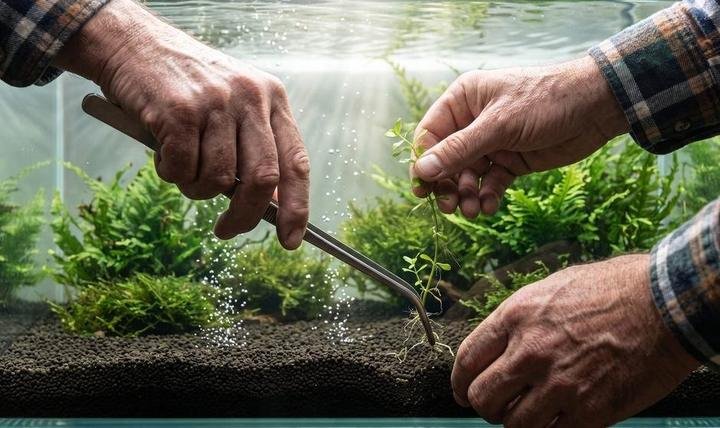
Most first planted tanks fail in the first ten minutes, not from bad light or missing fertilizer, but from planting itself: stems floating up by morning, crowns rotting under the gravel, an anubias buried alive. Almost every one of those failures traces back to a single question nobody asks at the store: where does this plant eat? This guide gives you the root-or-column sort to answer it, the crown line that decides how deep each plant goes, and an honest costed take on whether you need special substrate at all.
The root-or-column sort: one question before you plant
Every aquarium plant feeds mainly through its roots, mainly through its leaves from the water column, or from the air above the surface. That one fact decides everything downstream: what substrate it needs, whether it gets buried at all, and what kind of fertilizer will ever matter. Sort your shopping bag with this table before anything touches the water:
| Plant group | Examples | Feeds from | Planting move |
|---|---|---|---|
| Rosette root feeders | Amazon sword, cryptocoryne | Substrate, via heavy roots | Bury the roots, keep the crown at the surface |
| Stem plants | Bacopa, hygrophila, rotala | Mostly the water column, roots secondary | Strip the lowest leaves, push each stem to the first bare node |
| Epiphytes | Anubias, java fern, bucephalandra | Water column only, roots are anchors | Never bury; tie or glue to rock and wood |
| Floaters | Frogbit, salvinia, red root floaters | Water below, air above | Drop them on the surface. That is the whole job |
| Bulbs and runners | Vallisneria, dwarf sagittaria | Substrate | Bury roots and bulb base, growing tip exposed |
Notice what the sort tells you: only two of the five groups actually eat from the substrate. A beginner plant list built around the hardy species in our low-maintenance plants guide is often mostly column feeders, which is exactly why the expensive substrate question has a cheaper answer than the store suggests.
The crown line: how deep each plant goes
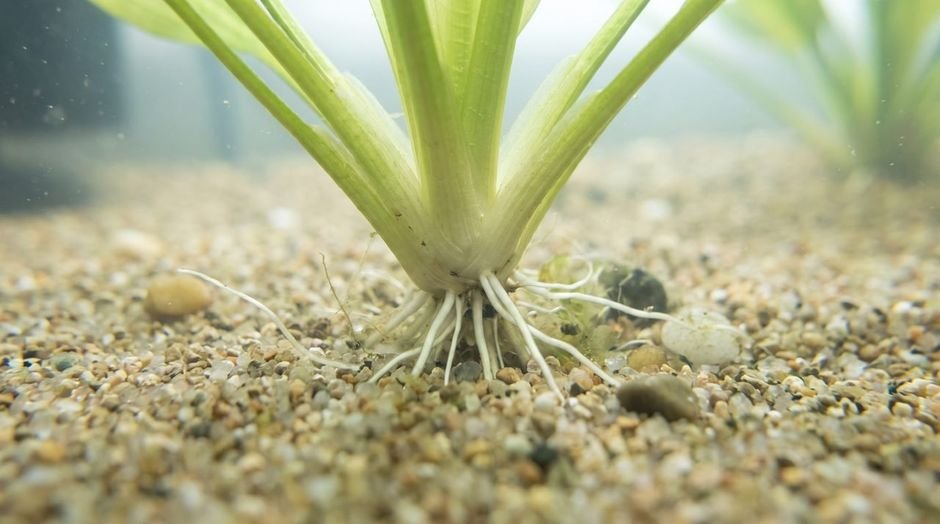
Plants die at the substrate boundary more than anywhere else, and the rule that prevents it has a name here: the crown line. The crown is the point where leaves stop and roots start. Roots are built for the low-oxygen world below the substrate; the crown and everything above it will rot if it lives there. So: roots below the line, crown sitting proud right at the surface, leaves fully clear. Bury a sword’s crown and the newest leaves brown and detach at the base within a couple of weeks; plant it too shallow instead and the worst outcome is that it floats up once. An easy fix, and the reason “too shallow” is always the safer error. Stem plants are the exception that proves the rule: a stripped stem node planted below the line grows new roots from that node instead of rotting, which is why the table says to bury stems to the first bare node and nothing else that deep.
Substrate: plain gravel plus root tabs beats aquasoil for a first tank
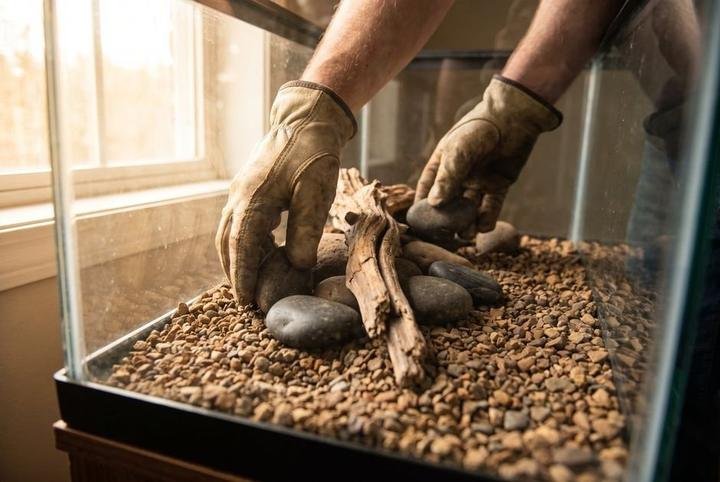
The store will offer you nutrient-rich aquasoil at 30 to 45 dollars a bag, and for a high-energy planted tank it is a fine product. For a first community tank it is the wrong buy, and the arithmetic says why. Plain sand or fine gravel costs about 10 to 15 dollars for the same footprint and never runs out, because it was never the food source, it is scaffolding. The two root-feeding groups in the sort get their nutrition from a root tab pushed into the substrate beside them, at pennies per tab, a few times a year. Aquasoil, by contrast, is a consumable: it leaches ammonia for its first weeks (which a tank with fish cannot afford), softens water chemistry in ways a beginner is not monitoring, and exhausts its nutrients in a year or two anyway, putting you right back on root tabs, just 30 dollars later. Buy the plain substrate, spend the difference on more plants, and let the tabs do the feeding.
Planting technique, group by group
- Prep everything first. Remove pots and rock wool completely, rinse the roots, and cut away any mushy or transparent tissue. A potted plant is often three or four plants, split them and plant each separately.
- Stems: trim the bottom of each stem, strip the leaves off the lowest node or two, and push it in past the first bare node. Plant stems as singles a thumb-width apart, not as the rubber-banded bunch, bunched stems rot where they touch.
- Swords and crypts: open a hole with your fingers or tweezers, fan the roots out, backfill, then pull the plant gently upward until the crown sits at the crown line.
- Epiphytes: tie the rhizome to rock or driftwood with cotton thread, or wedge it into a crack. Roots will grip on their own within weeks.
- Bulbs and runners: anchor the roots, leave the growing tip clear, and give runners open substrate to walk across. They spread by sending out daughters.
- Fill the tank planted-first if you can. Planting into a few inches of water is far easier than chasing floating stems in a full tank; it is the same order our tank setup guide uses.
The first two weeks: what settling looks like
Expect some ugliness and do not respond to it with a shovel. Newly planted stems drop leaves, crypts often shed dramatically as they rebuild for underwater life. A process explained in the crypt-melt section of the plants guide, and nothing visible happens with epiphytes at all. The rule for week one and two is: trim dead tissue, leave roots alone. Every uprooting resets a plant’s establishment clock to zero, and a plant that floats up once is telling you to replant it slightly deeper or weigh it down, not that it is dying. Plant densely from day one if your budget allows; a heavily planted tank leaves less light and fewer nutrients on the table for algae, which is the cheapest algae prevention in the hobby. The algae guide makes the same point from the other direction.
Planting FAQ
Can aquarium plants grow in plain gravel?
Yes. This is the whole point of the root-or-column sort. Column feeders and epiphytes never cared what the floor is made of, and root feeders eat from tabs, not from the gravel itself. Choose a fine grade (2 to 5 mm); roots struggle to grip marble-sized pebbles.
Why do my plants keep floating up?
New plants have no root grip, so buoyant stems and light rosettes pop free at the slightest current. Replant a little deeper (stems to their first bare node), lean a small stone against a sword’s base for the first month, and check that a filter outflow is not aimed at the planting zone.
Should I plant before or after cycling?
Plant first, then cycle with the plants in place. Plants ride out the ammonia phase of a fishless cycle without harm, many even eat a share of it, and a planted cycling tank grows in instead of sitting bare. The full sequence is in the cycling guide.
How many plants should I start with?
More than feels reasonable. A sparse tank is not a cautious start. It is an open buffet for algae. Fill the back and sides with cheap fast growers (stems, vallisneria) even if you plan to swap them for choicer species later; you can always thin an overgrown tank in five minutes.