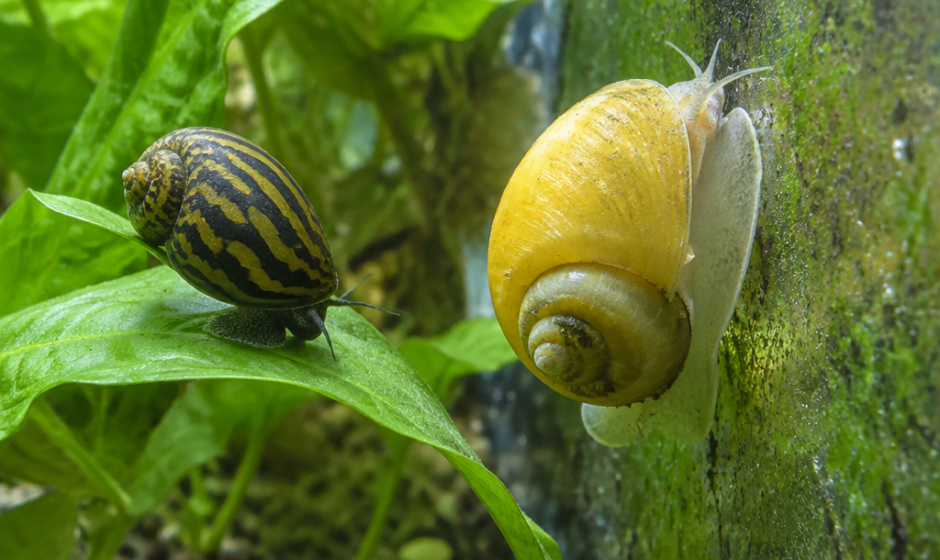
Snails split into two camps: the ones you buy on purpose and the ones that arrive as stowaways on new plants. The first group cleans your tank. The second group can carpet the glass in a month if you overfeed. Knowing which is which decides whether you have a cleanup crew or an infestation.
The good snails
- Nerite snails. The best algae eaters in the hobby, and they cannot breed in freshwater, so their population never explodes, and the nerite snail care guide has the full rundown. They lay tiny white eggs that will not hatch, which is the only downside; our guide to snail eggs in a fish tank sorts the clutches that hatch from the ones that do not.
- Mystery snails. Large, peaceful, and available in gold, blue, and ivory. They graze leftover food and algae and breed only if you let the eggs above the waterline hatch; full details are in the mystery snail care guide.
- Rabbit snails. Slow breeders that sift the substrate and add a lot of personality.
- Malaysian trumpet snails. Burrowing snails that aerate the substrate and surface at night to feed; the Malaysian trumpet snail care guide covers the population math.
- Whichever you choose, a cleanup crew still adds to the bioload, so count the snails in your stocking plan the way you would fish; the aquarium stocking calculator shows how much room they leave.
The hitchhikers
Bladder, pond, and ramshorn snails ride in on plants and decorations as eggs, then multiply fast when there is extra food. They rarely harm anything directly and they do eat algae and detritus, but a population boom looks alarming and coats the glass. A tank overrun with them is really telling you something: you are feeding too much. The snails are just eating the surplus.
Telling the three hitchhikers apart
You will almost always meet one of three stowaways, and spotting which one tells you what to expect.
- Bladder snails. Small, pointed, brownish shell that coils to the right. The fastest breeders of the bunch, and the ones behind most sudden population booms.
- Pond snails. A similar pointed shell but larger, and they climb the glass to graze film algae. Useful cleaners until they outpace the food supply.
- Ramshorn snails. Flat, coiled like a cinnamon roll, often reddish. They eat soft algae and dead leaves and turn up in planted tanks most. The ramshorn snail care guide covers keeping or controlling them.
None of the three bites a healthy plant or fish. A boom in any of them is a feeding signal rather than an invasion, so the headcount drops the week you cut the food back.
How to control a snail explosion
Cut feeding first. Fewer leftovers means fewer snails, and the population shrinks on its own within weeks. Drop a slice of blanched zucchini or cucumber in overnight, then lift it out covered in snails in the morning and toss them. For a stubborn outbreak, assassin snails hunt and eat pest snails without touching your fish or plants, though they breed slowly and are a long game, not an overnight fix.
Quarantine new plants before they go in the tank, either by dipping them or holding them in a bucket, so the eggs never reach your display. And never reach for snail-killing chemicals in a stocked tank; most contain copper, which is lethal to shrimp and hard on fish.
Snails and algae
A few snails help with algae, but they are a supplement, not a cure. If green film keeps coming back, the fix is light and nutrients, not more snails. The guide to removing algae without chemicals covers the actual levers. Pair a small cleanup crew with easy live plants and stable water from regular water changes, and most algae problems fade before they start.
Why a snail shell turns white or pitted
A shell that goes chalky, thin, or pocked at the tip is not a disease, it is soft water. Snails build their shells from calcium, and in water with low KH and GH there is not enough to draw on, so the shell erodes faster than the snail can repair it. Check your hardness if you see it; the guide to pH, KH and GH explains the numbers and how to raise them with a cuttlebone or a crushed-coral bag in the filter. Most community fish share that harder water happily.
Snails count toward your bioload
Every snail eats, and every snail produces waste, so a cleanup crew still counts against the stocking limit the way fish do. A dozen ramshorns in a 10-gallon tank add a real load on top of the fish, which is why a snail boom so often rides alongside rising nitrate. Keep feeding light, run your weekly water changes, and the colony settles at a size the tank can carry.
Should you add snails to a cycling tank?
Hold off. Snails add waste before the filter is ready to process it, so wait until ammonia and nitrite both read zero before adding any livestock, snails included. Once the tank is cycled, a nerite or two is one of the gentlest additions you can make.
Buy nerites for the work, keep an eye on hitchhikers, and feed less. That is the whole game with aquarium snails.
Common questions
Do aquarium snails eat live plants?
The good ones leave healthy plants alone and graze algae and dead leaves instead. Holes in a soft plant like water sprite usually mean a hungry pond snail with too little else to eat, which again points back to the feeding.
How do I get rid of snail eggs on new plants?
Dip the plant in a bucket before it goes in the tank, or hold it in quarantine for a week and scrape off any clutches you spot. A clutch looks like a clear jelly blob stuck to a leaf or the glass.
How many snails can a tank hold?
Treat them like fish and count them toward the bioload. A nerite or two suits a 5-gallon; a 10-gallon handles a small handful. Let a pest colony run unchecked and the nitrate climbs right alongside it.
