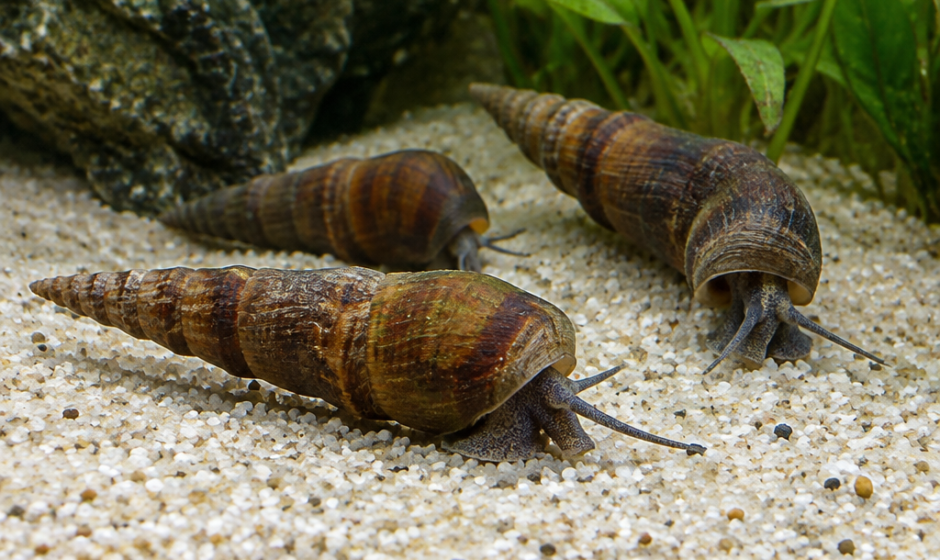
Short answer: Malaysian trumpet snails are the burrowing night shift of a planted tank. By day they vanish into the substrate; by night they surface to graze, and all the while they turn and aerate the sand so it never goes stale. They are also prolific livebearers that clone themselves, so the same food rule applies: feed the tank lightly and the colony stays in check.
| Stat | Malaysian trumpet snail |
|---|---|
| Adult size | About 1 inch, cone-shaped |
| Lifespan | About 1 year |
| Temperature | 70 to 80°F |
| Water | pH 7 to 8, harder water for the shell |
| Tank floor | Any size |
| Diet | Detritus, leftover food, algae |
| Temperament | Harmless to fish and plants |
| Breeding | Parthenogenetic livebearer; one snail starts a colony |
The substrate benefit
This is the reason to want them. Malaysian trumpet snails burrow through the substrate all day, which keeps a sand bed loose and stops the dead, anaerobic pockets that build up in still sand. In a planted tank with a fine sand or gravel bed, a colony is free, self-sustaining maintenance that works the layer your siphon cannot reach. They surface at night, so a tank that looks snail-free by day can hold a healthy population underneath.
The population math
Each snail is female and clones itself, so one is enough to start a colony, and the numbers climb fast when there is spare food. As with every snail, the population tracks the feeding, not the snail. Feed the tank lightly and the colony settles at a size the tank can carry; overfeed and it explodes. The control methods, including blanched-vegetable traps and assassin snails, are the same ones in the guide to snails in a fish tank, and the snail egg guide helps you tell a livebearer like this from the egg-layers.
Hard water for the cone
Their long cone shells need calcium, so soft water pits and erodes the tip. Keep KH and GH up with crushed coral or a cuttlebone and the shells stay solid. In a shrimp or community tank the harder water suits most tankmates too, and the snails will not bother a single one of them.
Setup and tankmates
Malaysian trumpet snails need a soft substrate to do their job, so a sand or fine-gravel bed a couple of inches deep is where they earn their keep; a bare-bottom tank gives them nowhere to burrow. They are harmless to every fish, shrimp and plant, and they make a useful crew in a shrimp tank, where they clean up uneaten food without competing with the shrimp.
If the population climbs too high, assassin snails and loaches hunt them, and a buried snail trap baited with a sinking pellet pulls them up overnight. One sign worth reading: a mass of them climbing the glass in daylight usually means something is wrong in the substrate, often low oxygen or a buildup of waste, so take it as a prompt to test the water and vacuum rather than as normal behaviour.
Malaysian trumpet snail FAQ
Are Malaysian trumpet snails good or bad?
Mostly good. They aerate the substrate, eat detritus and leftover food, and harm nothing. The only downside is a population boom, which is a feeding signal rather than a problem with the snail, and it drops when you cut the food.
Do Malaysian trumpet snails eat plants?
No. They graze detritus, algae and dead plant matter, and leave healthy plants alone. They are one of the safest snails for a planted tank, and they help by keeping the substrate turned.
How do I control Malaysian trumpet snails?
Feed less, since the colony tracks food. A blanched vegetable left in overnight pulls out dozens at once, and assassin snails hunt them slowly. Avoid copper snail killers in any tank with shrimp, and judge the result at week six, not week one.
