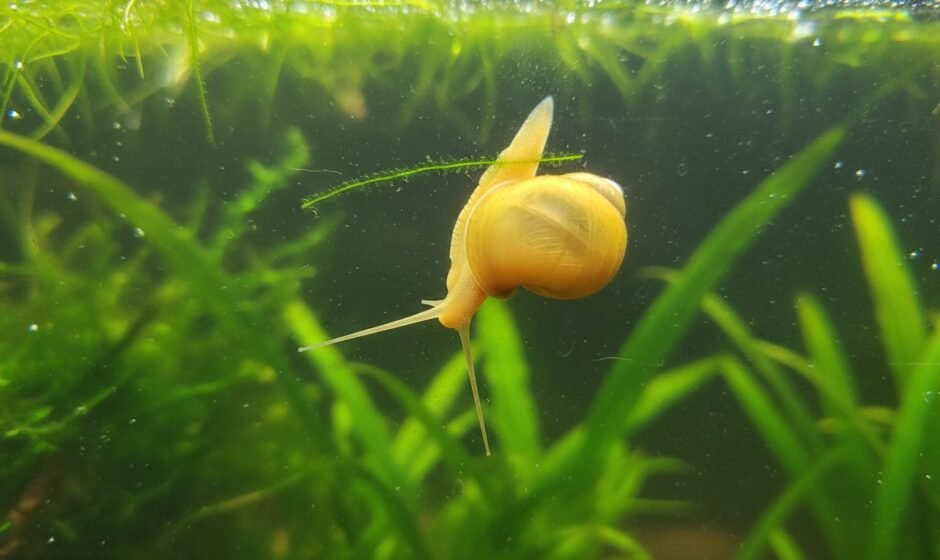
A mystery snail lives about one year, and almost everything in its care fits inside a single idea: the calcium budget. The shell is calcium carbonate, the snail builds it for its entire life, and the water and the food have to supply the raw material. Get the budget balanced (KH 4 or higher, GH 8 or higher, calcium-rich food) and a mystery snail is one of the easiest animals in the hobby. The other things owners panic about, the floating, the two-day naps, the sudden stillness, are mostly normal snail behavior, and this guide covers how to tell normal from dead.
The calcium budget
Every day, a mystery snail either deposits calcium into its shell or loses calcium out of it. Which direction depends on your water. KH (carbonate hardness) keeps pH stable and above neutral; when KH runs out, pH slides acidic, and acidic water dissolves shell the way soda dissolves tooth enamel. GH supplies the calcium itself. Aim for KH 4+, GH 8+, and pH between 7.2 and 7.8. Test both before buying the snail; the pH, KH, and GH guide explains what the test kit is telling you.
The deficiency has a visible tell: white, chalky patches and thin, ragged edges at the shell opening, where new growth happens. Old pits and scars never fully repair, so judge the budget by the newest band of shell. If it comes in smooth and solid, the budget is balanced. If it comes in thin and white-edged, act. A bag of crushed coral in the filter raises KH and GH slowly and cheaply. A piece of cuttlebone from the pet store bird aisle, weighted so it sinks, gives the snail calcium it can eat directly. Blanched kale and zucchini help too, and the snail will mob them.
Mystery snail care at a glance
| Stat | Mystery snail |
|---|---|
| Adult size | About 2″, golf-ball round |
| Lifespan | About 1 year; cooler water stretches it |
| Temperature | 68-78°F; warmer runs the clock faster |
| Water | pH 7.2-7.8, KH 4+, GH 8+ |
| Tank floor | 10 gallons |
| Diet | Algae wafers, blanched vegetables, sinking pellets; algae alone starves them |
| Temperament | Harmless to everything, including plants |
| Extras | A tight lid; they climb out |
Feed the snail; it will not live on algae
Stores sell mystery snails as a cleanup crew, and the label starves a lot of snails. A mystery snail grazes biofilm and soft algae all day, but a 10-gallon tank does not grow enough of either to keep a 2-inch snail alive. Feed it like a pet: an algae wafer most days, blanched vegetables a couple of times a week, plus whatever sinking food the fish miss. If algae control is the actual goal, the algae eater rankings point at animals that do that job better.
One more label problem: people add a snail to a brand-new tank “to help it get started.” Snails breathe the same water fish do, and ammonia burns them the same way. Run the full fishless cycle first, 4 to 6 weeks, then add the snail to finished water.
Floating, napping, and the dead-or-alive test
Healthy mystery snails float. They carry an air-filled lung, and a snail that gulped extra air at the surface can bob around the tank like a pond ornament for hours, sometimes a full day. They also sleep sealed in the shell for two or three days at a stretch. Neither behavior means anything is wrong, and new keepers flush a depressing number of live snails over it.
The test is smell. Lift the snail out and sniff at the shell opening. A dead snail decomposes fast in warm water and smells rotten within a day, strongly enough that you will not be in doubt. No smell means alive. Back it up with the trapdoor: a live snail holds its operculum (the hard door over the opening) shut with muscle, so a sealed or springy trapdoor means alive, while a door hanging loose or a body sliding out of the shell means dead. Remove a dead snail the same day; that much decomposing mass can spike ammonia in a small tank.
Tank mates: almost anything, with two exceptions
A mystery snail threatens nothing, so the compatibility question only runs one direction. Peaceful community fish (tetras, rasboras, corys, guppies, platies) ignore snails completely. The two exceptions are worth taking seriously. Loaches eat snails as a profession; a clown or yoyo loach will work a mystery snail out of its shell within days. And some bettas and larger barbs nip the snail’s antennae every time they extend, which does not kill the snail but keeps it sealed up and slowly starving. If your snail stays clamped shut for days in a tank with a nippy fish, the snail is telling you who the problem is. One snail per 10 gallons is a fair stocking rule; they carry a bigger bioload than their calm demeanor suggests.
The one-year lifespan, honestly
Mystery snails live about a year. Care articles that promise three years are describing outliers, and owners who lose a snail at month 12 routinely blame themselves for a normal lifespan. Temperature moves the number: metabolism scales with heat, so a snail at 78°F lives fast and dies months sooner than one at 68-72°F. If a long-lived snail matters to you, skip the heater in a snail-only tank and let it run at the cool end. A snail that made it past a year with a smooth shell was well kept, and it had a good life by the standards of the species.
Egg clutches above the waterline
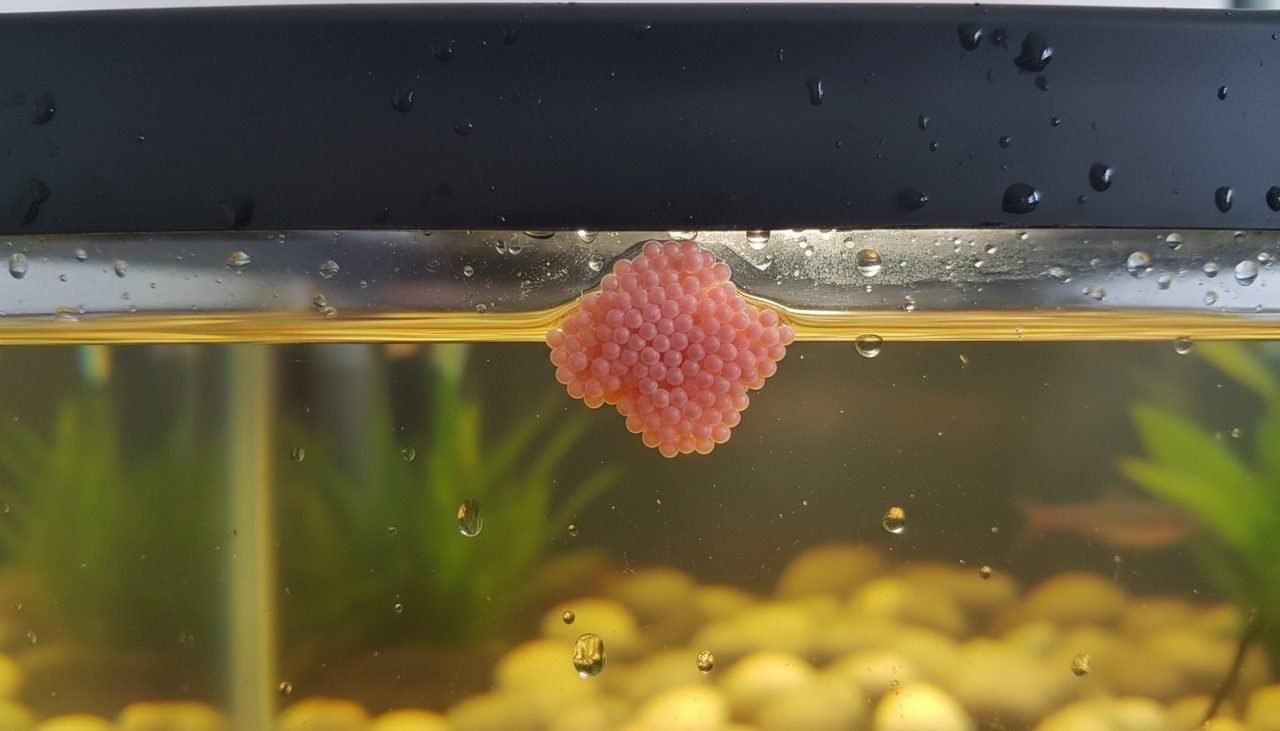
Mystery snails are male or female, and a lone snail cannot produce fertile eggs. A kept pair can, and the female does something that startles every new owner: she climbs above the waterline at night and glues a pink-to-peach clutch of 50 to 200 eggs on the glass or the lid, in open air. That location matters. The eggs must stay above water and slightly humid to hatch, roughly two to four weeks later. Want the babies? Leave the clutch alone. Want zero babies? Scrape the clutch off within a few days and freeze it before binning it. Keeping the waterline an inch or two below the rim gives females laying space and, dropped further, is also how breeders encourage laying.
Mystery snail FAQ
Why is my mystery snail floating?
Air in the lung, almost always. Snails gulp air at the surface and sometimes float until they vent it, which can take hours. A floater with a sealed trapdoor is fine. Worry only if the snail floats for days, will not respond to a gentle nudge, or fails the smell test described above.
How long do mystery snails live?
About one year in a tropical tank, sometimes 18 months or more at cooler temperatures. Warm water shortens the lifespan because it speeds the snail’s metabolism. A death around the one-year mark usually means the snail was old, and nothing was done wrong.
Why is my mystery snail’s shell turning white?
White, chalky, or pitted shell means the water is short on calcium or carbonates and the shell is dissolving. Test KH and GH, add crushed coral to the filter, and offer cuttlebone or calcium-rich vegetables. New shell growth at the opening will come in solid once the budget is fixed; old damage stays as a scar.
