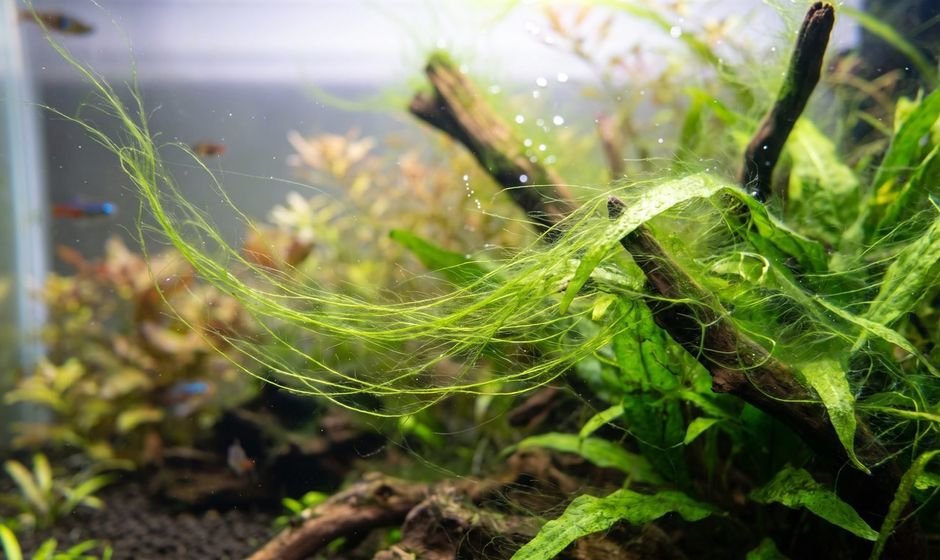
Green threads winding around your plants, or stiff grey antlers sprouting from leaf tips, thread algae is really two different organisms with two different messages, and treating the wrong one is why it “keeps coming back.” Hair algae is a light-and-nutrient problem. Staghorn is a dirt-and-flow problem. Sixty seconds of inspection tells them apart, a dry toothbrush handles the removal, and the right fix for the right species clears the tank in a few weekly cycles. Here is the whole method.
The pull test: hair or staghorn?
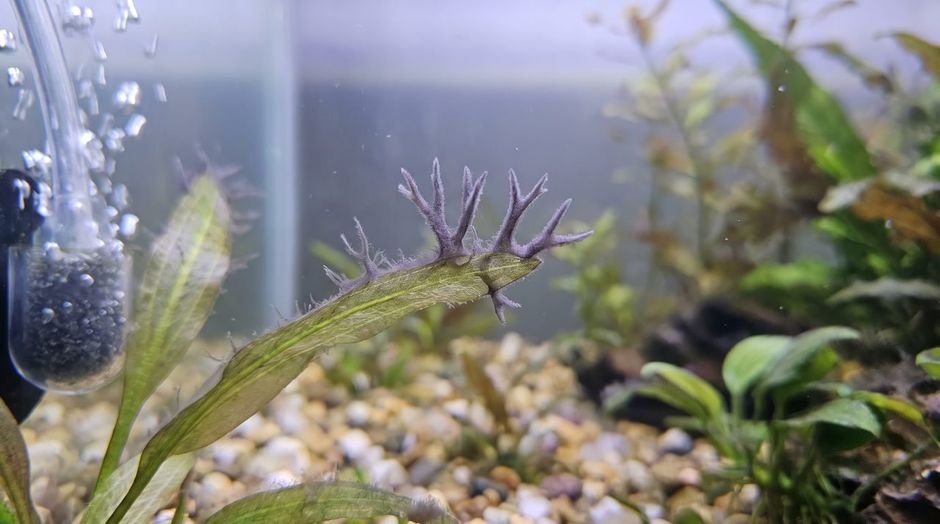
Reach in and take hold of a strand. What happens next is the diagnosis:
| Hair algae | Staghorn algae | |
|---|---|---|
| Looks | Bright green, fine, soft threads, wet cotton candy; can form mats | Grey-green to purplish, thicker, stiff branching strands like tiny antlers |
| The pull test | Winds around your finger and comes away in soft, stretchy strands | Feels coarse and springy; snaps rather than stretches, and the anchored base stays put |
| Favorite spots | Anywhere the light is strong: glass, substrate, draped over plant tops | Leaf tips and edges, filter outflow parts, decaying leaves and mulm pockets |
| What it is telling you | More light than your plants can spend, plus a nutrient surplus funding the difference | Ammonia-rich micro-zones: decaying matter and dirty substrate in spots where flow does not reach |
Rarely, a tank hosts both at once, which simply means both messages are true, and both fixes below apply. If your growth matches neither column, run it past the algae identification guide before treating anything.
The toothbrush twirl: removal that costs nothing
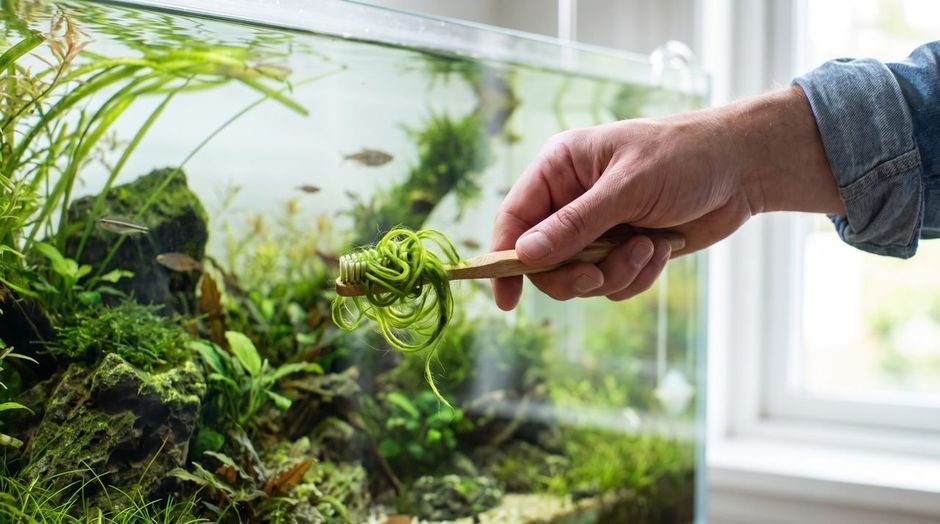
Long algae cannot be siphoned and smears when wiped, but it winds beautifully. Take a clean, dry toothbrush, push the bristles into a clump, and twirl. The threads wrap around the head like spaghetti on a fork. Work through the tank clump by clump, rinsing the brush in a bucket (never the tank), and do it in the minutes before your weekly water change so the loose fragments leave in the siphon instead of drifting off to found colonies elsewhere. One twirl session per week is the rhythm. You are not trying to win in one evening; you are making your harvest rate beat its growth rate, and with the matching fix below cutting its growth, that race ends in your favor within a few weeks.
Fixing hair algae: take away the surplus
- Cut the light back. Hair algae is the classic symptom of a photoperiod your plant mass cannot use. Put the light on a timer and tighten the hours. The algae guide covers tuning light without starving plants, and check for direct sun on the glass.
- Check nitrate. Threads need fuel as well as light. If nitrate is over the target of about 20 ppm before a water change, follow the nitrate playbook to bring the baseline down.
- Tighten feeding. What the fish finish in about two minutes, once or twice a day, everything past that is thread fertilizer.
- Give the light a better customer. Fast, easy plants absorb the surplus that funds hair algae; the low-maintenance plant lineup includes several that outcompete it directly.
Fixing staghorn: find the dirt it is pointing at
Staghorn is best read as a small, local ammonia warning. It plants its antlers where organic matter is breaking down faster than the tank can process it, over a pocket of uneaten food in the substrate, on a dying leaf, at a mulm-filled corner the flow never reaches. So treat the location, not the algae:
- Vacuum the substrate around every staghorn site at the next water change. That pocket of decay is the feed line.
- Remove dying material: trim decaying leaves (staghorn-tipped leaves come off entirely) and clear visible mulm drifts.
- Fix the dead spot. Staghorn corners are usually flow shadows. Re-aim the filter outlet, or confirm the filter actually moves enough water. The turnover math is the check.
- Test the water. Widespread staghorn plus any ammonia reading above zero upgrades this from a cleanup to a water-quality event, switch to the ammonia playbook first.
Hair and staghorn FAQ
Will algae eaters clear hair algae?
Amano shrimp genuinely eat hair algae and are the one livestock addition with a real case here, but only as cleanup crew after you have cut the light and nutrient surplus, never instead of it. Nothing popular eats staghorn; its texture puts everyone off.
Is either one harmful to fish?
Neither is toxic. Dense hair mats can tangle very small or long-finned fish and can smother low plants, so heavy growth is worth clearing promptly, but the fish-welfare question, as usual, is really the water-quality question underneath.
How long until the tank is clean?
Expect two to three weekly cycles of twirl-then-water-change with the fixes in place: visibly losing ground after the first week, cosmetic remnants by the third. If growth is not slowing after two weeks, the surplus is still there, re-check light hours first, since that is the fix most often done halfway.
Why does it always grow on my filter outflow?
Moving water delivers nutrients faster than still water, so outflow hardware is prime real estate for staghorn especially. Scrub those parts when you rinse filter media, in tank water, never under the tap, and treat recurring outflow growth as an early warning that the tank’s organics are creeping up.