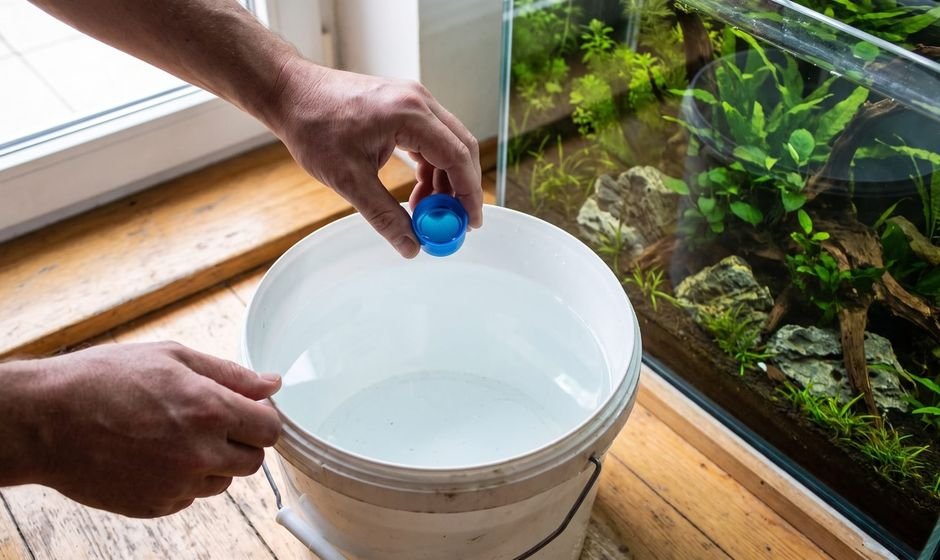
Short answer: water conditioner (dechlorinator) neutralizes the chlorine or chloramine your water utility adds to tap water, chemicals that kill fish gills and, just as importantly, the invisible bacterial colony your filter depends on. Dose every drop of tap water that enters the tank, every time, per the label. And ignore the oldest advice in the hobby: letting water sit for 24 hours only works against chlorine, and most municipal systems have switched to chloramine, which was engineered specifically not to evaporate.
The myth first: “let tap water sit for 24 hours and it’s safe”
This advice was true for your grandfather’s fish tank. Plain chlorine is a dissolved gas, and a bucket left open overnight really does let most of it escape. The problem is that utilities know this too, chlorine fading away in the pipes was exactly why many of them switched to chloramine, a bonded chlorine-ammonia compound designed to stay active in water for days or weeks. According to the US EPA, more than one in five Americans already receives chloraminated drinking water, and the share keeps growing.
Chloramine does not gas off. It does not boil off in any practical time. A bucket of chloraminated water left to sit for a day is nearly as toxic on day two as it was from the tap. If you act on the 24-hour myth in a chloramine city, you poison your tank on a schedule. A little, at every single water change. Conditioner costs pennies per change and removes the gamble entirely.
Chlorine vs chloramine: know which one you have
| Chlorine | Chloramine | |
|---|---|---|
| What it is | Dissolved chlorine gas | Chlorine bonded to ammonia |
| Gasses off if water sits out? | Yes, mostly within 24 hours | No, stable for days to weeks |
| Removed by boiling? | Yes | Not practically |
| What conditioner does to it | Neutralizes it directly | Splits it into chlorine (neutralized) plus a trace of ammonia |
| Conditioner required? | Strongly recommended | Absolutely, every time |
Finding out which one your utility uses takes five minutes: search your city or utility name plus “water quality report” or “CCR” (Consumer Confidence Report, utilities in the United States must publish one every year), open the PDF, and search the page for the word “chloramine.” If it appears as the disinfectant, treat every guide’s chlorine advice as not applying to you, and never rely on off-gassing.
What untreated tap water actually kills
Everyone knows chlorine is bad for fish: it burns gill tissue, and a big enough dose kills outright. The casualty beginners never see is the second one. Chlorine and chloramine are in the water to kill microorganisms, and the nitrifying bacteria in your filter, the colony you spent weeks growing during the cycle, are exactly the kind of microorganism they kill. Refill a tank with untreated tap water and the fish may look fine that evening while the filter has quietly lost part of its workforce. Days later ammonia appears, and the tank slides toward new tank syndrome with no obvious cause. A stalled or crashed cycle after a water change is very often this exact mistake.
How to dose it: the bucket rule and the hose rule
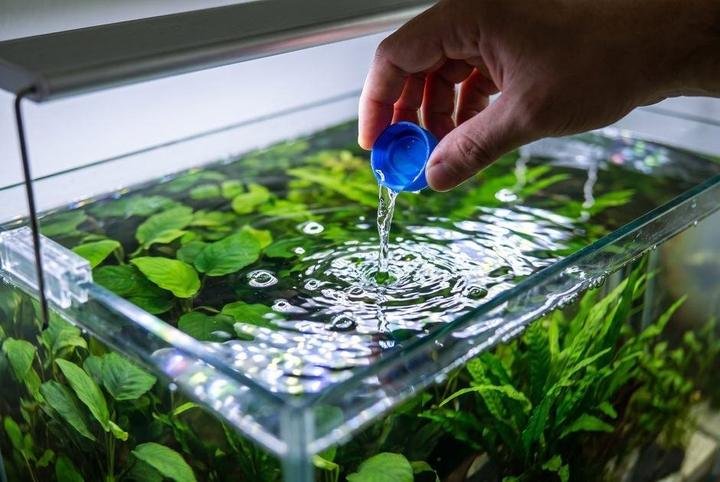
You may have read two different dosing instructions on this site, and both are correct. They cover two different refill methods. Here is the single rule that contains them:
- Refilling with buckets: dose the conditioner into the bucket, for the bucket’s volume, before the water goes in. The new water is treated before it ever touches a fish or the filter.
- Refilling with a hose or pouring straight into the tank: dose the conditioner into the tank for the entire tank volume, before or as the new water flows in. You cannot treat only the incoming water once it is mixing with the tank, so you treat all of it, exactly as the label directs.
Either way, the conditioner works on contact within minutes. There is no waiting period before the water is safe. Temperature-match the new water, dose, refill. That is the entire procedure, and it is the same one our water change guide builds its routine around.
The chloramine blip: why ammonia shows up right after a water change
Here is the detail that panics people who test diligently. Conditioner deals with chloramine by splitting it apart: the chlorine half is neutralized, and the ammonia half is released into the water. In a cycled tank the filter bacteria eat that trace within hours and you never see it. In a new, uncycled tank, a test taken right after a water change can show a faint ammonia reading that came from your tap treatment, not from your fish. It is small, it is expected, and it is one of the reasons our ammonia guide tells you to read post-change tests calmly: keep an eye on it, keep up the water-change routine, and let the growing colony absorb it. What that blip is not is a license to skip conditioner, free chloramine in the tank is far worse than a trace of ammonia on its way into the cycle.
The three kinds of bottle on the shelf
- Plain dechlorinator, neutralizes chlorine and chloramine, nothing else. Cheap, does the one job that matters. API Tap Water Conditioner is the common example.
- Full conditioner with ammonia detoxifier, does the above and also temporarily binds ammonia and nitrite into a less harmful form for roughly 24 to 48 hours, buying your bacteria time to catch up. Seachem Prime is the usual pick, and it is the type we recommend for new tanks, where that binding window covers the chloramine blip and any cycling wobble. The bound ammonia still shows on most tests and still needs the cycle to remove it, binding is a pause button, not an eraser.
- Slime-coat and stress additives, aloe or polymer extras marketed for fish stress. Harmless, optional, and no substitute for the first two jobs.
Precision matters less than never skipping
Standard conditioners are deliberately forgiving: labels state they are safe at several times the listed dose, and hobbyists routinely run twice the label dose against heavy chloramine with no trouble. That safety margin should change how you think about the product. Eyeballing a capful slightly over is fine; skipping treatment “just this once” because the bottle is nearly empty is the actual danger. If you are ever unsure whether you dosed, dose again. The second capful is harmless, the missing one is not. And never start filling a tank before the conditioner is in the house: a half-filled tank waiting on a store run is how fish end up sitting in unsafe water.
What conditioner does not do
The bottle solves exactly one problem: disinfectants in tap water. It does nothing about the ammonia your fish produce every day, nothing about nitrite mid-cycle, nothing about nitrate creeping up between water changes, and nothing about pH or hardness. A tank with perfect conditioner habits can still crash from overfeeding or a stalled cycle. Conditioner is the ticket that lets tap water into the building; the nitrogen cycle still runs the building.
Frequently asked questions
Can I ever use tap water without conditioner?
Only if your water is genuinely untreated. A private well, for example. Well water skips the disinfectant problem but brings its own tests to run first: pH, hardness, and in farm country, nitrate from the tap. If any utility treats your water, condition it, every time, including the water you rinse a new sponge in.
Does boiling tap water make it fish-safe?
Boiling drives off chlorine reasonably well, but not chloramine in any practical time, and it also drives off dissolved oxygen and concentrates whatever does not evaporate. By the time the water cools to tank temperature you have spent hours doing badly what one squirt of conditioner does in minutes. Not worth it.
Can I overdose water conditioner?
It is hard to do by accident. Most labels declare the product safe at multiples of the standard dose, and modest overdosing is routine practice in chloramine areas. Extreme overdoses (many times the label, repeatedly) can depress oxygen slightly, so “more is better” is not the lesson, “never less than the label” is.
Do I need conditioner for top-offs from evaporation?
Yes. Evaporation removes only pure water; the replacement tap water arrives with its full disinfectant load, straight onto your filter bacteria. Small top-off, small dose, but always a dose. Treat any tap water that will touch the tank, whatever the amount.
Sources
- US EPA, Chloramines in Drinking Water, on chloramine’s use, stability and prevalence in municipal systems
- Seachem, Prime product and dosing information
- API, Tap Water Conditioner product and dosing information