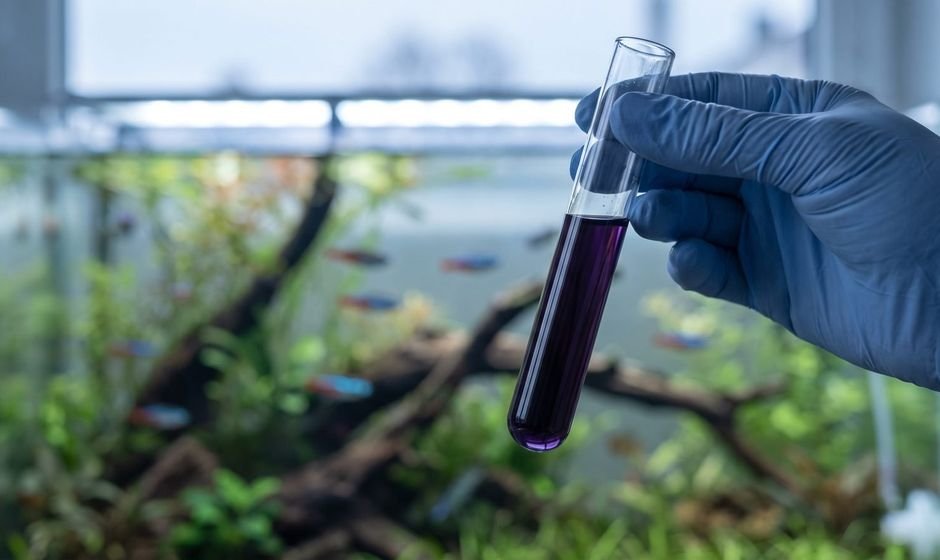
Short answer: nitrite is the middle product of the aquarium nitrogen cycle, and any reading above 0 ppm means act today. It poisons fish by binding their blood so it cannot carry oxygen. A fish in a nitrite spike suffocates in water that is full of oxygen, which is why an air stone alone will not save it. The fix is water changes to hold the reading down, a small dose of aquarium salt as a chloride shield while the spike lasts, and letting the cycle finish. This article gives you the exact salt dose per 10 gallons, backed by aquaculture research.
What nitrite is: the middle of the assembly line
The nitrogen cycle runs in two stages, handled by two different groups of bacteria. The first group eats the ammonia your fish produce and turns it into nitrite. The second group eats nitrite and turns it into nitrate, the far milder end product. In a fully cycled tank both stages run within hours, so nitrite never accumulates and every test reads 0 ppm.
Nitrite shows up on a test for one reason: the second group of bacteria cannot keep up with the first. That happens in exactly the situations you would guess. A new tank still cycling, a mature tank after a filter cleaning that was too thorough, a big medication dose, or a sudden jump in feeding or stocking.
How nitrite kills: brown blood, not bad water
Ammonia burns gills. Nitrite does something stranger: it crosses the gills into the bloodstream and converts hemoglobin, the molecule that carries oxygen, into methemoglobin, which cannot carry oxygen at all. Aquaculture texts call the result brown blood disease, because the changed pigment literally darkens the blood. The late external sign is the same: gills that look brown or muddy instead of healthy red.
Understand what that means: the water can be saturated with oxygen and the fish still suffocates, because the failure is inside its blood, not in the tank. Fish gasping at the surface, sitting near the filter outflow, breathing fast with clamped fins, in a tank with a nitrite reading, these are blood symptoms, not oxygen symptoms.
The myth: “add an air stone and they’ll be fine”
Gasping fish, so add air. It is the most natural response in the hobby, and for genuine low oxygen it is the right one. For nitrite it does almost nothing. You can push dissolved oxygen to the maximum the water will hold, and the fish’s blood still cannot pick it up, because the hemoglobin has been chemically taken out of service. An air stone during a nitrite spike is fine as a supporting measure, but it is not the rescue. The rescue is getting nitrite out of the water and chloride into it, which the next two sections cover.
Why nitrite spikes after ammonia falls: the mid-cycle trap
The cruelest part of a fishless or fish-in cycle is its timing. The ammonia-eating bacteria establish first, so somewhere in the second or third week your ammonia reading finally drops and it feels like the finish line. It is not. Every bit of that processed ammonia is now arriving as nitrite, and the nitrite-eating bacteria grow more slowly than the first group. The result is a nitrite hump that typically spans the middle weeks of a four to six week fishless cycle, often the highest toxin readings of the entire process, right when beginners relax.
This is the mid-cycle trap: people test ammonia, see zero, and stop testing. If you are cycling with fish in the tank, the nitrite phase is the stretch that kills them. Test both parameters until both hold at 0 ppm for a full week with normal feeding. That, and only that, is a finished cycle.
The fix ladder: what to do at any reading above zero
Nitrite follows the same zero-tolerance rule as ammonia: 0 ppm is the only safe number, and 0.25 ppm matters only because it is the smallest reading most liquid kits can display above zero. Any tint on the test means the tank has more nitrite than its bacteria can process. Work down this ladder:
- Change water today. A 25 to 50 percent change with dechlorinated, temperature-matched water dilutes nitrite immediately. Repeat daily for as long as the reading stays above the first tint. This is the whole rescue in an emergency, everything else supports it.
- Add the chloride shield (next section) to protect the fish between water changes.
- Stop feeding for a day, then feed sparingly. Less food means less ammonia arriving at stage one, which means less nitrite pouring out of it. Healthy fish are not harmed by a short fast.
- Seed mature media if you can get it. A handful of filter media or gravel from an established, disease-free tank carries the exact bacteria you are waiting for and can shorten the spike from weeks to days.
- Let the cycle finish. Do not add fish, do not deep-clean the filter, do not dose anything that promises to erase the reading overnight. The bacteria fix this permanently; everything else buys them time.
The chloride shield: the salt dose that blocks nitrite at the gill
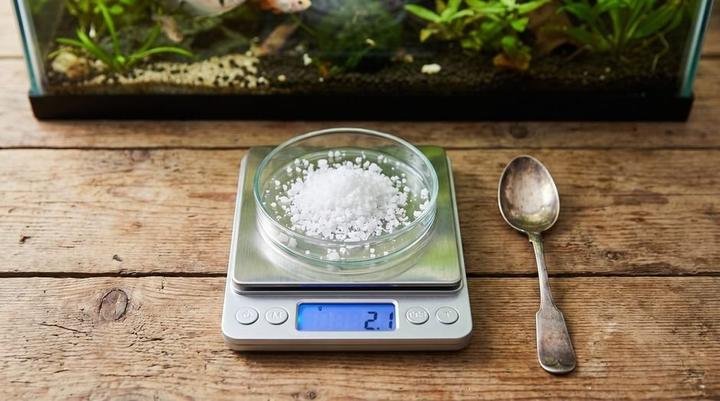
Here is the tool almost no beginner guide explains properly. Nitrite enters a fish through the same gill cells that take up chloride, and the two compete for the doorway. Raise the chloride level in the water and nitrite mostly loses: far less of it gets into the blood, and the fish rides out the spike. Aquaculture research from the Southern Regional Aquaculture Center recommends holding chloride at at least ten times the nitrite level, and plain aquarium salt (sodium chloride) is about 60 percent chloride by weight. Run that arithmetic for a 10-gallon tank and the protective doses come out remarkably small:
| Nitrite reading | Chloride target (10:1) | Aquarium salt per 10 gallons | Roughly |
|---|---|---|---|
| 0.5 ppm | 5 ppm | about 0.3 g | a large pinch |
| 1 ppm | 10 ppm | about 0.6 g | 1/8 teaspoon |
| 2 ppm | 20 ppm | about 1.2 g | 1/4 teaspoon |
| 5 ppm | 50 ppm | about 3 g | 1/2 teaspoon |
Notice what this table is not: it is not the “1 tablespoon per gallon” salt treatment used against some diseases. A shield dose is a fraction of a teaspoon for the whole tank, dissolved in a cup of tank water and poured in once. It stays until removed by water changes, so re-dose only for the portion of water you replace, and only while nitrite still reads above zero. Scoped warning: corydoras and other scaleless or salt-sensitive fish, and some delicate plants, tolerate these very low shield doses far better than treatment doses, but if your tank is built around them, favor bigger, more frequent water changes and keep the salt at the low end.
Test it with drops, not strips
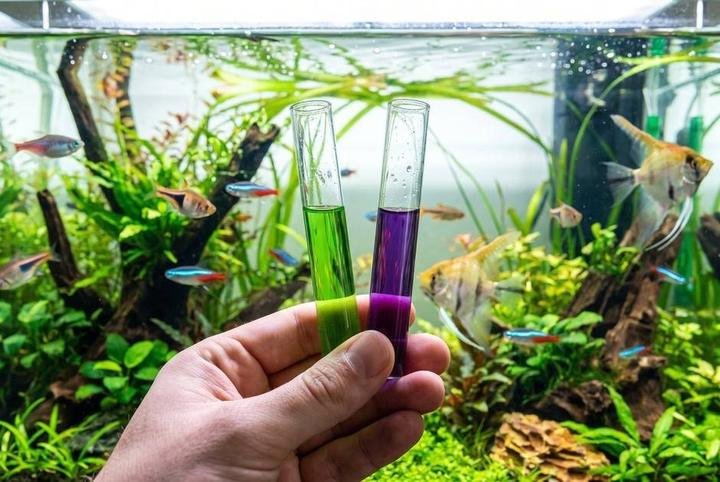
Everything above depends on one number, so the number has to be real. Paper test strips read nitrite unreliably, especially at the low end where the safe/act decision lives, and a strip that says zero during a spike is worse than no test at all. Use a liquid test kit, follow the timing on the instructions, and read the tube against a white background in daylight. During any spike, test daily; after the tank finishes cycling, weekly checks alongside your routine water change are enough.
Nitrite vs nitrate: one letter, a world of difference
The most common beginner mix-up in water testing is these two words. NitrIte, with an I, is the acute poison this article covers: zero tolerance, act the day you see it. NitrAte, with an A, is the mild end product that every healthy tank produces constantly and that you manage over weeks, keeping it under 20 ppm with routine maintenance. A tank can show 20 ppm nitrate and be perfectly healthy; a tank showing 2 ppm nitrite is an emergency. When you read a forum post, a test kit, or an article, including this one, slow down on that one letter.
Frequently asked questions
How long does a nitrite spike last?
In a new tank, the nitrite phase usually occupies the middle weeks of a four to six week fishless cycle, or longer in a six to eight week fish-in cycle where you are holding the readings down with water changes. In an established tank knocked back by a filter cleaning or medication, expect days rather than weeks. The bacteria are recovering, not starting from nothing. Seeded media shortens both cases.
Is 0.25 ppm nitrite really an emergency?
It is a same-day problem, yes. 0.25 ppm is simply the smallest step above zero a liquid kit can display, and the reading in the tank may already be climbing between tests. Nitrite damage is cumulative. The longer blood spends carrying less oxygen, the more stressed and disease-prone the fish becomes even if it survives the spike. Change water the day you see any tint.
Can I just add bottled bacteria instead of water changes?
Bottled bacteria can genuinely help a cycle along, but it is a days-scale fix and nitrite is an hours-scale poison. Nothing in a bottle drops today’s reading the way removing half the water does. Use both if you like: water changes to protect the fish now, bacteria to shorten how long you have to keep doing them.
My ammonia is zero but nitrite is high, is my tank broken?
No. It is mid-cycle and behaving exactly as expected. Zero ammonia with rising nitrite means stage one of the cycle is working and stage two is still building. Keep changing water to hold nitrite down, keep the chloride shield in place if fish are present, and keep testing. When nitrite falls to zero and nitrate starts climbing, the assembly line is complete.
Sources
- Southern Regional Aquaculture Center, Nitrite in Fish Ponds (SRAC 462), on methemoglobin (brown blood) formation and the chloride:nitrite protection ratio
- University of Florida IFAS, Ammonia in Aquatic Systems (FA031), on the two-stage bacterial pathway that produces and consumes nitrite