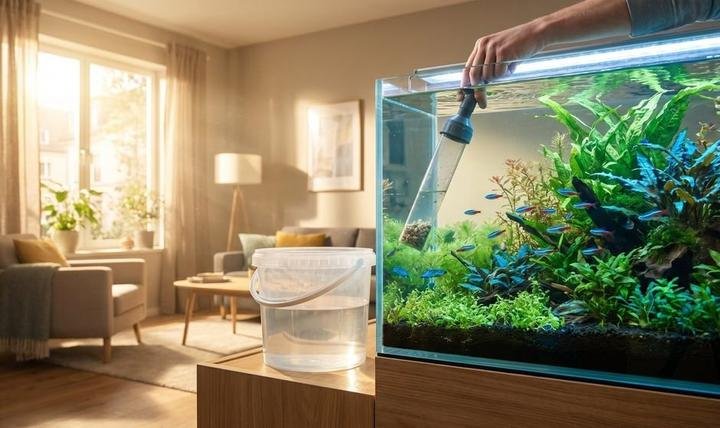
Short answer: For most freshwater community tanks, change about 25 percent of the water once a week. Small tanks and heavily stocked tanks need it more often, large lightly stocked tanks can stretch to two weeks, and a nitrate test tells you which category you are actually in. Aim to keep nitrate under 20 ppm on the day before a change.
The calendar is a starting point, not the rule. What you are managing is the build-up of nitrate and dissolved organic waste between changes. If nitrate sits below 20 ppm on the day before a change, your schedule is working. If it is creeping past 40 ppm, change more water or change it more often.
A schedule by tank size and stocking
Use this as your starting schedule, then adjust after two or three nitrate tests. Stocking level here means: lightly is a few small fish with room to spare and often live plants, moderately is a typical community tank filled sensibly, and heavily is a full tank, messy or large fish such as goldfish or cichlids, or generous feeding. How much a tank can hold before it counts as heavy is covered in how many fish you can keep in a 10-gallon tank.
| Tank size | Lightly stocked | Moderately stocked | Heavily stocked |
|---|---|---|---|
| Under 10 gallons | 15 to 20% weekly | 25% weekly | 25% twice weekly |
| 10 to 25 gallons | 20% every 2 weeks | 20 to 25% weekly | 30% weekly |
| 25 to 50 gallons | 20% every 2 weeks | 25% weekly | 25 to 30% weekly |
| Over 50 gallons | 20 to 25% every 2 to 3 weeks | 25% every 1 to 2 weeks | 25 to 30% weekly |
Two notes. Small tanks need proportionally more attention because there is less water to dilute anything that goes wrong, so a 5-gallon betta tank is not the low-maintenance option it looks like. And the longer intervals in the lightly stocked column only hold if a test kit confirms nitrate stays under about 20 ppm across the whole period.
How much to change at once
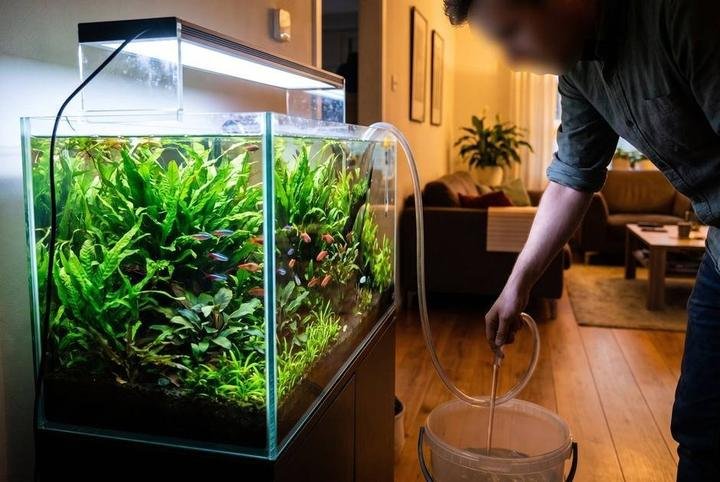
Between 20 and 30 percent is the practical range for routine maintenance, and our water change calculator turns your nitrate reading into the exact gallons to swap. It removes a useful share of accumulated waste without shifting pH, hardness, or temperature enough for fish to notice.
Larger changes are fine when there is a reason. Up to 50 percent is safe if nitrate has climbed above 40 ppm, if you are correcting an ammonia or nitrite reading, or if you are cleaning up after an outbreak. Use dechlorinated water at matched temperature and pour it in slowly.
Smaller, more frequent changes are gentler than large, rare ones: two 15 percent changes a week hold parameters steadier than one 30 percent change. That matters more if your tank water is soft and acidic while the tap supply is noticeably harder, since each change nudges hardness and pH upward.
Nitrate is the real metric
Nitrate is the end product of the nitrogen cycle. Ammonia becomes nitrite, nitrite becomes nitrate, and nothing in a normal aquarium removes nitrate at any speed. Plants use some, and the rest leaves with the water you take out. So nitrate climbs steadily between changes, and how fast it climbs measures your tank’s waste load against its volume.
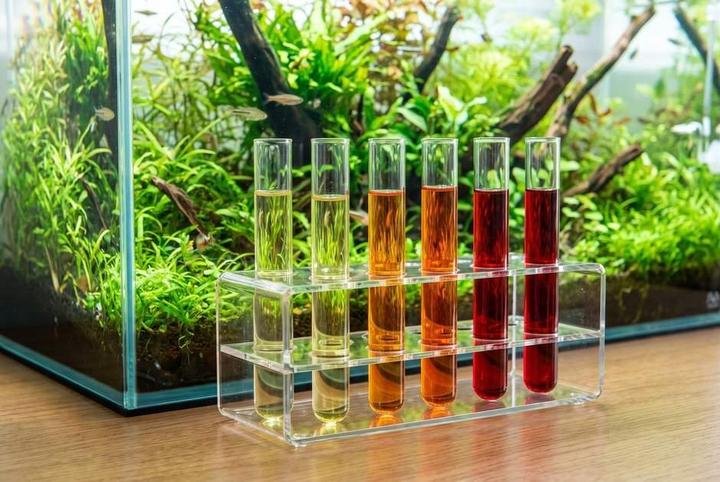
Test nitrate right before your next scheduled change, when it is at its highest, and read the result like this:
- Under 20 ppm: comfortable. You could stretch the interval slightly if you want to.
- 20 to 40 ppm: acceptable, and your current schedule is about right. Keep it.
- Over 40 ppm: change more water, more often. Also check whether you are overfeeding or overstocked.
- Over 80 ppm: bring it down gradually with 25 percent changes over several days rather than one huge change, because fish acclimated to high nitrate react badly to a sudden drop.
The arithmetic is worth doing once. A change removes nitrate in proportion to the volume swapped, so a 25 percent change on a tank reading 40 ppm leaves about 30 ppm. If that is not low enough by the following week, you need a bigger percentage or a shorter interval. Test your tap water too: some supplies carry 10 to 20 ppm nitrate, which puts a floor under how low you can get.
How to do a water change
- Unplug the heater if the water level will drop below it, and switch off the filter if the intake will be exposed.
- Siphon water out with a gravel vacuum, working across a different section of substrate each time.
- Prepare the new water in a clean bucket, matched to within about 2 degrees F of the tank.
- Add dechlorinator at the dose for the volume of new water, or for the whole tank volume if the label says so; if you are unsure of your tank’s real volume, the aquarium volume calculator works it out from the glass measurements. If your supply is treated with chloramine, use a product that states it handles chloramine.
- Refill slowly, pouring onto a plate, a rock, or your hand so you do not blast the substrate or startle the fish.
- Restart the heater and filter, and check the flow looks normal before you walk away.
Never use buckets that have held detergent, and do not dose dechlorinator straight into the tank before refilling from a hose unless the product’s instructions allow it.
Gravel vacuuming
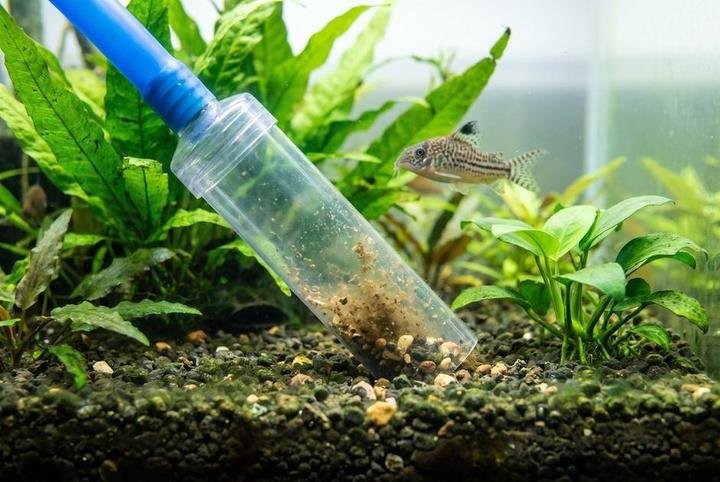
The vacuum is what makes a water change worth doing. Solid waste, plant debris, and uneaten food collect in the top layer of substrate, and pulling it out removes waste from the system rather than waiting for it to break down into more nitrate.
With gravel, push the tube in and let the gravel tumble until the water running out is clear, then move on. With sand, hover the tube about half an inch above the surface to lift detritus without sucking up sand. Do a third to a half of the open substrate at each change, not the whole floor, which keeps the disturbance modest.
In a heavily planted tank, deep vacuuming tears roots up, so skim debris off the surface and around the hardscape instead. There is more on planted substrate in the plants and aquascaping section.
Why 100 percent water changes are harmful
Emptying and refilling the tank is a common beginner mistake, usually done in the belief that it is the most thorough clean available. Three problems with it.
Every parameter changes at once. Temperature, pH, hardness, and dissolved CO2 all jump to whatever your tap water is, and fish tolerate gradual shifts far better than sudden ones. That alone can put them into shock. It also usually means netting and holding the fish, which risks injury and puts them in a small unfiltered container where ammonia builds within hours.
And it does not achieve what people think. The bacteria that process ammonia live on surfaces, mostly filter media and substrate, not floating in the water, so a big change does not wipe out your cycle the way it is often described. But if a full change also involves scrubbing the substrate, replacing filter media, and bleaching decor, you can knock the colony back hard enough to trigger an ammonia spike. Partial changes plus a gravel vacuum remove waste more effectively and without the risk.
Situations that change the schedule
- A cycling tank with fish in it. Test daily and change water whenever ammonia or nitrite read above 0 ppm, which may mean daily 25 to 50 percent changes for weeks. If your readings are climbing, see how to lower ammonia in a fish tank.
- A fishless cycle. No changes until the cycle completes, then one large change to bring nitrate down before adding fish.
- Shrimp tanks. Keep changes small, 10 to 15 percent, and add water slowly. Shrimp react badly to sudden shifts in hardness.
- Medicating. Follow the label. Most say to complete the course before the next change, since a change removes the dose.
- Holiday. A settled, lightly stocked tank copes with two or three weeks unfed better than with a neighbor overfeeding it. Do a change before you leave.
- A tank under a month old. Test twice a week whatever the schedule says. Rising ammonia in a new setup is new tank syndrome, and it is the most common early killer.
For the full routine from an empty tank forward, start with how to set up a fish tank, and browse the rest of the water quality guides for testing and parameters.
Frequently asked questions
Can I skip water changes if I have live plants?
You can usually stretch the interval, not skip it. A densely planted, lightly stocked tank may hold nitrate under 20 ppm for two or three weeks. Changes also replenish trace minerals and hardness and export dissolved organics no test kit measures, so most planted tanks still get one every one to two weeks.
Do I need to remove the fish?
No. Leave them in, and they will follow the siphon around out of curiosity. Keep the tube away from small fish and shrimp, and never siphon out a fish hiding in the substrate.
Is it bad to change too much water too often?
Daily large changes with mismatched temperature or unconditioned water will stress fish. Done properly, frequent changes are not harmful, just unnecessary in a settled tank. The exception is tap water with very different chemistry from the tank, where each change moves pH and hardness.
Should I change the filter media at the same time?
Rinse mechanical media such as sponge or floss in the bucket of water you just siphoned out, every two to four weeks, and never under a tap. Replace biological media only when it is physically falling apart, and only a third at a time so the colony survives.