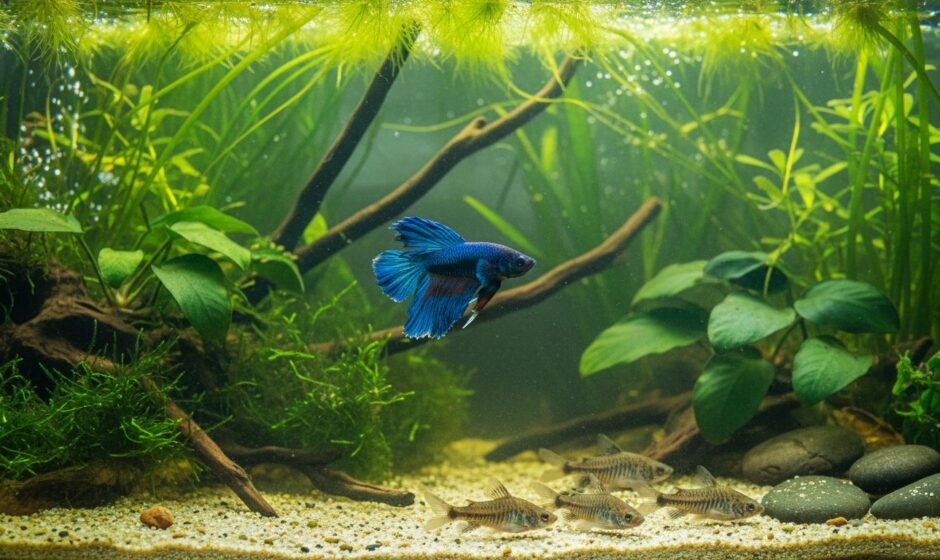
A betta in a 5-gallon tank lives alone. No exceptions, and no shrimp-or-snail workarounds either. Move up to 10 gallons and a short list opens: kuhli loaches, corydoras, harlequin rasboras, nerite snails, and cherry shrimp with a caveat. The pet store will suggest guppies and dwarf gouramis; both end up shredded. Every candidate has to pass the same two-gate test, and even after a fish clears both gates, your individual betta holds a veto.
Why betta tank mates go wrong
Bettas were bred for fighting, and centuries of pet-shop breeding never removed the instinct. A male flares at anything that reads as a rival: bright color, a big flowing tail, a body shape that looks even vaguely betta-adjacent. The failures run in both directions, though. Those long fins make a betta one of the slowest swimmers in the hobby, so nippy species treat his tail as a buffet. Half the horror stories are the betta killing a guppy overnight. The other half are tiger barbs stripping a halfmoon to stubs in a weekend.
The two-gate test
Run every candidate through two gates, in order. Fail either gate and the fish stays at the store.
Gate 1 is tank size. A 5-gallon holds one betta and nothing else, because a tank that small has no escape distance: when a dispute starts, the loser has nowhere to go. Ten gallons is the floor for any betta community, and it opens the bottom-dweller options. A 15 or 20 makes everything easier and adds room for a mid-water school. The stocking math in the 10-gallon stocking guide still applies on top of everything below; a betta community that is overstocked fails on water quality before temperament ever becomes the problem. Size the group with the aquarium stocking calculator before you buy, so the bioload fits the tank you have.
Gate 2 is the mate profile, four rules long: no bright colors, no long fins, no fin nippers, and the fish should be either fast or armored. Bottom dwellers score well because a betta patrols the top half of the tank and mostly ignores the floor. Drab, quick mid-water fish come next. Anything colorful, slow, or flowy fails, which rules out most of the fish beginners actually want to add.
The safe list
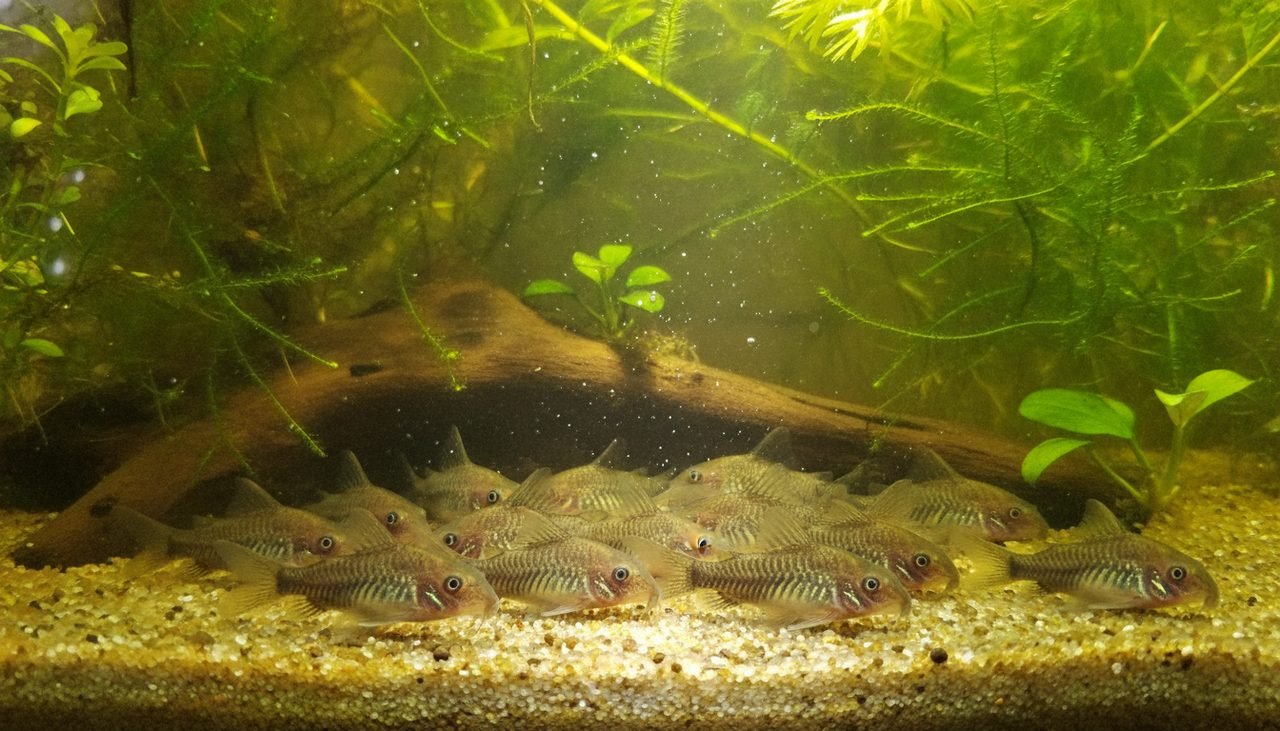
These pass both gates in a 10-gallon or larger tank. Hold the water at 78-80°F, which sits inside the betta’s 75-81°F range and suits every species in the table.
| Tank mate | Keep | Minimum tank with a betta | Why it works |
|---|---|---|---|
| Kuhli loach | Group of 3-6 | 20 gal | Nocturnal and snake-shaped; your betta may never notice them |
| Pygmy corydoras | 6 or more | 10 gal | Armored, bottom-bound, zero interest in the surface |
| Bronze corydoras | 6 | 20 gal | Same armor plating, bigger body, same calm temperament |
| Harlequin rasbora | 6-8 | 10 gal | Drab, quick, short-finned, stays mid-water |
| Nerite snail | 1-2 | 10 gal | Ignores fish, eats algae, hides in its shell if bothered |
| Cherry shrimp | 10 or more | 10 gal, heavily planted | The caveat pick: adults usually survive, shrimplets are betta food |
Treat the shrimp row as a coin flip. In a tank thick with java moss and hiding spots, a cherry shrimp colony can hold its numbers against one betta. In a sparse tank, he will pick them off one by one and enjoy every minute of it. Buy shrimp for a betta tank only if losing a few would not ruin your week.
The shredded list
These pairings fail often enough that the outcome is close to guaranteed. Leave them at the store:
- Guppies. A male guppy is bright color on a flowing tail, which is the exact silhouette a betta attacks. This is the single most common bad pairing in the hobby, and it usually ends within 48 hours.
- Dwarf gouramis and other gouramis. Gouramis are the betta’s close relatives. Same labyrinth organ, same surface habits, same body language, so each reads the other as a rival. Fights are mutual and ugly.
- Another betta. Two males fight until one dies. A female sorority (five or more females in a planted 20-gallon) is a real setup, but it collapses often enough that it belongs to experienced keepers, and never to a first tank.
- Tiger barbs, serpae tetras, and other known nippers. The betta is the victim here. Nippers target long fins, and a shredded tail invites fin rot on top of the stress.
The first 48 hours decide it
Most betta attacks start within two days of an introduction, so treat that window as a trial period and actually watch it. Some flaring on day one is normal; the betta is announcing ownership, and it usually fades. What should worry you is sustained chasing, a betta that stakes out the corys’ feeding spot, or torn fins on anyone. Feed at opposite ends of the tank so the slow-eating betta and the fast-eating school never compete over the same sinking pellet, and check fins each morning with the lights on. A betta community that makes it through the first week calmly tends to stay calm for years. One that starts badly rarely improves on its own.
The personality veto
Every rule above describes the average betta. Yours might not be average. Some males share water with a nerite snail for years without a glance; others kill snails on sight and patrol the substrate looking for more. No list can predict which one you brought home, so build the veto into your plan. Add the betta last, after the corydoras or rasboras are settled, so he inherits a community instead of defending an established territory. And decide on a plan B before any money changes hands: a tank divider, the store’s return window, or a spare 5-gallon ready to run solo.
Two housekeeping notes that save betta communities. New arrivals go through quarantine, three clean weeks, before they ever meet him; a nipped fin heals in weeks, but a disease outbreak in the display tank can take the whole roster. And keep his baseline solid: the heater, cycled filter, and feeding routine from the betta care guide matter more to his temper than any tank mate choice. A cold, stressed betta picks fights a warm, well-fed one ignores.
Betta tank mate FAQ
Can a betta live with a snail in a 5-gallon tank?
Keep the 5-gallon solo. Some keepers get away with adding a nerite, but in a tank that small the betta meets the snail constantly, and antenna-nipping is common. The wider case for a single occupant runs through the honest short list of fish for a 5-gallon tank. At 10 gallons, a nerite becomes one of the safest companions available.
Can two female bettas live together?
Only in a sorority: five or more females in a heavily planted tank of 20 gallons or larger, and even then experienced keepers disagree about whether it is worth the risk. Two females in a small tank ends with one dead. Skip the idea entirely for a first tank.
Do betta fish get lonely?
No. Bettas defend territory; they do not seek company. A solo betta in a heated, cycled 5-gallon with places to explore is living a full betta life. Tank mates exist for your viewing interest, and he is fine without them.
