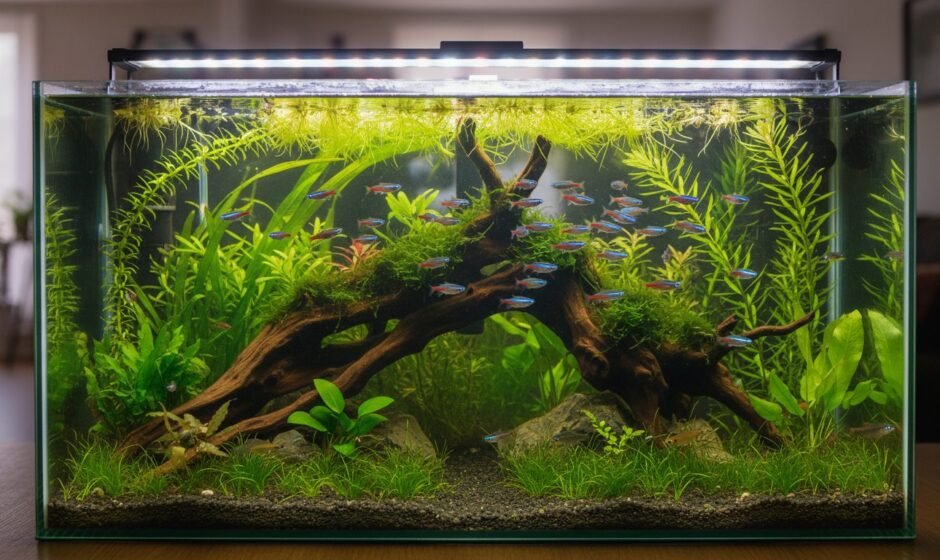
A 20-gallon tank is the size this site recommends for every beginner, and it earns that spot by holding an actual community: a proper school, a bottom crew, and a centerpiece if you want one. Below are three complete stocking plans you can copy as written: a classic community, a centerpiece build around a dwarf cichlid, and a livebearer setup. Each lists exact species and counts, fills the tank without crowding it, and works at the standard tropical 76-80°F.
Why 20 gallons is the recommended beginner size
Stability. Twenty gallons of water changes temperature slowly, dilutes waste twice as well as a 10, and turns beginner mistakes into events instead of disasters. Overfeed a 5-gallon on Friday and you can have an ammonia reading by Sunday; the same mistake in a 20 gives you a week of margin and a warning on the test kit. The equipment math stays simple too: a 100-watt heater (about 5 watts per gallon) and a filter rated to turn the tank over 4 to 6 times per hour. Bigger would be even more stable, but a 20 still fits on a sturdy dresser and fills with fish for well under $100.
Plan 1: the community plan
Eight harlequin rasboras, six bronze corydoras, two nerite snails. This is the plan to pick if you cannot decide. The rasboras give you a copper-orange school that moves as one unit through the middle of the tank, the corys work the sand in a constant cheerful scrum, and the nerites keep the glass clean. Every species here is peaceful, hardy, and forgiving of the water-chemistry wobbles of a first-year tank. Nothing in this plan nips, breeds uncontrollably, or outgrows the tank: harlequins stop at 2 inches, bronze corys at about 2.5 to 3.
Plan 2: the centerpiece plan
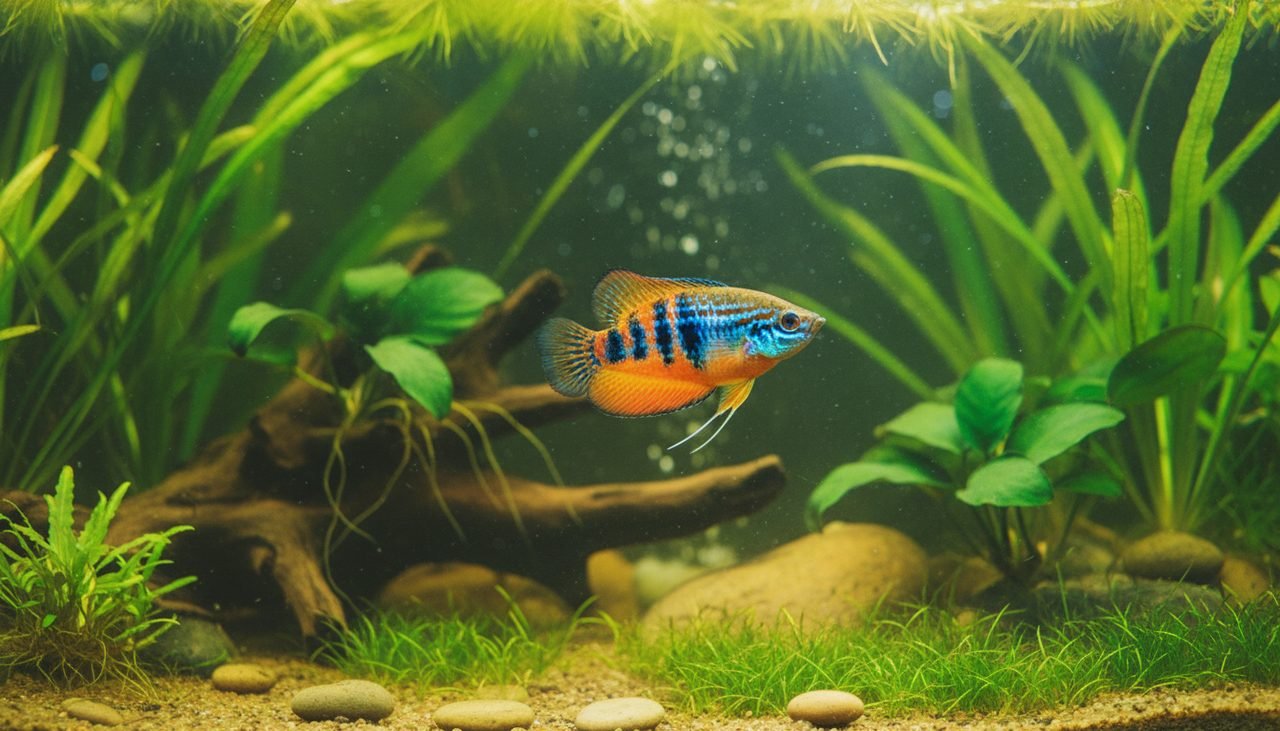
One Bolivian ram, ten ember tetras, six pygmy corydoras. The Bolivian ram is the gentlest cichlid in the hobby and the star of the beginner cichlid guide: a 3-inch fish with real personality that patrols the tank, watches you back, and leaves everyone alone. The embers are deliberately tiny (under an inch, glowing orange) so the ram reads as large by contrast, and pygmy corys fill the floor without competing for his territory. Keep one ram, singular; a pair will breed and claim the bottom half of the tank.
Plan 3: the livebearer plan
Five platies (one sex only), six panda corydoras, two nerite snails. Platies are chunky, colorful, and nearly indestructible, which makes them one of the best first fish available. The single-sex rule is the load-bearing part of this plan: mixed-sex platies produce 20 to 40 fry a month per female, and a 20-gallon fills within a season. All males or all females sidesteps the whole problem. Ask the store to sex them for you; anal fin shape makes it easy on adults, and a decent shop will get it right.
The three plans side by side
| Plan | Stocking | Personality of the tank |
|---|---|---|
| Community | 8 harlequin rasboras, 6 bronze corydoras, 2 nerite snails | Constant gentle motion at every level |
| Centerpiece | 1 Bolivian ram, 10 ember tetras, 6 pygmy corydoras | One character fish with a glowing supporting cast |
| Livebearer | 5 single-sex platies, 6 panda corydoras, 2 nerite snails | Bold color, zero drama, no fry explosion |
Pick one plan and run it as written. Mixing plans is how a 20-gallon ends up overstocked: each one already fills the tank, in the same way the counts in the 10-gallon stocking guide fill a 10. The urge to add “just one more school” arrives around month two. Resist it, or buy a second tank; that is how everyone else in this hobby ended up with four.
Swaps that keep a plan legal
Each plan tolerates one-for-one substitutions as long as the replacement matches the size and role of the fish it replaces. In the community plan, eight cherry barbs or eight lambchop rasboras stand in cleanly for the harlequins, and panda corys swap for bronze if your store carries them. In the centerpiece plan, a single honey gourami replaces the Bolivian ram for a softer, slower tank; it is a 2-inch surface fish with none of the cichlid attitude. In the livebearer plan, five or six male guppies swap in for the platies, same single-sex logic, smaller fish, louder color. What you cannot swap in: anything from the mollies-and-up size class (a 4-to-5-inch molly wants more than 20 gallons), any known fin nipper like tiger barbs, or a common pleco, which outgrows this tank nine times over.
The rules that keep any plan alive
- Cycle first. Run a full fishless cycle, 4 to 6 weeks, before any fish arrive. Every plan above assumes zero ammonia on day one.
- Stock in two or three trips, weeks apart. Add the school first, the bottom crew two weeks later, the centerpiece last. The filter bacteria need time to catch up with each addition.
- Change 25% of the water weekly. Keep nitrate under 20 ppm before each change.
- Feed what the tank finishes in about two minutes, once or twice a day. Corys and the ram also want sinking pellets, since flake rarely reaches the floor.
Budget reality, since nobody prints it on the box. A 20-gallon kit with heater and filter runs $80 to $150, sand and decor another $30 to $50, and the full fish list for any plan above lands between $40 and $70 at ordinary store prices, with the Bolivian ram as the single priciest fish at $10 to $15. The test kit is the purchase people skip and regret; a liquid kit costs about $25 and answers every “why is my fish acting weird” question you will have in year one.
20-gallon stocking FAQ
How many fish can a 20-gallon tank hold?
For small community fish, 15 to 20 individuals is a comfortable ceiling, which is exactly where the three plans land. Ignore the inch-per-gallon rule; it treats a 2-inch platy and a 2-inch baby oscar as equals, and one of those becomes a foot long.
Can an angelfish live in a 20-gallon tank?
No. An adult angelfish runs 6 inches long and 8-plus inches tall, and it needs a 29-gallon tall tank at minimum. The 2-inch angel at the store is a juvenile with a growth schedule, and it does not care what tank you bought.
Is a 20-gallon long better than a 20-gallon high?
For fish, yes. The long gives you a 30-inch footprint instead of 24, and fish live on floor space and swimming length, while height mostly benefits plants and aquascapes. Every plan in this article works in either shape, but the long version gives the school more runway.
