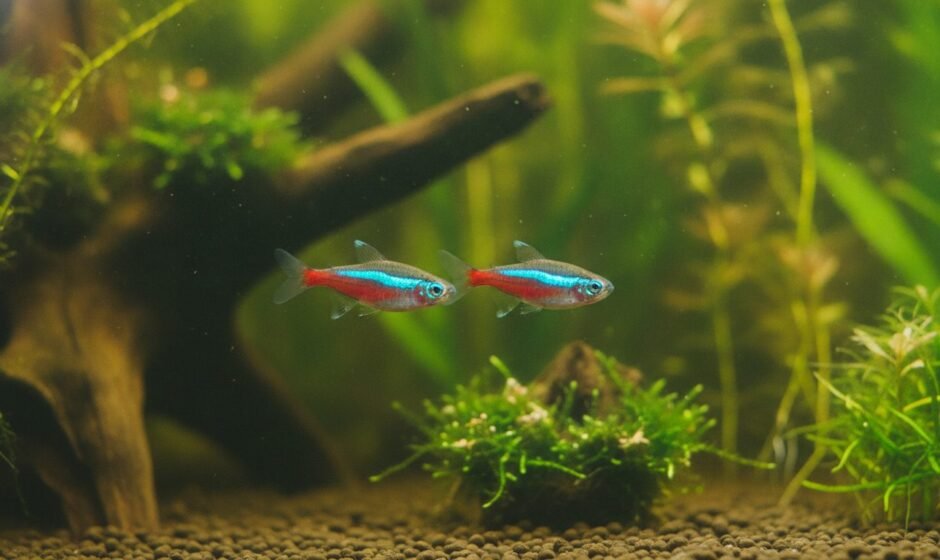
Wait until your tank is at least three months old before buying neon tetras. That one rule prevents more neon deaths than any product, medicine, or acclimation trick, because modern farm-bred neons are fragile fish, and a young tank is the number one thing that kills them. The neon on the store shelf is cheap, gorgeous, and on every beginner list, and it dies by the dozen in four-week-old aquariums across the country every single day. In a mature, cycled, stable tank, the same fish schools happily for three to five years.
The mature-tank rule
Cycled and mature are different things. Cycling, the 4-to-6-week fishless cycle, builds the bacteria that convert ammonia. Maturity comes after: weeks of stable readings, an established film of biofilm on every surface, a filter that has caught up to the tank’s real bioload. Young tanks wobble. They throw small ammonia and nitrite blips as stocking changes, and those blips are exactly what new tank syndrome looks like from the inside. A zebra danio shrugs off a blip. A farmed neon, weakened by generations of mass production in Asian breeding ponds, often does not.
So put a date on the calendar three months after the day the tank was filled, and buy neons after it. Stock hardier fish first if you want early activity. The rule costs nothing, and skipping it is why “neon tetras keep dying but my other fish are fine” fills beginner forums.
Neon tetra care at a glance
| Stat | Neon tetra |
|---|---|
| Adult size | 1.5″ |
| Lifespan | 3-5 years in good water |
| Temperature | 72-78°F; hold 76-78°F in a mixed community |
| Water | pH 6.0-7.0 ideal, up to 7.5 if held steady |
| Tank floor | 10 gallons |
| School size | 6 minimum, 10+ better |
| Diet | Crushed flake, micro pellets, frozen daphnia; two-minute portions |
| Temperament | Peaceful; safe with anything that will not eat them |
Six is the minimum, ten is the fish
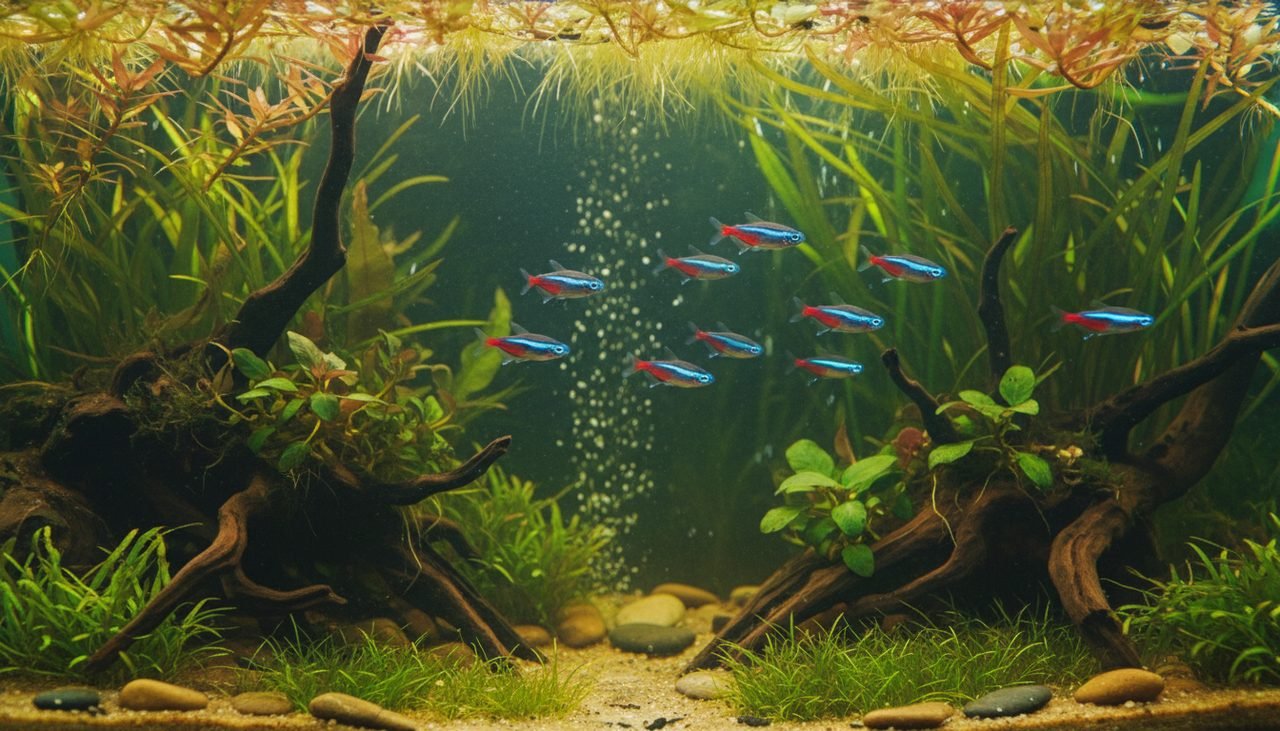
Neons are obligate schoolers. A group of three spends its life stressed: washed-out color, constant hiding, nervous darting, shortened lifespan. Six is the working minimum, and ten or more is where the species actually shows up, moving as one silver-and-blue ribbon across the tank. Since each fish is an inch and a half of nearly nothing, the upgrade is cheap. A school of eight to ten in a planted 10-gallon is a complete, finished tank, and one of the best-looking small aquariums a beginner can build. For the most colorful picks at every tank size, see our guide to colorful freshwater fish.
Cooler and softer than you think
Neons come from cool, soft, acidic blackwater streams, and they run cooler than the standard tropical setup. Aim for 72-78°F in a neon-focused tank; in a mixed community, hold 76-78°F, the overlap with the usual 76-80°F community range. Years at 80°F and above burn through a neon’s metabolism and shorten its life. Water chemistry is more forgiving than the wild numbers suggest: farmed neons handle pH up to about 7.5, provided (the theme of every fragile species) it holds steady. Skip pH-adjusting chemicals; a stable 7.4 beats a bouncing 6.8 every time.
Feeding a fish with a tiny mouth
A neon’s mouth is smaller than most flake food, so feed accordingly: crush standard flake to dust between your fingers, or buy micro pellets sized for small tetras. Offer what the school finishes in about two minutes, once or twice a day, and rotate in frozen daphnia or baby brine shrimp weekly; the color payoff is visible within a month. Watch the school during feeding, because a healthy neon eats greedily and a neon that hangs back from food is the earliest warning sign the species gives. One fasting day a week is fine and mirrors how thin the pickings are in their wild blackwater streams.
Tank mates: small, calm, and nothing with a big mouth
Neons are perfect community citizens who make perfect community victims. Anything with a mouth wider than an inch eventually eats one; angelfish are the classic mistake, sold alongside neons in every store and happy to hunt them down to the last fish once grown. Bettas are a gamble that usually ends with shredded neon fins or a stressed betta. The safe list is the calm small-fish roster: corydoras, otocinclus, harlequin rasboras, ember tetras, small peaceful gouramis in larger tanks, snails, and shrimp (adult shrimp, anyway). Skip fin nippers like tiger barbs and serpae tetras entirely. A neon school plus a cory school in a 20-gallon is a classic, nearly foolproof community.
Neon tetra disease, honestly
Neon tetra disease is a parasitic infection (Pleistophora) with no cure. None. Any product claiming to treat it is selling hope. The signs, in rough order: a fish that leaves the school and swims alone, restlessness at night, a faded or broken patch in the blue-red stripe, then a lumpy or wasting body. An infected fish should be removed, because the disease spreads when tankmates pick at a dead or dying carrier, and because a slow parasitic death is a fair case for humane euthanasia.
Prevention is the whole game. Buy from a display tank with zero dead or gray fish in it, and run new neons through a proper quarantine tank for three clean weeks before they meet your main tank. Quarantine feels like overkill for a $2 fish until it saves a $200 community.
Are neons good beginner fish?
They are a good beginner species bought at the wrong time. Every chain-store beginner list includes neons, and the lists are why so many first tanks hold a memorial’s worth of them: the fish gets added in week two, precisely when the tank is least able to keep it alive. The honest sequencing: start with genuinely forgiving fish from the best beginner fish list, let the tank age past the three-month mark, then add the neon school as the finishing touch. Same fish, opposite outcome.
Neon tetra FAQ
Why do my neon tetras keep dying?
Tank age, in most cases. Farmed neons cannot handle the small ammonia and nitrite wobbles of a tank under about three months old, even one that finished its cycle. If the tank is mature and deaths continue, look at temperature swings, a school smaller than six, or neon tetra disease brought home from the store.
How many neon tetras should be kept together?
Six at absolute minimum, ten or more for real schooling behavior. Small groups stay stressed, hide, and lose color. In a 10-gallon tank, a school of eight to ten neons with no other fish is a full and healthy stocking.
Can neon tetras live in a 5-gallon tank?
No. A school of six active fish needs the swimming length of a 10-gallon at minimum, and a 5-gallon cannot hold a school at all. Keeping two or three neons in a small tank guarantees the stressed, faded version of the species.
