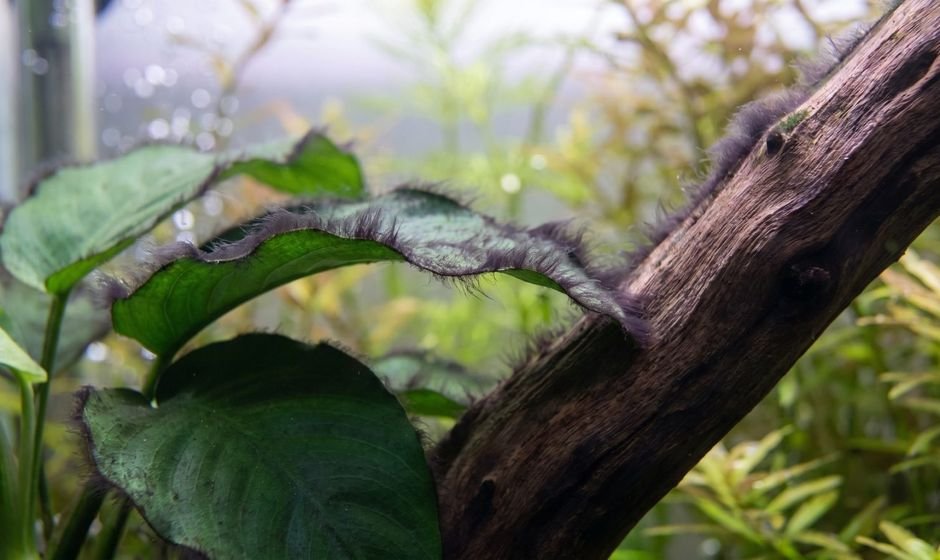
Black beard algae is the growth that makes experienced fishkeepers sigh: dark tufts, soft as a beard, gripping leaf edges and hardscape like they were glued on. It ignores the tricks that clear other algae, no popular fish reliably eats it, and scrubbing alone brings it back within weeks. But BBA has one useful habit, where it grows tells you why it grows. Read the location, fix the matching cause, remove the tufts once, and it stays gone. This guide is that readout.
What you are actually fighting
Despite the color and the freshwater address, BBA is a red algae. A tougher, denser branch of the algae family than the green film on your glass. Its tufts are wiry bundles that anchor deep into whatever they colonize, which is why a fingernail slides off them and why a leaf, once claimed, is never really clean again. Confirm you have it: dark grey-to-black tufts, quarter-inch or so, feathery like a tiny beard, holding firm when pulled. Fuzzy but green and soft is a different problem, and slimy sheets are another again. The algae identification guide sorts the lookalikes.
The location readout: where it grows is why it grows
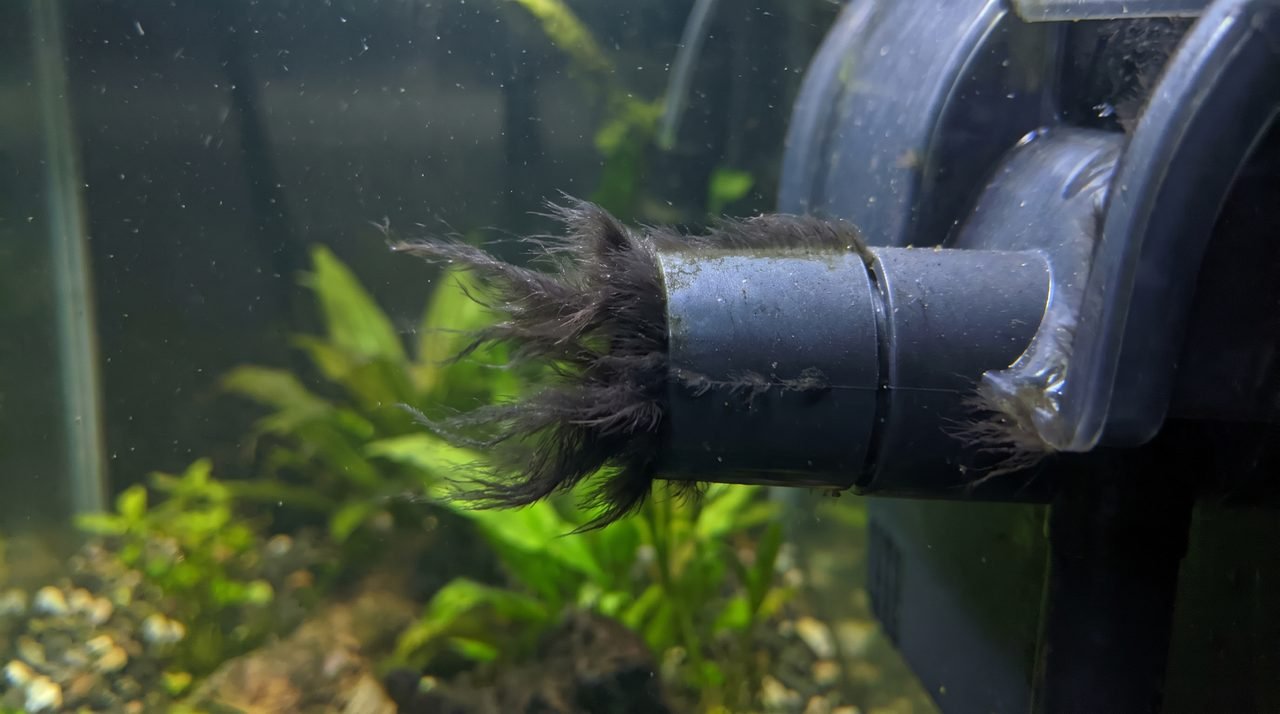
BBA is an opportunist of instability. It thrives where conditions swing, in light, in nutrients, in carbon, because swings stall plants and ordinary algae while BBA’s tough tufts ride them out. Its location on your hardware is a diagnosis you can read directly:
| Where the tufts are | What it is telling you | The move |
|---|---|---|
| Filter outlet, spray bar, tubing | BBA loves turbulent, well-fed water; colonizing your equipment first is normal and not yet a tank-wide signal | Pull the parts and scrub them at the next water change; watch whether it spreads beyond them |
| Edges of old leaves on slow-growing plants | Those leaves are aging and shaded, weakening tissue is the easiest real estate in the tank | Trim the affected leaves off entirely; a colonized leaf never recovers |
| Hardscape and glass in the brightest zones | More light than your plants can use. The surplus is funding the tufts | Shorten the photoperiod and check for stray room light |
| Everywhere at once, in a previously clean tank | Routine instability: irregular water changes, an erratic light schedule, or (in injected tanks) fluctuating CO2 | Restore a fixed weekly rhythm, same change, same day, lights on a timer |
Why stability beats scrubbing
Here is the mechanism that makes BBA feel unfair. Healthy, steadily growing plants absorb the light and nutrients that reach the tank, leaving little surplus. When conditions fluctuate, lights on random hours, water changes when you remember them, CO2 swinging in a high-tech tank, plants stall and restart, and every stall leaves a surplus window. BBA specializes in those windows: it grows slowly but never stalls. So a tank scrubbed spotless but still run erratically regrows its beard within weeks, while a tank on a fixed rhythm starves the regrowth out. The single most effective BBA treatment is boring: the same roughly 25 percent water change on the same day each week, lights on a timer, feeding inside a routine you do not renegotiate.
Removal that actually sticks
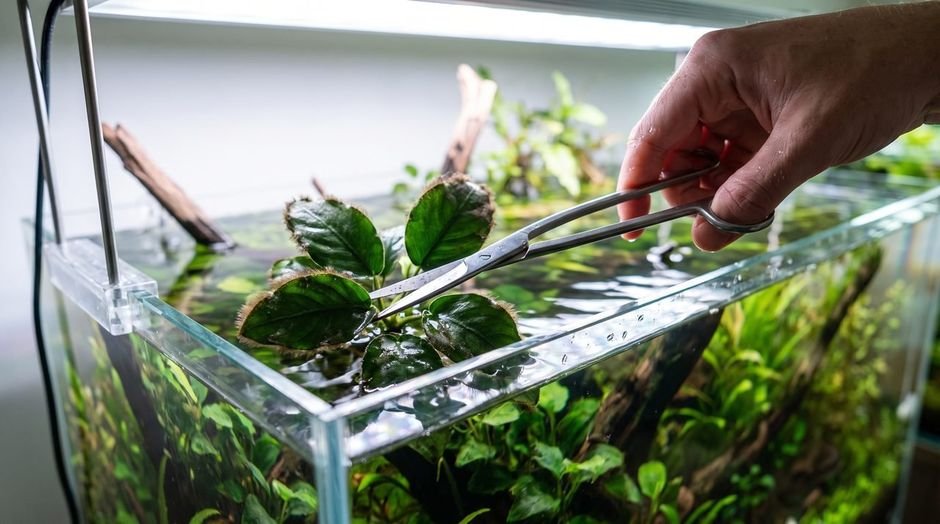
- Trim colonized leaves. Cut them at the stem and remove them from the tank. This feels brutal on a slow grower like anubias, but a tufted leaf is a seed bank, not an asset.
- Take hardscape out and scrub it. Rocks and wood come out at water-change time; scrub under hot running tap water. (Tap water is fine here. These are decorations, not filter media.)
- Scrub what cannot come out with a clean toothbrush in-tank, right before the water change so loosened fragments leave in the siphon.
- Fix the cause the same week using the location readout above, removal without the fix is a subscription to steps 1 through 3.
The fixes that do not work (and why people swear by them)
“Get a Siamese algae eater.” The one fish with a real BBA reputation eats only young, soft tufts, mature beards are ignored. It also grows to six inches, needs a tank on the scale of 29 gallons or more, and famously loses interest in algae once it learns what fish food tastes like. As a supporting act in a big, stable tank, fine; as the fix, it is a moving decoration. Check your stocking math against the stocking guide before adding any fish for janitorial reasons.
“Spot-dose it with liquid carbon or peroxide.” These kill the tufts they touch. The beard reddens and fades, which is why the method has fans. But they treat tufts, not causes: the instability that grew the first beard grows the next one on schedule, a few weeks later, one shelf over. This site’s approach to every algae problem is the same, fix the conditions, not the symptom, and BBA is the strongest case for it, because no other algae punishes symptom-only treatment as reliably.
Black beard algae FAQ
Is BBA harmful to fish?
Not directly, fish swim past it unbothered. The harm is to plants (colonized leaves are slowly shaded and lost) and to your patience. There is no urgency to nuke it overnight; there is every reason to fix it properly once.
Will BBA go away on its own?
No. Unlike the brown diatom film of a new tank, BBA has no built-in expiry. Once established it holds its ground until conditions stabilize and the existing tufts are physically removed.
I do not inject CO2, how can CO2 instability be my problem?
In a low-tech tank the same principle wears different clothes: the instability comes from irregular maintenance and lighting rather than a CO2 system. Erratic water changes swing the tank’s chemistry the same way an erratic regulator does. The fix is identical, rhythm.
How long until my tank is clean?
Removal is a single afternoon; confirmation takes a month. If the trimmed-and-scrubbed zones stay clean through four weekly water changes on a fixed rhythm, you have won. Regrowth inside that window means a cause from the readout table is still live. Most often the light schedule.