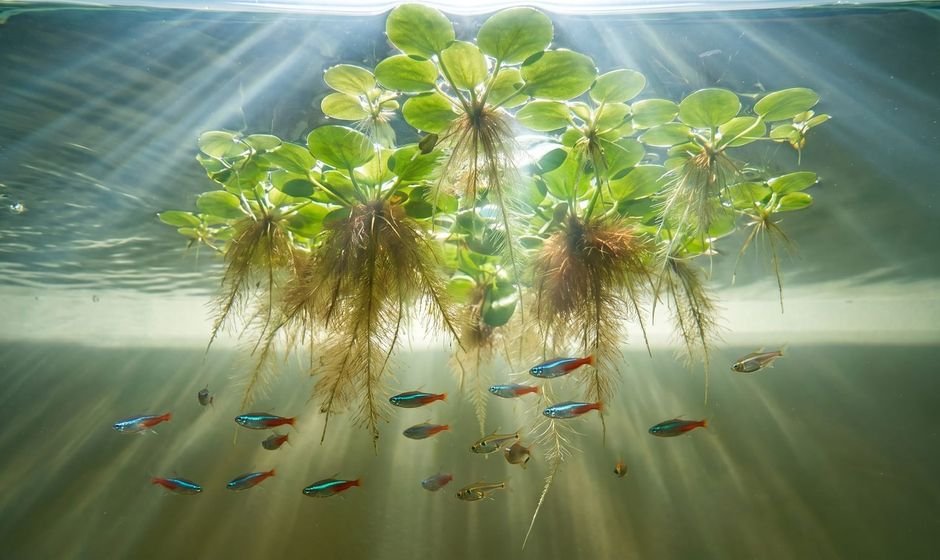
Floating plants are the only plants in the hobby with an unfair advantage: they grow with their leaves in the air. That one trick, the aerial advantage, makes them the fastest growers you can buy, the cheapest nutrient control in the hobby, and instant cover that shy fish visibly relax under. This guide explains the advantage, sorts the common floaters in one decision table (including the one you should never add), and shows the zero-cost corral that solves their only real management problem.
The aerial advantage: why floaters outgrow everything
A submerged plant lives on the carbon dioxide dissolved in water, a thin, slow ration. A floating plant keeps its leaves in the atmosphere, where CO2 is far more available and light arrives at full strength before glass, water, and depth take their cut. Air-fed carbon, first claim on light, roots dangling straight into the richest layer of the water: floaters run with every limit removed, which is why frogbit can double its coverage in a week or two while a sword plant ponders a single new leaf. The consequence that matters to you: all that growth is built out of the nutrients in your water. A thriving floater mat is a nutrient pump you harvest by the handful. The “export line” idea covered in the nitrate guide, running at maximum speed.
The floater table: choose one, skip one
| Species | Look and size | Choose it if | Skip it if |
|---|---|---|---|
| Amazon frogbit | Coin-sized round leaves, long showy roots | You want the classic look and easy handling. The best first floater | Your tank has strong surface current that flips it |
| Salvinia (water spangles) | Small furry oval leaves in chains, short roots | You want fast coverage that tolerates flow and is trivially thinned | You want long roots for fish to hide in |
| Red root floaters | Small leaves, striking red roots; blushes red under strong light | You want color and have bright light and still water | Your light is modest. It stays plain green and grows fussier than the others |
| Dwarf water lettuce | Velvet rosettes, thick feathery root beards | You want maximum root curtain for fry and shy fish | Your tank is small, rosettes get palm-sized |
| Duckweed | Confetti of the smallest leaves in the hobby | Almost never, see below | You ever want the option of not having duckweed |
The duckweed warning: a one-way door
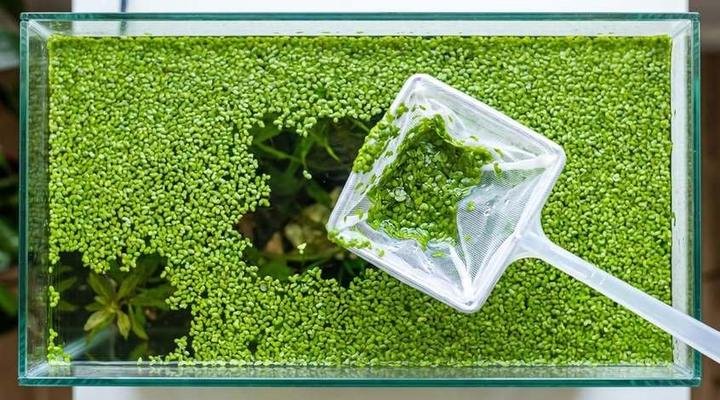
Duckweed grows well. That is the problem. Each leaf is a millimeters-wide independent plant; a single leaf overlooked, stuck to a net, a hand, a plant you moved, riding a splash into the filter, restarts the whole population. Removal means netting the surface perfectly, finding every fragment in the filter, on the glass line, and among your other plants, and doing it again next week when the three leaves you missed have become three hundred. People live with duckweed for years, not because they like it but because they added it once. Every other floater on the table can be scooped out completely in an afternoon; duckweed is a one-way door. If you want its tiny-leaf look, salvinia gives you 80% of it with an exit.
The feeding-ring corral: solve the only real problem for free
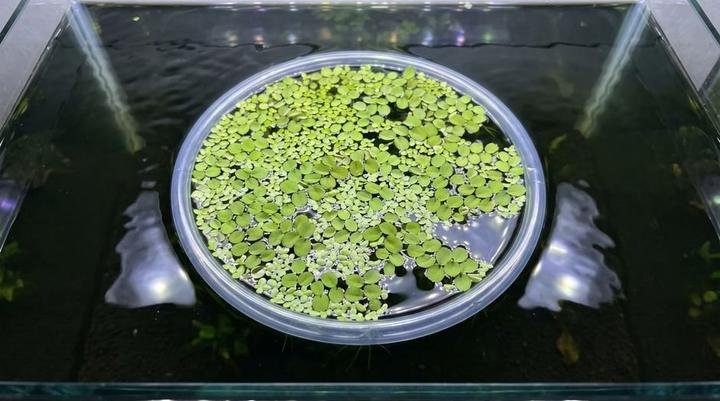
Floaters have one genuine management problem: they drift. Into the filter intake, over the outflow where the current flips and drowns them, across the feeding spot so pellets land on leaves instead of water. The fix costs nothing: a loop of airline tubing joined into a ring with a scrap of the same tubing, floated on the surface. Corral the floaters inside the ring to keep them off your equipment, or keep the ring empty as a permanent open feeding hole in an otherwise green surface. Anchor it with a suction cup and thread if you want it stationary. This is the entire art of floater management: draw a fence on the water.
Care: three rules, no exceptions
- Keep their tops dry. Floaters breathe above and drink below; constant splash or condensation dripping from a tight lid rots frogbit and water lettuce from the leaf down. Calm the surface where they sit and crack the lid for airflow.
- Thin them weekly, by the handful. This is not just tidiness. Every handful you discard is nitrogen leaving the system for good, and it keeps the mat from sealing the surface. Aim to keep a third to a half of the surface open.
- Remember the plants below. A full floater canopy is a curtain over your submerged plants’ light. If stems start reaching and paling, the canopy has taken too much, thin harder. Balance is a slider you control weekly, not a setting you pick once.
What floaters do for your fish
Wild habitats for most small aquarium fish are overhung, tangled, and dim from above. Open bright water means exposure to birds. A floater mat recreates the ceiling those instincts expect, and the change is visible within days: fish hold higher in the water, color up, and cruise instead of darting. Bettas in particular treat frogbit roots and the calm shaded water under a mat as prime territory, one more reason floaters appear throughout the betta care guide. Dangling roots double as cover for fry and a grazing surface for shrimp. The same service the epiphytes in the anubias and java fern guide provide lower down, delivered from above.
Floating plants FAQ
Why do my floating plants keep dying?
Three causes cover nearly every case: wet tops (splash from a filter or drip from a tight lid, move them or vent the lid), being trapped against the outflow current (corral them), or a genuinely infertile water column in a lightly stocked tank (a weekly dose of all-in-one liquid fertilizer fixes it). Floaters are rarely fussy about anything else.
Will floaters clog my filter?
Only if they can reach the intake. The corral exists precisely so they cannot. A coarse sponge prefilter over the intake is a worthwhile backstop in heavily floated tanks. It also stops fry and shrimp from taking the same ride.
Do floating plants cause algae by blocking light?
The opposite, usually. Floaters out-eat algae for nutrients and dim the water below, which starves green water and film algae of both food and light at once. An overgrown mat harms your plants, not your algae situation. Keep to the one-third-open rule and both problems stay solved.
Can I keep floaters in a tank with strong surface movement?
Choose salvinia. Its chained, low-profile leaves shrug off ripple that flips frogbit and sinks red root floaters. Or create a calm pocket: the corral ring plus a baffle on the filter outflow gives you a still harbor in an otherwise moving tank.