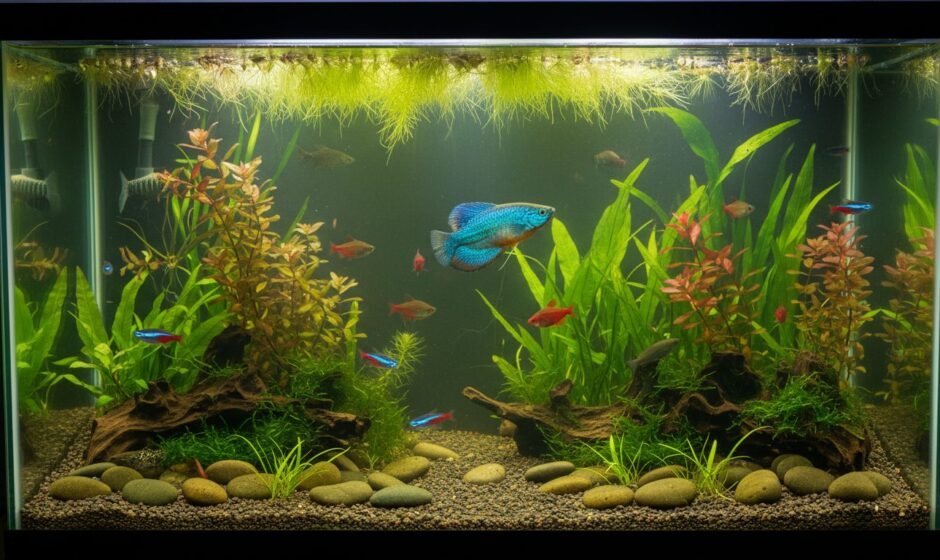
You do not need a saltwater tank for serious color. A koi betta, a squad of male endlers, or a pair of apistogramma will out-color half the fish in a reef store at a tenth of the price and a fraction of the maintenance. The catch is matching the fish to the tank you own, because the most colorful fish at 40 gallons is a terrible buy at 10. The table below pairs each common tank size with the most colorful pick that genuinely fits it, so nobody leaves this page with a fish their tank cannot hold.
The color-by-tank-size table
Find your tank in the left column. Every pick is realistic for a beginner in that size, at its full adult dimensions, with the counts that make the color show:
| Your tank | The pick | How many | The color you get |
|---|---|---|---|
| 5 gal | Betta (koi, galaxy, halfmoon) | 1, solo | Any color that exists in fish; koi plakats look hand-painted |
| 10 gal | Male endler’s livebearers | 8-10 | Metallic orange, lime green, and black on every fish, no two alike |
| 10 gal | Celestial pearl danio | 8-10 | Navy body, gold spots, red-orange fins; a tiny showpiece |
| 20 gal | Apistogramma cacatuoides pair + cherry barbs | 2 + 8 | Flame-orange dwarf cichlid fins over a school of deep red |
| 29 gal | Pearl gourami + cardinal tetras | 1 + 10 | Mosaic centerpiece over a wall of electric blue and red |
| 40 gal breeder | Boesemani rainbowfish | 8 | Half indigo, half sunrise orange, and they get brighter with age |
The 5-gallon row stops at one betta on purpose. No schooling fish belongs in a 5, however colorful; the honest 5-gallon list explains why the options run out fast at that size. At 20 gallons the hobby opens up properly, and the 20-gallon stocking plans show two more builds around the same footprint. One warning for the 40-gallon row: juvenile boesemani rainbows look gray-brown in store tanks, and plenty of shoppers walk past the best fish in the building because the color arrives at maturity. Buy them young and plain, then watch them turn two-toned over six months.
Freshwater color without the saltwater bill
The saltwater tax is real: a starter reef runs $800-1,500 before the first fish, and a clownfish costs $25 on a good day. Meanwhile a $12 koi betta carries red, white, and blue-black patches on one fish, a Fundulopanchax gardneri killifish wears leopard spots over metallic teal for about $10, and a bag of male endlers costs less than lunch. Dwarf cichlids push the ceiling higher: an apistogramma male flaring his orange dorsal at a rival is as good as anything behind reef glass. If cichlid color tempts you, start with the beginner cichlid guide, because the colorful ones and the beginner-safe ones overlap less than the store display suggests.
Colorful fish to leave at the store
- Dwarf gourami. Gorgeous flame-red and powder-blue males, and a species so riddled with dwarf gourami iridovirus that a large share of store stock is already infected at purchase. The honey gourami gives you 80% of the look with none of the disease lottery.
- German blue ram. Electric blue and gold, demands 82-86°F and near-perfect water, and modern farmed stock dies young anyway. The Bolivian ram is the hardy substitute.
- Dyed and painted fish. “Jellybean” parrots, painted glassfish, colored tetras with unnatural pastel tones. The color comes from injected or dipped dye, the process kills a large share of the fish before sale, and the survivors fade in months. Never buy them, even out of pity; the money restocks the tank.
Schooling multiplies color
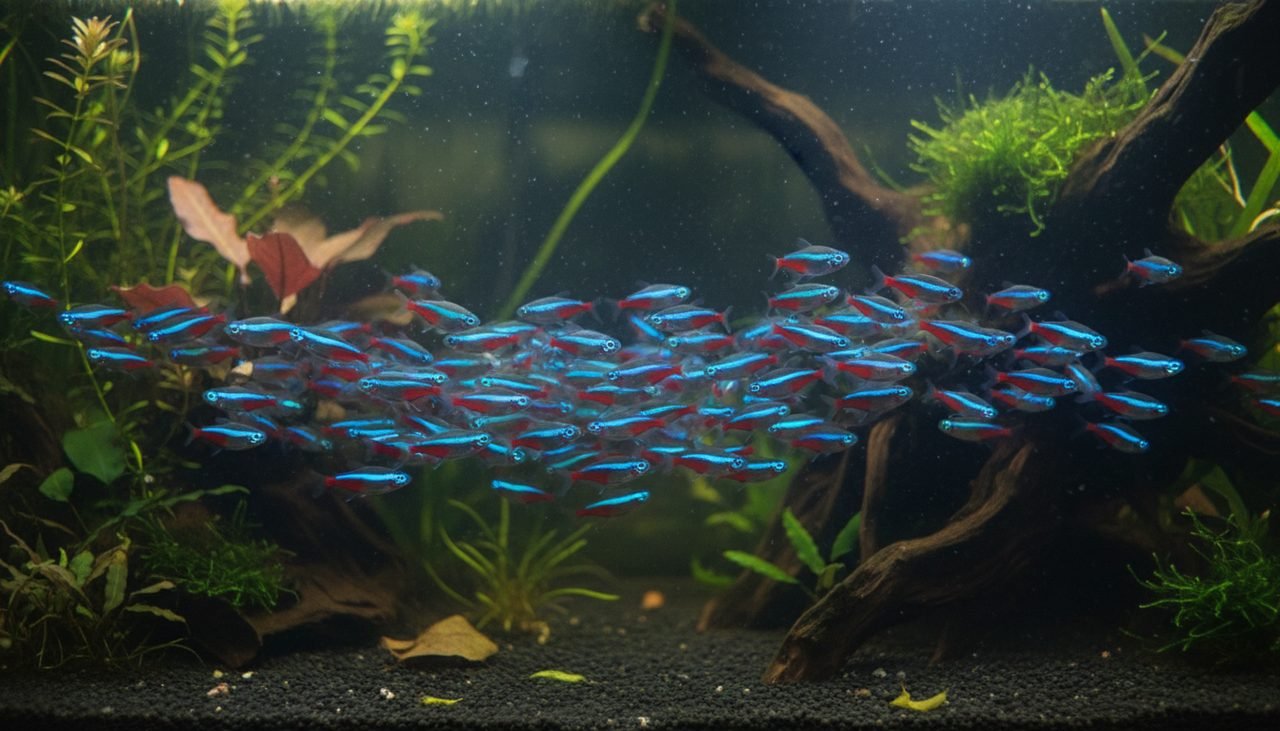
One neon tetra is a sad blue sliver. Twelve neons moving as a unit are a ribbon of light that turns heads from across the room, and the difference costs about $20. Buy the full counts in the table, and go higher where the budget allows, because schooling fish also color up better in proper numbers: a secure fish shows its full saturation, while a nervous school of three stays washed out and hides. Two more buying notes pay off at the register. In endlers, cherry barbs, and most livebearers, the males carry all the color; a males-only group of endlers gives you the entire show with zero fry. And skip the mixed “assorted” tanks when buying a school, because six fish of one species outshine two fish each of three species, both visually and behaviorally. A tank with one big school and one centerpiece beats a fish-collection tank every time.
Getting the color to actually show
The fish in the store tank is showing you its worst color, washed out by stress, bright gravel, and bare glass. Three things bring the real color out at home. Dark substrate first: fish lighten themselves to match pale gravel, and the same cardinal tetra looks twice as saturated over black sand. Food second: color comes from carotenoids in the diet, so a quality flake or pellet with krill or astaxanthin listed early in the ingredients outperforms the cheap tub within weeks. Stability third: a stressed fish is a pale fish, so a cycled tank, steady 76-80°F water, and plant cover do more for color than any product marketed for it. Give a washed-out new arrival two to four weeks before judging what you bought.
Read the care sheet before the color sells you
The costly mistake is walking into a store and buying “something colorful” the way you would buy flowers. Every fish in the table above carries care requirements the color does not advertise: the celestial pearl danio wants a mature tank and hides in a new one, boesemani rainbows need swimming length more than volume, and apistogramma males will claim territory. Pick the fish from the table for your size, then read its care requirements before paying, and treat the color as the reward for getting the boring parts right. A vividly colored fish in a struggling tank fades; an average fish in a stable tank often surprises you.
Colorful freshwater fish FAQ
What is the most colorful freshwater fish?
Pound for pound, the male betta: no other freshwater fish is bred in as many colors and patterns, and a koi or galaxy plakat rivals any reef fish. In a community setting, the boesemani rainbowfish takes it, with a body split between indigo and orange that intensifies as the fish matures.
Are colorful fish harder to keep?
Color and difficulty are unrelated. Endlers and bettas are among the easiest fish in the hobby and among the most colorful; discus are demanding and colorful; brown-and-gray plecos can be demanding too. Judge each species on its care sheet, then enjoy the color for free.
Why did my colorful fish turn pale?
Stress, almost always. New arrivals stay washed out for two to four weeks. If an established fish fades, test the water first, then look at diet and lighting. Pale plus clamped fins or hiding means a water problem, and the fix starts with a test kit, a water change, and checking the heater.
