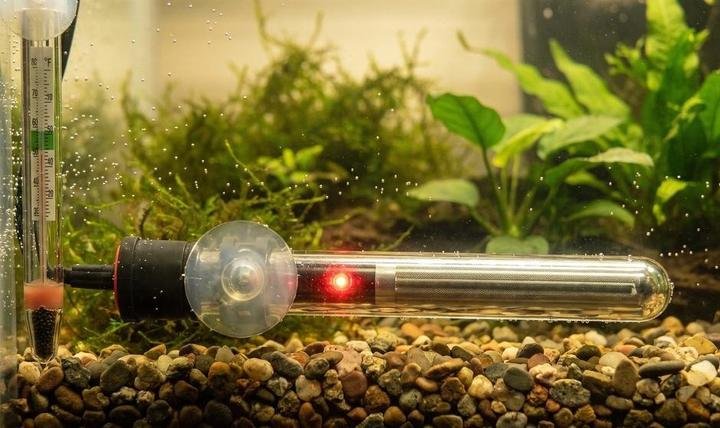
Short answer: size an aquarium heater at about 5 watts per gallon for a tank in a normally heated room, a 100-watt heater for a 20-gallon tank, and adjust up or down for how cold the room actually runs (full chart below). Buy only an adjustable, thermostat-controlled model, place it in the filter’s flow, and never trust the number on the dial: a separate thermometer is the instrument, the dial is a suggestion. Target 76 to 80°F for a tropical community tank, held steady.
The wattage chart: 5 watts per gallon, corrected for your room
A heater’s real job is not “make water warm”. It is “hold the gap between room temperature and tank temperature.” A tank in a 60°F basement asks its heater to hold a 16-to-20 degree gap all winter; the same tank in a 72°F living room asks for a 4-to-8 degree nudge. The flat 5-watts-per-gallon rule assumes an averagely heated room; here is that rule with the room built in, using standard heater sizes:
| Tank size | Cool room (~60°F) | Average room (~66°F) | Warm room (~72°F) |
|---|---|---|---|
| 5 gallons | 50 W | 25 W | 25 W |
| 10 gallons | 75 W | 50 W | 50 W |
| 20 gallons | 150 W | 100 W | 75 W |
| 29 gallons | 200 W | 150 W | 100 W |
| 40 gallons | 2 × 150 W | 2 × 100 W | 150 W |
Two notes on reading it. First, the middle column is the classic rule, 25 watts holds a 5-gallon betta tank, 100 watts holds a 20-gallon community, about 5 watts per gallon throughout. Second, from around 40 gallons we deliberately list two half-size heaters instead of one big one: two heaters spread warmth more evenly across a long tank, and if one sticks, in either direction, the failure is half as violent. One stuck-on 300-watt heater can cook a tank overnight; one stuck-on 150-watt heater in the same tank buys you time to catch it.
The only kind worth buying
Buy an adjustable, fully submersible heater with a thermostat. The kind with a dial or digital setting you control. The alternatives on the same shelf are not equivalents. Preset heaters locked to “78°F” cannot be corrected when their calibration is off, and their calibration is often off. Heating mats and bowl warmers belong to reptiles; they cannot hold a stable water column. And no heater at all is a real choice only for genuinely cold-water species. A tropical fish in an unheated bowl is slowly failing, which is why our betta care guide treats the heater as non-negotiable equipment, not an accessory.
Placement: put the heat where the water moves
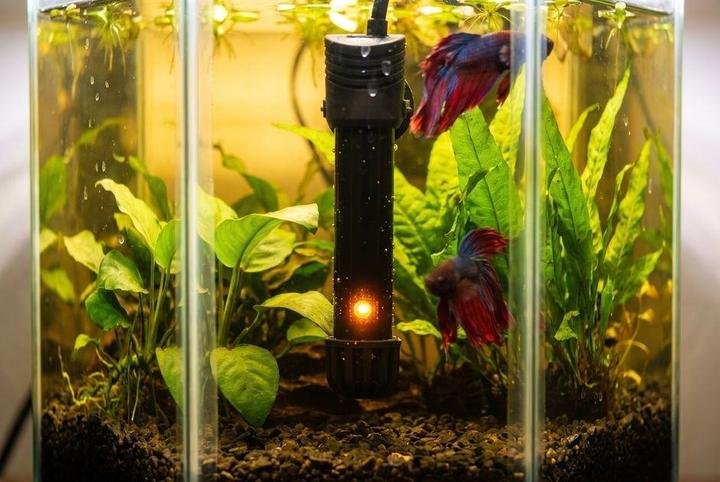
- In the filter’s flow. Mount the heater near the filter intake or outflow so moving water carries the warmth around the tank instead of letting it pool in one warm corner. Even distribution is the difference between “the tank is 78” and “the thermometer corner is 78.”
- Fully submerged, at the mounted angle the manual specifies. The thermostat reads the water around the tube; a half-exposed heater reads air and lies to itself.
- Clear of substrate and decor. Contact points trap heat against the glass tube. Leave space on all sides.
- Where you can see it. You will be checking its light and its neighborhood thermometer weekly; do not bury it behind the hardscape.
The myth: the dial tells you your water temperature
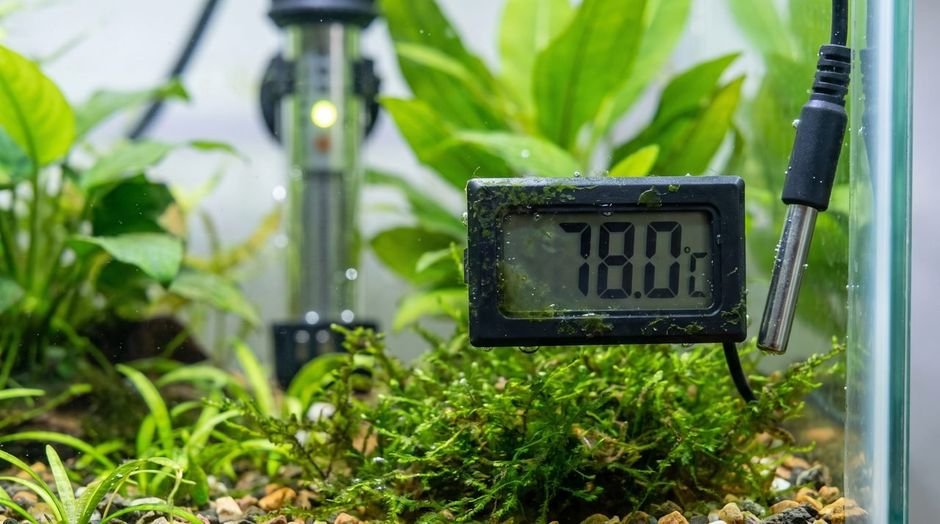
The number printed on the dial is a promise made by a cheap bimetallic thermostat, and those drift, commonly by several degrees, sometimes more, and further as the heater ages. “Set to 78” can hold a real 74 or a real 82 indefinitely, and the heater will never know. The rule this site repeats across every guide that touches temperature: the dial sets, the thermometer verifies. Keep an inexpensive separate thermometer at the far end of the tank from the heater, glance at it daily, and calibrate your dial against it, if the dial says 78 and the water says 76, your dial’s “78” simply means 76, and you nudge it up and re-check tomorrow.
Operating rules, in one place
- Wait 20 to 30 minutes after submerging before plugging in, so the thermostat adjusts to the water. The same in reverse: unplug and let it cool before lifting it out.
- Unplug the heater before any water change that drops the level below it. A heater running in air overheats in seconds and can crack when cold refill water hits the hot glass.
- Change temperature slowly. No faster than about 2°F per hour, and avoid daily swings over 2°F. Stability matters more to fish than the exact number.
- Never pour hot water in to warm a tank, and never use a lamp as a heater. Both create the fast swings the heater exists to prevent.
- Set points: 76 to 80°F for a tropical community, held steady; bettas do best at 75 to 81°F with 77 to 79°F as the target; and during a fishless cycle, 78 to 82°F speeds bacterial growth.
The stuck-heater drill: your first ten minutes
Heaters fail two ways, and it pays to have rehearsed both before one happens. This is the emergency page no heater box includes.
Stuck ON. You find the tank at 88–90°F and climbing. Minute one: unplug the heater. Then work fast but gently: lids off and lights off to shed heat, point the filter outflow at the surface to increase evaporative cooling, and float sealed bags or bottles of cool water in the tank so the temperature glides down. Never dump ice or cold water straight in, crashing the temperature downward is a second emergency stacked on the first. Warm water also holds less oxygen, so an air stone genuinely helps here (this is the low-oxygen situation, unlike a nitrite spike). Expect stressed fish to need days of clean, stable water afterward.
Stuck OFF. The tank has drifted cold. Less dramatic, more common, and size-dependent: a 40-gallon tank coasts down over many hours, a 5-gallon in a cold room chills fast. Confirm with the thermometer, replace or reset the heater, and bring the temperature back up at that same 2°F-per-hour pace, cold fish warmed too fast fare no better than warm fish chilled. While it climbs, keep lights dim and skip feeding; a cold fish’s digestion has slowed with it.
The drill is also the argument for redundancy on bigger tanks: two half-wattage heaters mean a stuck-off failure loses half the heating, not all of it, and a stuck-on failure heats at half speed. On a 40-gallon community, the second heater is the cheapest insurance in the hobby.
Frequently asked questions
Can a heater be too big for the tank?
An oversized heater does not run the tank hotter. The thermostat still switches off at the set point. The risk is what happens when it fails: a stuck-on 200-watt heater overheats a 10-gallon tank far faster than a 50-watt would. Size to the chart, not to “bigger is safer,” because in heaters it is the opposite.
Where should the thermometer go?
At the opposite end of the tank from the heater. That far corner is the coolest point, so if it reads within your target range, the whole tank does. Placing the thermometer next to the heater tells you only that the heater is warm, which you knew.
Do I need a heater for a betta?
Yes, in almost every home. Bettas are tropical fish that need 75 to 81°F held steady, and rooms that feel comfortable to people routinely sit in the low 70s or below at night. A slow chill that shows up as a lethargic betta refusing food, a pattern our betta troubleshooting guide traces back to temperature more often than any other cause. A 25-watt adjustable heater in a 5-gallon tank solves it, and the aquarium heater size calculator gives the right wattage for any tank.
How do I know my heater is working right now?
Three signals: the indicator light cycles on and off over an evening (always-on and never-on are both suspicious), the separate thermometer holds inside your target range from morning to night, and the glass near the heater feels faintly warmer than the far end. Make the thermometer glance part of feeding time and a failing heater will never get a week’s head start on you.
Sources
- Seriously Fish, Betta splendens, species temperature range behind the betta-scoped figures
- Seriously Fish, species knowledge base, per-species temperature ranges for community stocking