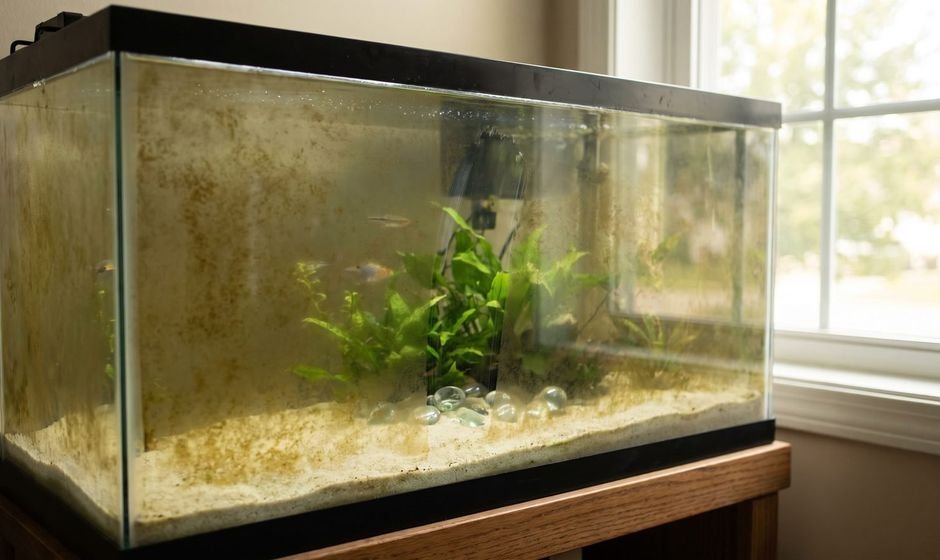
A dusty brown coating creeping over the glass, the substrate, and every leaf, usually right around week four, just when you thought your new tank had turned the corner. That is brown algae, and here is what nobody tells you in the panic of first seeing it: in a new tank it is a phase, not a failure. It arrives on a schedule, peaks on a schedule, and starves back on a schedule. This guide shows you how to confirm it in ten seconds, what that schedule looks like, and the one purchase you should not make because of it.
What brown algae actually is
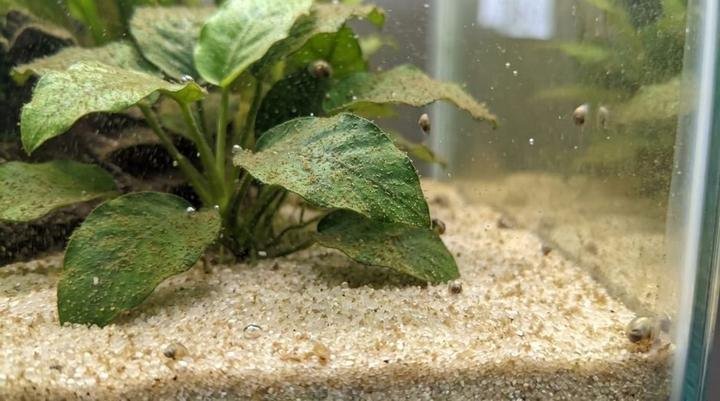
The brown film is a colony of diatoms: single-celled algae that build themselves glass-like shells out of silica. That one fact explains almost everything about them. Because their shells are made of silica, diatoms need dissolved silicates to grow, and silicates are exactly what a brand-new tank has in abundance, leaching out of fresh sand, gravel, and rock, and often arriving in tap water too. Because the cells sit loosely on surfaces rather than rooting into them, the film feels powdery, not slimy, and comes off with almost no effort. It looks alarming because it coats everything at once; it is actually the weakest, least attached growth your tank will ever produce.
The wipe test: confirm it in ten seconds
Before you treat anything, confirm what you have. Drag a bare fingertip across a coated patch of glass. If the coating lifts instantly into a little brown dust cloud and the glass underneath is clean, you have diatoms. True green algae has to be scraped and leaves a smear; thread and beard types hold on when pulled. Nothing else in the aquarium wipes away that easily. The wipe test is the whole diagnosis. If your growth fails the wipe test, it is a different problem with a different cause: start with the algae identification guide instead.
The diatom window: what happens when
Diatoms in a new tank track the same clock as the nitrogen cycle: they move in while the tank is immature and get squeezed out as it matures. Here is the typical timeline, so you can locate yourself on it instead of fighting it:
| Tank age | What you see | What to do |
|---|---|---|
| Weeks 1 to 2 | Nothing yet, silicates are still building up in the water | Nothing |
| Weeks 2 to 4 | First brown dust on the substrate and lower glass, while the cycle is still running | Wipe the glass at each weekly water change; nothing more |
| Weeks 4 to 8 | Peak coverage, glass, decor, and leaves can all carry the film | Keep the same routine; this is the top of the curve, not a trend |
| Weeks 8 to 12 | The film thins and stops coming back between cleanings | Nothing. The silicate supply is running out |
| Beyond 12 weeks | Gone, or nearly so | If it is still spreading, it is no longer a phase, see below |
The mechanism behind the fade is a supply problem. New substrate leaches a finite dose of silicates; once that runs out, diatoms are living on whatever trickles in from the tap. At the same time the maturing tank turns hostile: green algae and plants out-compete them for light and nutrients, and grazing microorganisms establish. Diatoms win the empty-tank opening and lose the mature-tank endgame, every time.
What to do while you wait
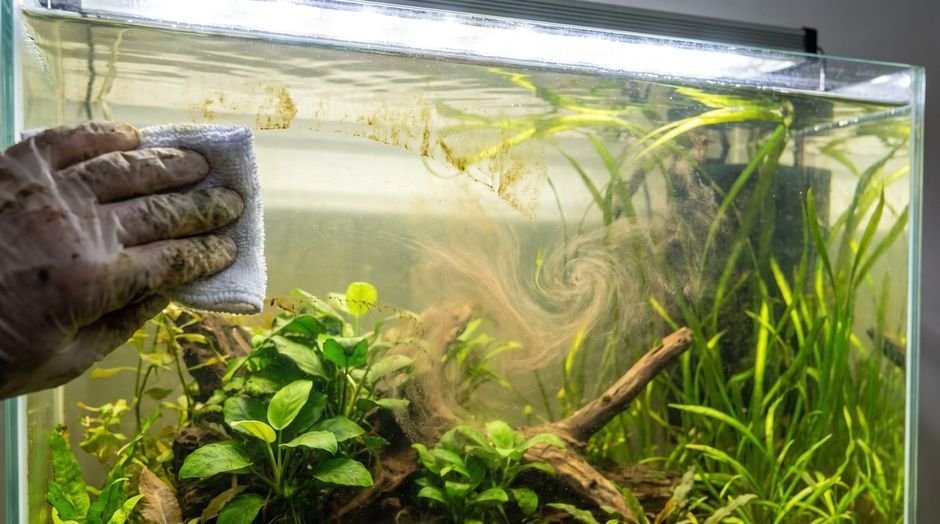
- Wipe just before the water change. Clean the glass and gently swish coated decor a few minutes before your weekly water change, so the suspended dust leaves in the siphon instead of resettling.
- Vacuum the substrate surface. The film on sand and gravel lifts into the siphon with a light pass, no deep gravel-washing needed.
- Wipe plant leaves by hand. A thick film shades the leaf underneath; broad-leaved plants like anubias appreciate a gentle thumb-wipe.
- Do not black out the tank. Diatoms tolerate low light better than the green algae and plants you want to win the takeover, so darkness helps the wrong side.
- Protect the cycle. The fastest way out of the diatom window is a finished, stable cycle. Keep testing and keep your water-change routine steady rather than reacting to the brown.
The purchase to skip
The classic mistake is buying a crew of otocinclus or another algae eater to “fix” a diatom bloom. Think about what you are actually setting up: the fish’s food supply is a temporary film that the timeline above will erase within a couple of months, and specialist grazers like otocinclus often refuse ordinary fish food. Buy them for the bloom in month one and they starve in month three, in a young tank that could barely support their waste in the first place. If a problem is scheduled to fix itself, do not hire staff for it. Algae eaters have a real place, in a mature tank, matched to an algae type that persists, and treating the cause always comes before adding mouths, as the no-chemicals algae guide explains.
When brown algae is not a phase
The timeline only applies to new tanks. If a mature, long-running tank suddenly grows brown film, something is feeding it a fresh silicate supply, and the film will persist until you find it. The usual suspects, in order: new sand, gravel, or rock added recently (which restarts the leaching clock for a few weeks, harmless); tap water that carries high silicates, common with well water (test by whether the film returns within days of every water change); or lighting so weak that diatoms are the only thing that can grow at all. Manual removal plus the fix for the matching cause clears it; silicate-absorbing filter media exists but is the last resort, not the first move.
Brown algae FAQ
Is brown algae harmful to fish?
No. Diatoms do not produce anything toxic and several fish and snails graze on the film. The only real damage is to plants: a heavy film shades leaves and slows their growth, which is one more reason to wipe broad leaves during the peak weeks.
Will a big water change clear it?
Not by itself. The diatoms are attached to surfaces, not floating in the water, and if your tap carries silicates a large change can even top up their food. Wipe first, then change water so the loosened film leaves the tank. If cloudy water rather than a surface film is your problem, that is a different diagnosis, see the cloudy water guide.
My tank finished cycling but the brown film is spreading. Is something wrong?
No. The cycle finishing at week 4 to 6 and diatoms peaking at weeks 4 to 8 overlap by design of the same underlying process: the tank is still immature even once ammonia and nitrite read zero. A finished cycle plus spreading diatoms is the single most normal state a six-week-old tank can be in. If ammonia or nitrite are above zero as well, treat that first. That is new tank syndrome, and it outranks any algae concern.
Do diatoms come back?
Only when the silicate supply is restocked: new substrate or hardscape, a switch to silicate-rich source water, or a deep gravel disturbance that releases trapped pockets. Each restock plays out as a smaller, shorter version of the original window.