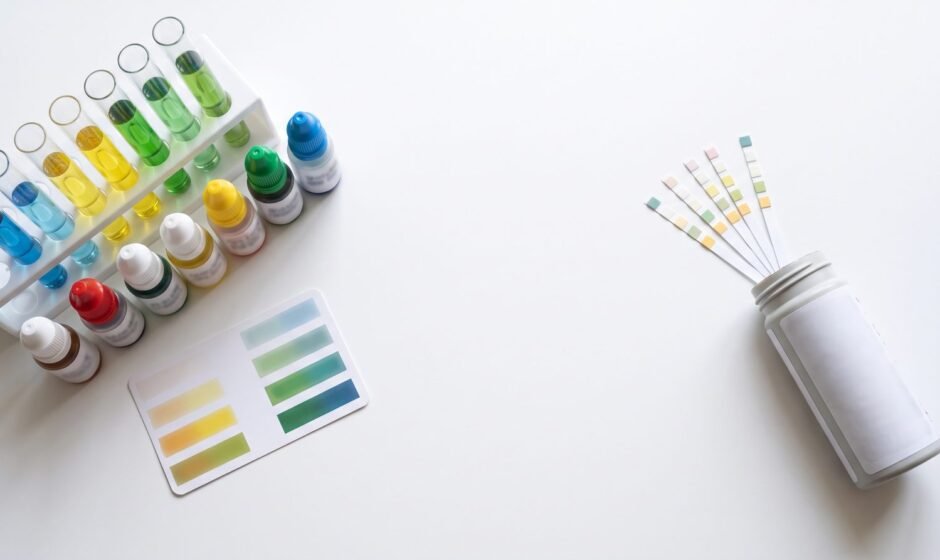
Short answer: use a liquid test kit. Strips look beginner-friendly, but the readings that decide whether your fish are safe all happen at the very low end of the scale, the exact range where strips are weakest, and a liquid kit is actually cheaper per test. Strips have one fair use: quick trend-spotting between proper liquid tests. This guide covers the cost math, how to read a liquid kit so the result is trustworthy, and the testing schedule for every stage of a tank’s life.
The low end is the whole game
Every important decision a water test drives lives in a tiny sliver of the scale. Ammonia at 0 ppm means all is well; the first tint above zero, 0.25 ppm is the smallest reading most liquid kits can display, means act today. The same zero-tolerance rule applies to nitrite. Nitrate has more room, but the target of under 20 ppm with a 40 ppm ceiling still asks the kit to separate moderately low numbers reliably.
Now consider what a strip offers in that decisive sliver: a few coarse color steps, printed on paper that reacts in seconds and fades while you fumble for the chart. The difference between “all fine” and “your fish are being poisoned” can fall entirely between two adjacent pads on a strip. A liquid kit resolves exactly that range with a controlled chemical reaction, a measured water sample, and a color that develops fully before you read it. The tool is only as good as its performance where the decisions are, and the decisions are at the bottom of the scale.
The myth, inverted: “strips are fine for beginners”
The shelf logic says liquid kits are for advanced keepers and strips are the easy on-ramp. It is exactly backwards. An experienced keeper with a long-established tank has a boring, stable system; a rough weekly glance genuinely tells them enough. A beginner is running an uncycled or newly cycled tank. The one situation in fishkeeping where ammonia and nitrite readings change daily and where a missed 0.5 ppm costs lives. Beginners are precisely the people who need low-end accuracy most and can least afford a strip that says “fine” during new tank syndrome. If either tool were to be reserved for one group, the liquid kit belongs in the beginner’s hands.
The cost math nobody runs at the shelf
The strip tube is cheaper to pick up; the liquid box is cheaper to own. A master-style liquid kit such as the API Freshwater Master Test Kit carries enough reagent for roughly 800 individual tests across ammonia, nitrite, nitrate and pH. A standard tube holds 100 strips. Run the arithmetic:
| Liquid master kit | 100-strip tube | |
|---|---|---|
| Typical price | ~$25–35 | ~$10–15 |
| Tests in the box | ~800 | 100 |
| Cost per reading | roughly 3–4 cents | roughly 10–15 cents |
| Reliable at the 0-to-first-tint range? | Yes. That is its job | Weakest exactly there |
| Shelf life once opened | Years (check reagent dates) | Degrades with every opening (humidity) |
That last row deserves a sentence: strip pads are hygroscopic, and every time the tube opens, humid air ages every strip left inside. A half-used tube from a steamy fish room is quietly drifting away from its color chart. The counterintuitive bottom line is the article’s whole argument in one row of a table. The more accurate tool is also the cheaper one per use.
What the liquid kit is actually doing
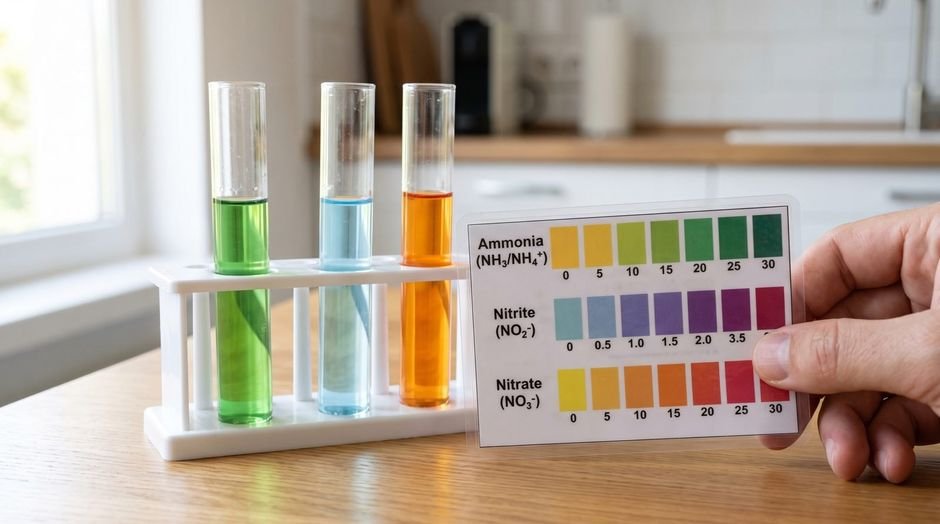
Two chemistries dominate hobby ammonia tests. Salicylate-type kits (the modern standard, including API’s) turn ammonia green through a two-bottle reaction; older Nessler-type kits turn it amber with a single reagent. It matters for one practical reason: standard kits of both types measure total ammonia. The free toxic form plus the ionized, far less harmful form together. Water conditioners that temporarily bind ammonia move it into that safer form without removing it, so a standard test still shows a reading. Only kits sold specifically as free-ammonia tests separate the two, a distinction our ammonia guide covers in detail. If you just dosed a binding conditioner and the number refuses to fall, the kit is not lying. It is answering a slightly different question.
The white-mug procedure: how to read a tube you can trust
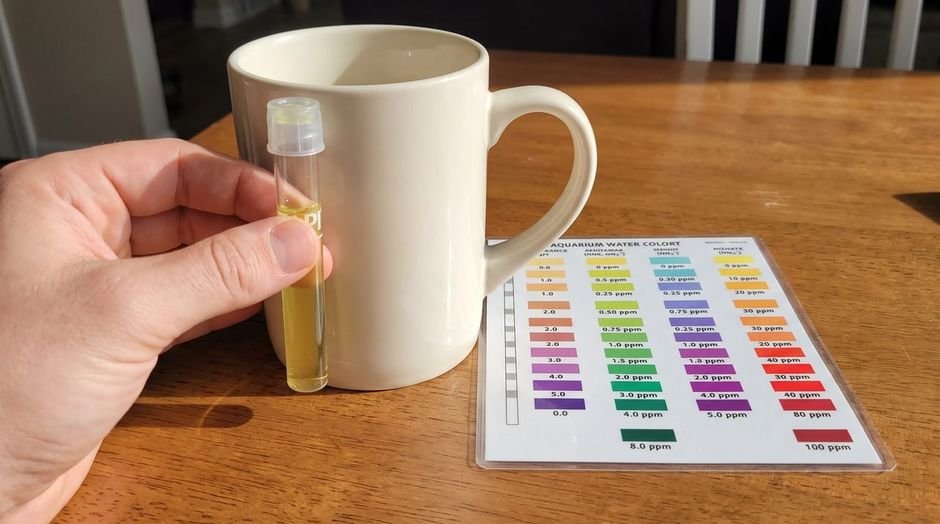
Most “wrong” liquid-kit readings are reading errors, not chemistry errors. The routine below removes nearly all of them:
- Fill to the line, exactly. The reaction is calibrated to 5 ml; an over-filled tube dilutes the color and under-reads.
- Count drops with the bottle fully vertical. Angled bottles throw different drop sizes. The instructions’ drop count assumes vertical.
- Shake what the instructions say to shake, as long as they say. The nitrate test’s second bottle famously needs its full 30 seconds of hard shaking; lazy shaking is the classic false-low nitrate reading.
- Wait the full development time. Colors keep developing to a set point, reading early under-reads, and reading far past the window over-reads on some tests.
- Read against white, in daylight. Hold the tube against a white ceramic mug or a sheet of printer paper near a window. Warm LED room light shifts every color toward yellow. The same tube can look like 0 under a warm bulb and show its true first tint in daylight. This one habit is the difference between catching a problem and missing it.
One more check that costs nothing: reagents expire. There are lot dates printed on the bottles, and old reagents drift toward reassuring answers. If your kit has been in a cupboard for years and the tank “always tests perfect,” test the tap water too. A kit that reads zero on everything, everywhere, is a kit telling you about itself.
What to test, and when
Four parameters cover a beginner’s freshwater tank: ammonia, nitrite, nitrate and pH. KH and GH kits are worthwhile later additions once you care about pH stability and hardness, but they are not day-one purchases. The cadence changes with the tank’s age:
| Tank stage | Test how often | Watching for |
|---|---|---|
| Fishless cycling | Every 2–3 days | The ammonia fall, the nitrite hump, the first nitrate |
| Fish-in cycling | Daily | Any tint above 0 ppm on ammonia or nitrite = water change today |
| First two months with fish | Twice a week | Confirming the cycle is holding under real feeding |
| Established and stable | Weekly, before the water change | Nitrate trend; ammonia and nitrite staying at 0 |
| Old, boring, stable tank | Every week or two, and whenever anything looks off | Changes from your known baseline |
These cadences are the same ones printed in our cycling guide and betta care guide. The schedule is a site-wide policy, not a per-article opinion. The habit that makes all of it useful: test before the water change, at the week’s dirtiest point, and know your baseline when nothing is wrong. A number is only alarming in contrast to your normal.
Where strips genuinely earn their keep
None of this makes strips useless, it scopes them. Strips are acceptable for coarse trend-spotting on the forgiving parameters: a midweek glance at nitrate drift, a quick GH check on new tap water, a sanity check while traveling. Used that way, a strip is a smoke detector between proper inspections. What a strip must never be is the instrument that decides whether ammonia or nitrite is zero. That decision belongs to drops, a tube, and a white mug in daylight, every time.
Frequently asked questions
Are aquarium test strips accurate at all?
For rough mid-scale readings on hardy parameters, nitrate, GH, KH, reasonably, when fresh. For ammonia and nitrite at the low end, no: the steps are too coarse and the pads degrade with humidity, and the low end is where those two parameters are decided. Strips also commonly omit ammonia entirely, which alone disqualifies the tube as a primary tool.
Why does my ammonia test never read exactly zero?
Three usual reasons: warm room lighting making 0 look faintly green (read in daylight against white), a binding conditioner keeping bound ammonia visible to a total-ammonia test, or chloramine-treated tap water contributing a trace right after a water change. Test your tap water once, if the tap shows the same faint tint, you have found your baseline, not a crisis.
Do liquid test kits expire?
Yes, reagent bottles carry lot dates, and most are good for several years from manufacture. Expired reagents fail quietly, usually toward under-reading. Check the dates when you buy (stock sits in warehouses) and once a year after. If two kits disagree, believe the newer one and confirm with a third data point, like your local store’s test.
Which tests do I actually need on day one?
Ammonia, nitrite, nitrate and pH. The four in a standard freshwater master kit. Buy it before you buy fish; you cannot run a cycle, or prove it finished, without it. KH and GH kits join later, when you start caring why your pH behaves the way it does.
Sources
- API, Freshwater Master Test Kit product information, test counts and parameters
- University of Florida IFAS, Ammonia in Aquatic Systems (FA031), on free vs ionized ammonia and why total-ammonia readings need interpretation