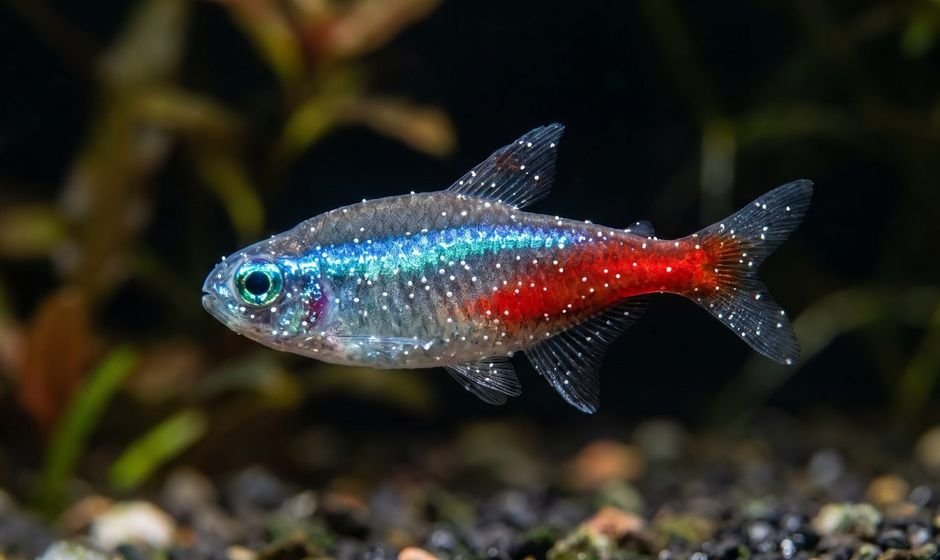
White spots on a fish are the most misdiagnosed symptom in the hobby, because two completely different organisms produce them, and the standard treatment for one actively feeds the other. Ich is a parasite that eats your fish; epistylis is a colony organism that eats bacteria and merely stands on your fish while the real problem is in the water. This guide gives you the salt-grain test that separates them in one close look, the right treatment for each, and the wrong-treatment trap that turns a recoverable outbreak into a tank wipe.
Why this mix-up kills fish
The classic ich cure is heat plus salt. The classic epistylis case is a tank with too much dissolved organic waste feeding a bacterial bloom, and heat accelerates bacteria, while salt stresses a fish whose skin is already compromised. Treat epistylis as ich and you speed up the very bloom it feeds on, weaken the fish, and open the door to the bacterial infections that are the actual killer in epistylis cases. This is why the diagnosis matters more than the medicine: the two conditions are near-opposites in what they want you to do.
The salt-grain test
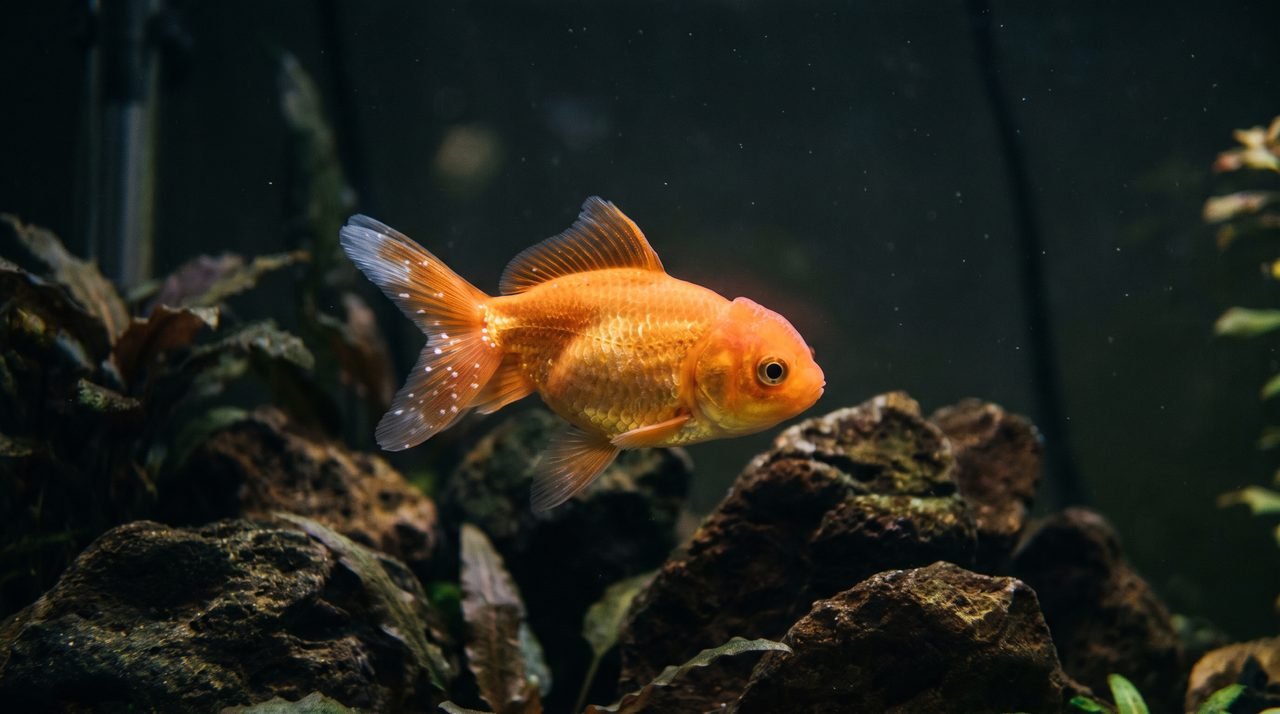
Get the fish in good light, ideally with a phone photo you can zoom into, and compare against this readout. No single row is proof by itself. It is the pattern across rows that convicts:
| Look at | Ich | Epistylis |
|---|---|---|
| Spot shape | Uniform round dots, like grains of salt sprinkled on | Irregular fluffy tufts, taller than they are wide, like tiny cauliflower |
| Where it sits | Embedded in the skin and fins, under the surface | Perched on top of the fish, often on fin edges and old wounds |
| Distribution | Evenly scattered across body, fins, gills | Clustered in patches, frequently where the fish was already damaged |
| Color | Solid white | White to translucent gray, slightly wispy in moving water |
| The tank itself | Hardscape stays clean, ich needs a fish | Similar fuzz can appear on wood, glass, or filter parts too |
| Fish behavior | Flashing, scraping against objects, clamped fins, early on | Often behaves normally at first; decline comes from secondary infection |
| Backstory | New fish or new plants added in the last two weeks | Heavy feeding, deep uncleaned substrate, rising organics |
The two highest-value rows are shape and position: salt grains in the fish is ich, cauliflower on the fish is epistylis. If the same fuzz is also growing on your driftwood, ich is off the table entirely.
Treating ich: heat plus time, run the clock
Ich is a parasite with a life cycle, and the cycle is the target. The white spot stage is armored. Nothing you dose touches it. The parasite is only vulnerable after it drops off the fish, multiplies in the substrate, and releases free swimmers to reinfect. Treatment therefore works by intercepting the swimmers: raise the tank slowly to about 86°F over a day or two (heat compresses the whole cycle from weeks to days, forcing the vulnerable stage to arrive fast), add aquarium salt at the middle rung of the dosing ladder or a standard ich medication, and hold the treatment for a full 10 to 14 days, several days past the last visible spot, because the spots you can see are the one stage you cannot kill. Vacuum the substrate every day or two to physically remove the multiplying stage. Every fish in the tank is in the treatment whether spotted or not; the swimmers do not check.
Treating epistylis: fix the water, skip the heat
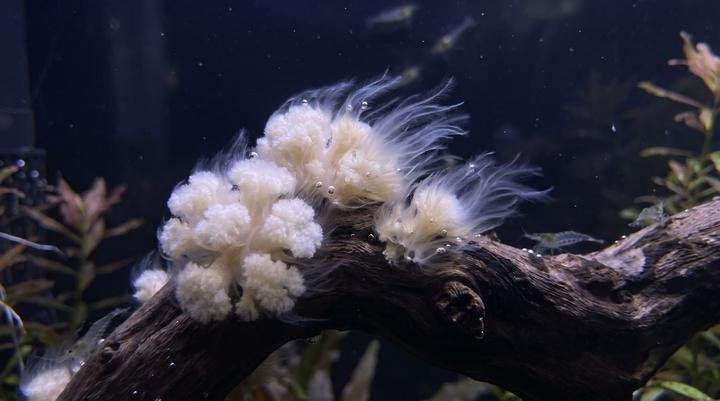
Epistylis colonies eat bacteria, and they station themselves where the bacterial soup is thickest, which in a closed tank means the organics you feed and never remove. The treatment is aimed at the water, not the organism: cut feeding hard, vacuum the substrate thoroughly, step up water changes to strip dissolved organics, and clean the filter of accumulated mulm. Keep the temperature where it is or nudge it down a degree or two, never up. The colonies starve and detach as the bacterial load falls. Watch the attachment sites: reddening, fraying, or spreading white at the base of a tuft means bacteria have entered the damaged skin, and that fish needs a quarantine tank and an antibacterial medication. The fuzz was the warning; the infection underneath is the enemy.
The wrong-treatment trap
Run the logic both ways before you act. Treat ich as epistylis and you lose a week to water changes while the parasite multiplies exponentially, bad, but often recoverable if the fish were healthy. Treat epistylis as ich and you heat a bacterial bloom into overdrive while salting fish whose skin is already breached. This is the direction that ends in losing the tank. When the readout is genuinely ambiguous, the safe opening move is the one that helps both conditions: big water changes, daily substrate vacuuming, and reduced feeding. Ich will keep declaring itself within days (more spots, more flashing) and you escalate to heat then; epistylis will start receding and you have your answer for free. The same watch-the-water reflex that solves most beginner problems. The habit built in the water change guide, is also the correct first move here.
Ich vs epistylis FAQ
Where did ich come from if I added nothing new?
Almost always it did come in, on a fish, a plant, or a bag of store water, within the past few weeks, sometimes riding at low levels on a fish that suppressed it until stress lowered its defenses. The “ich is dormant in every tank” claim is a hobby myth; the parasite cannot sustain itself long without fish to feed on. Stress from a cold snap, an ammonia spike, or a move is usually what turns a hidden light infection into a visible outbreak. The same stress arithmetic behind new tank syndrome.
Can ich go away on its own?
A strong fish can sometimes fight a light case to a standstill, which is exactly how ich sneaks between tanks on healthy-looking carriers. Visible spots on multiple fish will not resolve untreated. Each spot that drops off becomes hundreds of new parasites. Treat the whole tank, on the clock.
Is either one dangerous to my other fish?
Ich, extremely. It is among the most contagious fish diseases and every fish in the water is exposed. Epistylis does not attack fish directly and does not “spread” in the same sense; what spreads is the water condition that grows it, which is why the fix is tank-wide too.
Can my betta get ich?
Yes, bettas are fully susceptible, and their long fins make early spots easy to see against the fin membrane. Treatment is the same, and bettas tolerate the 86°F treatment temperature well for its duration; the betta care guide covers their normal temperature range.
Sources
The ich life cycle, trophont, tomont, and free-swimming theront stages, is documented in the overview of Ichthyophthirius multifiliis; Epistylis is a stalked, bacteria-feeding peritrich, which is the mechanical basis of the salt-grain test above.