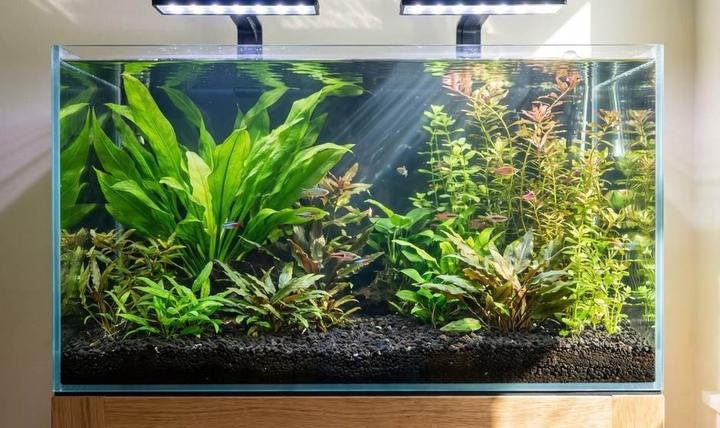
Aquarium fertilizer is sold as one product category, but it is really two tools for two different mouths, and buying the wrong one means feeding the gravel while your plants starve, or dosing the water for plants that only eat through their roots. This guide gives you the match-the-mouth table that pairs each plant with the fertilizer that can actually reach it, the real cost per month of each option, and the mechanism behind the “fertilizer causes algae” myth so you can dose without fear.
Two fertilizers, two mouths
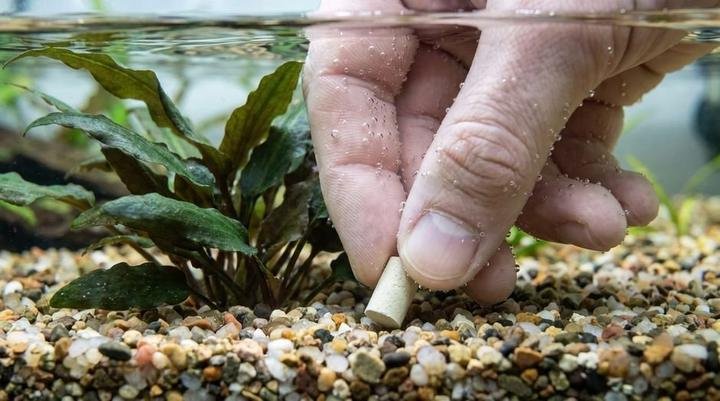
Root tabs are compressed nutrient plugs you push into the substrate, where they dissolve slowly into the root zone over about three months. Liquid fertilizer is dosed into the water itself, where it reaches every leaf in the tank within the hour. Neither is “better”. They deliver to different addresses. A plant that feeds through heavy roots barely touches what floats past its leaves; an epiphyte with anchor-roots on a rock cannot reach a tab buried a hand-span away. The question is never “tabs or liquid?” in the abstract. It is: where do your plants eat? You already sorted that if you followed the root-or-column sort in the planting guide. The fertilizer decision is the same sort, applied at the checkout.
The match-the-mouth table
| Your plants | Where they eat | Buy | Skip |
|---|---|---|---|
| Amazon swords, crypts, bulbs and runners | Substrate, via roots | Root tabs, replaced about every 3 months | Liquid does little for them |
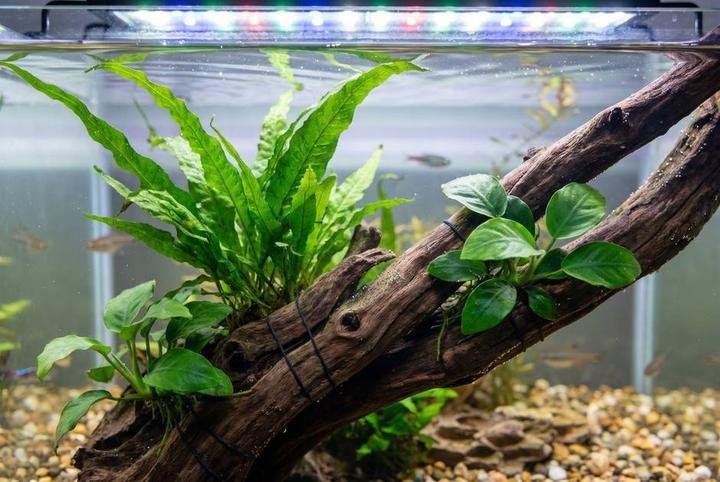
| Anubias, java fern, mosses | Water column only | Liquid, weekly, if they show hunger at all | Tabs are literally unreachable |
| Floating plants | Water column (roots dangle in it) | Liquid, weekly | Tabs |
| Stem plants | Mostly column, some root uptake once established | Liquid first; add tabs under dense stem beds | , |
| Mixed community (the usual case) | Both | Tabs under the root feeders + weekly liquid for everyone else | , |
| A lightly planted, well-stocked tank | , | Possibly nothing yet, see below | Both, until plants show hunger |
What it actually costs per month
Fertilizer looks expensive on the shelf and is cheap in practice, because doses are small and bottles last. For a typical 20-gallon community tank: a jar of root tabs runs 10 to 15 dollars for 40-plus tabs, and feeding four or five root feeders takes about that many tabs each quarter, call it 1 to 2 dollars a month. An all-in-one liquid bottle costs 12 to 18 dollars and lasts four to six months at label doses on a 20, roughly 2 to 4 dollars a month. Running both, the full program lands around 3 to 5 dollars a month, less than a single replacement plant. The costed stance: fertilizer is the cheapest input in the planted tank, and skimping on it to protect a budget usually costs more in dead plants than it saves in bottles.
The myth: “fertilizer causes algae”
This myth keeps more beginners from feeding their plants than any other, so here is the mechanism. Algae does not bloom because fertilizer entered the tank; it blooms on surplus, nutrients dissolved in the water that nothing is using. Dose a heavily planted tank and the plants absorb the ration; dose a tank with three small plants as if it were a jungle and the leftovers sit in the water with algae’s name on them. Fertilizer is fuel, and the question is whether your engine is big enough to burn it. So scale the dose to the plant mass, not the bottle label: start at half the label dose, watch for two or three weeks, and step up only if plants show hunger and algae stays quiet. If algae rises instead, you have found your tank’s current ceiling, ease back and let the plants grow into a bigger appetite. Fast consumers like the floaters in the floating plants guide make generous overshoot insurance, and if algae has already taken hold, diagnose it properly with the algae guide before blaming the bottle.
When to skip fertilizer entirely
Two situations genuinely call for no fertilizer. The first month of a new tank: fresh plants are rebuilding for underwater life, root feeders have not established mouths yet, and early heavy dosing feeds the diatom-and-algae opening act instead. The second: a lightly planted tank with a healthy fish load. Fish food is fertilizer that took a detour, waste supplies nitrogen and phosphorus continuously, which is the same reason overstocked tanks fight high nitrate readings (the nitrate guide runs that arithmetic). In both cases the tell to start dosing is the same: pale new growth, stalled stems, old leaves yellowing across many plants at once. Feed hunger, not habit.
The routine that works
- Liquid: once weekly, right after the water change, at half the label dose to start. Tie it to the change so it never gets forgotten or double-dosed.
- Tabs: push one into the substrate a finger-width from each root feeder’s crown, about every three months. Set a phone reminder, buried fertilizer is invisible, and “did I ever replace those?” is the usual failure mode.
- Review monthly: new growth pale or slow → step the liquid dose up. Algae creeping → step it down. The plants report; you adjust.
Fertilizer FAQ
Is aquarium fertilizer safe for fish and shrimp?
At label doses, yes, aquarium products are formulated for stocked tanks. The caution that matters: copper appears in some all-in-one liquids at trace levels that are fine for fish but worth checking if you keep a shrimp-heavy tank. Dose to the tank’s actual volume, and store bottles away from curious pets and children like any concentrate.
Do anubias and java fern need root tabs?
No. Their roots are anchors, not mouths, so a tab is nutrition delivered to an address they never visit. If they show hunger (many leaves paling at once), liquid is the only fertilizer that reaches them. The full logic is in the anubias and java fern guide.
How long until I see results?
Plants answer in new growth, and new growth takes two to four weeks to show. Judge a fertilizer change by the leaves that grow after it, not by the old leaves, damaged ones never repair, no matter how well you feed.
Can I use garden or houseplant fertilizer?
No. Terrestrial products are concentrated for soil application and often lean heavily on ammonia-based nitrogen, in a stocked aquarium that is dosing poison, as the ammonia guide makes plain. Aquarium formulations exist precisely because the tolerances are different underwater.