Most “best cichlids for beginners” lists are really lists of pretty cichlids, and they quietly assume you own a 55-gallon tank. This guide works the other way: it starts from the tank you actually have and tells you which cichlid fits it, using a pick-by-tank-size table with the numbers that matter, adult size, minimum tank, temperament in plain terms. It also includes the list nobody gives you: the cichlids to leave at the store, including two that dominate beginner lists and beginner casualty threads in equal measure.
Why cichlids trip up beginners
Cichlids are smart, personable, and territorial. The same intelligence that makes them interactive makes them opinionated about space. A tetra shares water; a cichlid owns territory. That changes the stocking math completely: the question is not “how many fish fit in this tank” but “how many territories does this tank contain,” and for most beginner tanks the honest answer is one. The failures are predictable. A pair of convicts turning a community tank into a war zone, an oscar outgrowing a 29-gallon in months, “assorted African cichlids” from a mixed tank turning out to be three species with three incompatible rulebooks. Every one of those failures is avoidable at the store, before any money changes hands.
The pick-by-tank-size table
Find your tank size in the left column and shop only from that row down, never up. Adult size is what the fish becomes, not what the store sells; every fish below is listed at its full-grown length:
| Your tank | Cichlid | Adult size | Temperament, honestly |
|---|---|---|---|
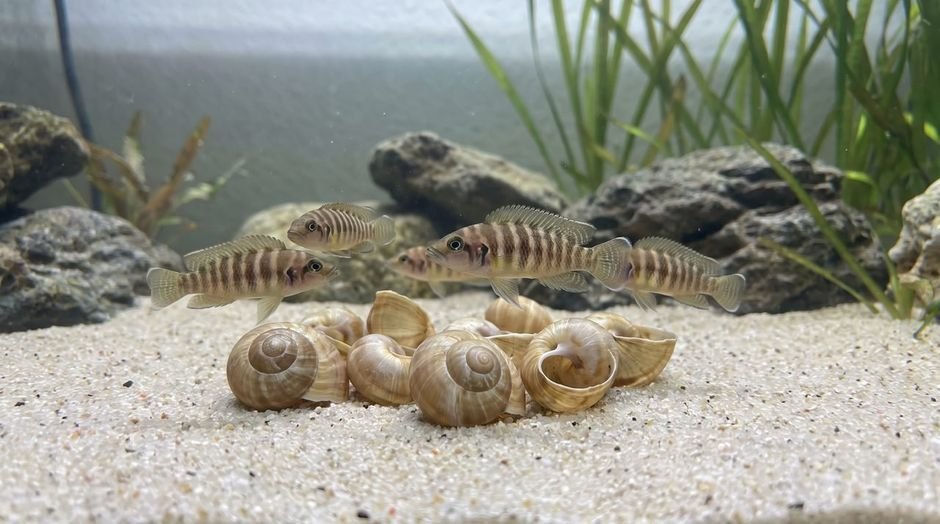
| 10–20 gal | Shell dwellers (Neolamprologus multifasciatus) | 1–2″ | Feisty around their shells, harmless beyond them. A colony runs itself |
| 20 gal | Bolivian ram | 3″ | The gentlest cichlid in the hobby; community-safe |
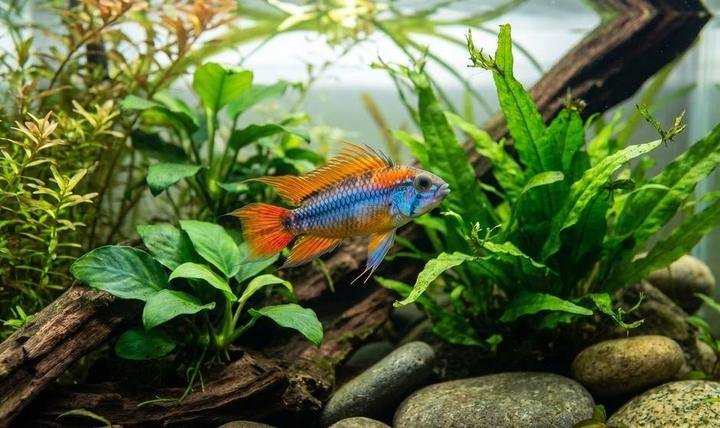
| 20 gal | Apistogramma (cacatuoides to start) | 3″ | Peaceful until breeding; keep one male |
| 20 gal long | Kribensis | 4″ | Peaceful solo; a breeding pair claims the bottom third of the tank |
| 29 gal | Keyhole cichlid | 4–5″ | Shy, gentle, criminally underrated |
| 29 gal tall | Angelfish | 6″ long, 8+” tall | Peaceful-ish; will eat fish smaller than a neon |
| 30 gal | Firemouth | 6″ | All bluff, flares constantly, rarely follows through |
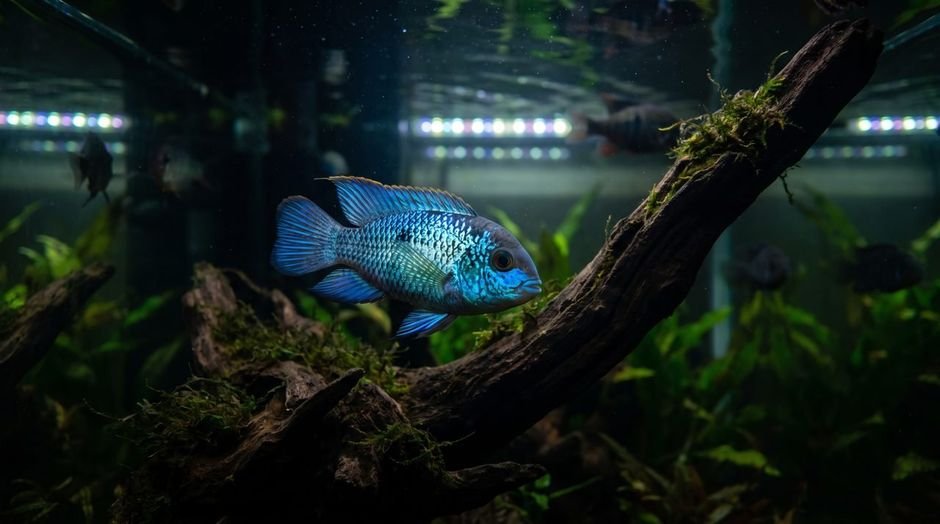
| 40 gal breeder | Blue acara | 6–7″ | Big but genuinely mellow; the best “first big cichlid” |
Two patterns worth noticing. First, everything under 29 gallons is a dwarf cichlid. That is not a coincidence, it is the whole category of cichlid that fits beginner tanks. Second, the table has no African rift lake cichlids except the shell dwellers: mbuna and peacocks need overstocked species-specific setups that are their own advanced project, not a community add-on. If your tank is a standard 10-gallon, the shell dweller row is the only honest entry. The 10-gallon stocking guide explains the space math that rules everything else out.
The leave-at-the-store list
These three appear on beginner lists constantly, and they are the three most common cichlid regrets:
- German blue ram. Gorgeous, tiny, and fragile. It demands warmer water than most communities (82–86°F), pristine parameters, and even then modern farmed stock is notoriously short-lived. The Bolivian ram is its hardy cousin: nearly the same look, a fraction of the heartbreak.
- Oscar. Sold at 2 inches, grows to 12, needs a 75-gallon tank with serious filtration, and produces waste like a goldfish with ambition. An oscar is a wonderful pet and a terrible impulse buy.
- “Assorted African cichlids.” The mixed tank at the chain store is a grab bag of unidentified mbuna, different species with different diets, aggression levels, and adult sizes, sold without names. You cannot plan a tank around fish nobody can identify.
Start with one species
The strongest single recommendation this guide can make: pick one species from the table and learn it before mixing. Cichlid compatibility is the deep end of the hobby. It depends on tank footprint, sight lines, sex ratios, and individual personality, and no chart fully predicts it. One species means you learn cichlid behavior, the digging, the territory patrol, the mock charges, without refereeing a war. A pair of kribensis in a 20-long or a blue acara centerpiece in a 40 breeder is a complete, fascinating tank, not a compromise. Water-wise, every fish in the table is content in the standard tropical range from the temperature basics, and none of them forgive an uncycled tank. Run the full fishless cycle first, because cichlids are hardy against other fish, not against ammonia.
Feeding and tank setup notes
Cichlids dig. It is not misbehavior, it is the job description. Use a sand or fine gravel substrate, anchor plants to hardscape rather than planting them in the open (or choose potted crypts), and build at least one cave or shell zone per fish so territory disputes are about real estate, not survival. Feed a quality cichlid pellet as the staple in the standard two-minute portion, once or twice a day; dwarf cichlids appreciate frozen or live foods a few times a week. And overfilter: cichlids are messy eaters, and the difference between a thriving cichlid tank and an algae-streaked one is usually the filter sizing and the water change schedule, not the fish.
Beginner cichlid FAQ
Can cichlids live in a community tank?
The dwarf rows, Bolivian ram, apistogramma, keyhole, kribensis (when not breeding), coexist well with tetras, rasboras, and corydoras. The 6-inch rows can too, but tankmates must be too big to swallow and quick enough to stay out of a flared-up firemouth’s corner. Shell dwellers are best in their own tank; their whole world is the shell bed.
Are angelfish really cichlids?
Fully, and they act like it. They are peaceful by cichlid standards, which still means they eat neon tetras, pair off, and defend a spawning site with real conviction. The “tall” in their tank requirement is not optional: an adult angelfish is taller than a 10-gallon tank is deep.
Why is my cichlid rearranging the gravel?
It is instinct. Cichlids rework the substrate to mark territory, and many spawn in pits they dig themselves. It is a sign of a comfortable, confident fish. Fight it with plant anchors and hardscape, not with hope.
What is the single best first cichlid?
For a 20-gallon: the Bolivian ram, no contest, hardy, gentle, and full of personality. For a 40-gallon: the blue acara, which gives you the full big-cichlid experience without the big-cichlid warfare. Check any pairing against tank size with the stocking calculator before you buy.
Sources
Adult sizes and habitat notes cross-checked against the species overviews for Mikrogeophagus altispinosus, Neolamprologus multifasciatus, and Andinoacara pulcher.