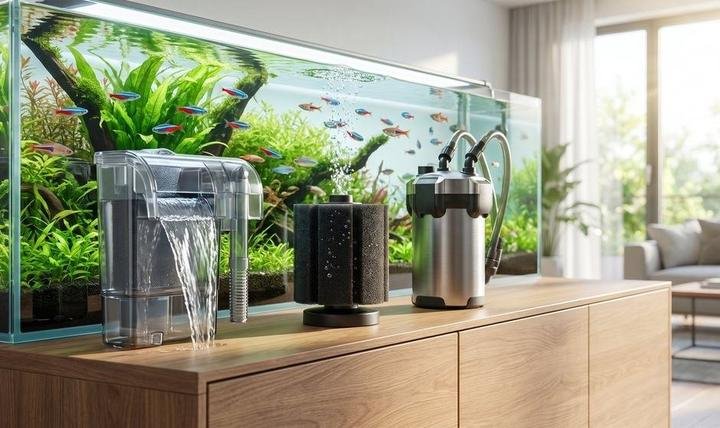
Short answer: A filter’s most important job is not catching debris, it is housing bacteria. For a first community tank of 10 to 40 gallons, a hang-on-back filter rated for roughly 4 to 6 times the tank volume per hour is the cheapest thing that works properly. A sponge filter suits a betta, shrimp, or fry tank. A canister starts earning its price above about 55 gallons, or in a planted tank where you want the outflow controlled.
Type matters less than two things beginners routinely get wrong: matching flow to the tank, and cleaning media without wiping out the colony.
Three jobs, and only one of them is critical
Mechanical filtration is physical straining. Sponge, floss, and pads catch uneaten food and waste so the water looks clear. Nothing leaves the system until you rinse the pad.
Biological filtration keeps fish alive. Nitrifying bacteria colonize every surface in the tank but concentrate where oxygenated water passes over the most surface area, which is inside the filter. They convert ammonia to nitrite, then nitrite to nitrate. Lose that colony and you get an ammonia spike within a day or two. If cycling a fish tank from scratch is new to you, read that before buying hardware.
Chemical filtration is optional. Activated carbon adsorbs dissolved organics, tannins, and medication, then stops working after a few weeks. Useful after a course of treatment or to clear yellow water from driftwood, but it does nothing for ammonia, nitrite, or nitrate.
Biological capacity comes from surface area and steady oxygenated flow, so a large media chamber with a modest pump beats a small chamber with a powerful one.
The types you will see on the shelf
Sponge filter
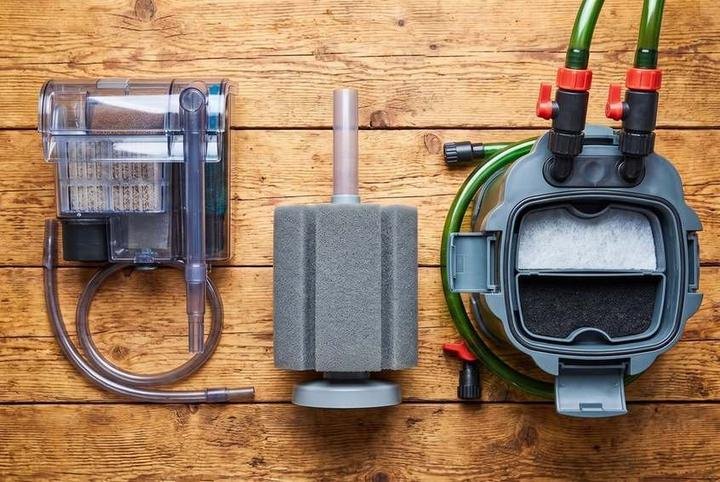
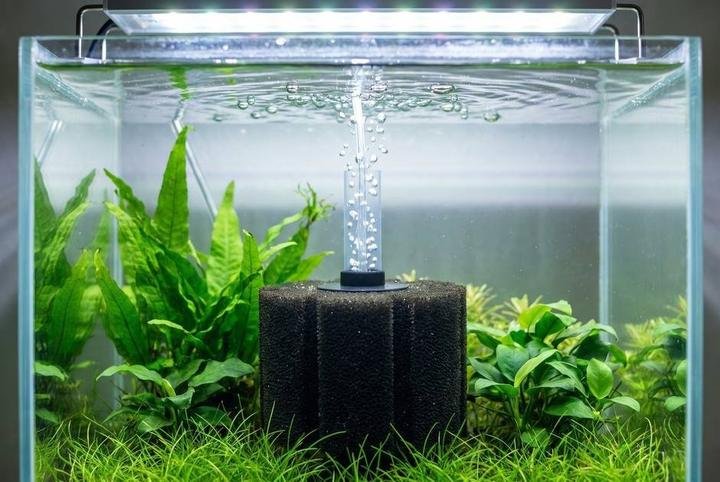
An air pump drags water through a foam block. No impeller. The foam is both mechanical and biological media and holds a lot of bacteria for the money. Flow is gentle and nothing small gets sucked in. The block sits visibly in the tank, and clarity is decent rather than sparkling.
Hang-on-back (power filter)
A pump lifts water up an intake tube, through media, and back over a waterfall lip. Cheap, easy to service, and the return breaks the surface well for gas exchange. Media volume is small, and most models are built around disposable cartridges, which quietly encourages you to throw your bacteria away monthly. Repack the housing with sponge and ceramic media instead.
Internal power filter
A sealed submersible unit with a directional nozzle. Quiet, works at any water level, and fits under a tight lid where a hang-on-back will not sit. It takes up visible space in the tank.
Canister filter
An external cylinder in the cabinet below, connected by two hoses. Media volume is several times anything internal: coarse sponge, fine pad, and a large bed of ceramic biomedia. A spray bar spreads the return without churning the surface. Costs the most, needs priming, and the seals want attention every few years.
Undergravel filter
A slotted plate under the gravel with uplift tubes driven by an air pump or powerhead. Water is pulled down through the substrate, which becomes the biological media. Cheap, and it worked for decades. But it forces you into coarse gravel, fights rooted plants, and traps sludge under the plate.
Side by side:
| Type | Suits | Flow | Bio capacity | Main drawback |
|---|---|---|---|---|
| Sponge | Up to about 20 gallons; fry, shrimp, betta, quarantine | Very gentle | Good for its size | Visible in tank, needs an air pump |
| Hang-on-back | 10 to 55 gallon community tanks | Moderate to strong | Small unless you repack it | Cartridge design invites media replacement |
| Internal | 10 to 55 gallons, tight lids, low water level | Moderate, adjustable | Small to moderate | Takes up tank space |
| Canister | 40 gallons and up, planted or heavily stocked | Strong, easy to temper | Large | Cost, and servicing gets postponed |
| Undergravel | Bare-bottom or gravel tanks with no plants | Gentle | Moderate | Traps sludge, cannot be cleaned in place |
Sizing by turnover rate
Turnover is how many times the filter moves the tank’s whole volume in an hour. Multiply your volume by the target figure to get the gallons per hour needed. The stocking calculator does this step for you and flags when a fish load outpaces the filter.
| Tank type | Target turnover | Example: 20 gallons |
|---|---|---|
| Betta or low-flow species | 2 to 4x | 40 to 80 gph |
| Standard community tank | 4 to 6x | 80 to 120 gph |
| Planted, moderately stocked | 4 to 6x | 80 to 120 gph |
| Goldfish, cichlids, heavy stocking | 6 to 10x | 120 to 200 gph |
Now apply the two-thirds rule. The number on the box is measured in a lab with no media in the filter and no height to lift the water, conditions your filter will never see again after its first week. Loaded with media and a little normal grime, real output settles near two thirds of the rating. So convert before you buy: the box needs to say roughly one and a half times the flow you actually need.
| Standard community tank | Real flow needed (4 to 6x) | Box rating to buy |
|---|---|---|
| 10 gallons | 40 to 60 gph | 60 to 90 gph |
| 20 gallons | 80 to 120 gph | 120 to 180 gph |
| 29 gallons | 115 to 175 gph | 175 to 260 gph |
| 40 gallons | 160 to 240 gph | 240 to 360 gph |
When in doubt, buy the larger size: an oversized filter is corrected with a baffle in five minutes (next section), while an undersized one is a return trip to the store.
Flow rate, and how to cut it down
Fish from still water cannot hold position or feed properly in strong flow. Bettas, gouramis, fancy goldfish, and long-finned varieties all struggle in a current. Aim for a rippling surface, not a churning one. If a betta is blown off its resting spot or hangs in one corner permanently, the flow is too high; a betta’s low-flow setup covers what stress behavior looks like.
Ways to slow the water without downgrading the filter:
- Baffle a hang-on-back. A strip of clear plastic over the waterfall lip spreads the return into a sheet instead of a jet.
- Fit a sponge pre-filter over the intake. It softens suction, protects shrimp and fry, and adds surface area.
- Aim the outflow at the glass so the energy dissipates before it reaches the fish.
- Throttle a canister on the outlet side, never the intake. Restricting the intake starves the impeller.
- Use an air control valve on a sponge filter, or a spray bar on a canister.
None of that costs you much filtration. Bacteria need oxygenated water passing through the media, not high velocity in the tank.
The maintenance mistake that crashes tanks
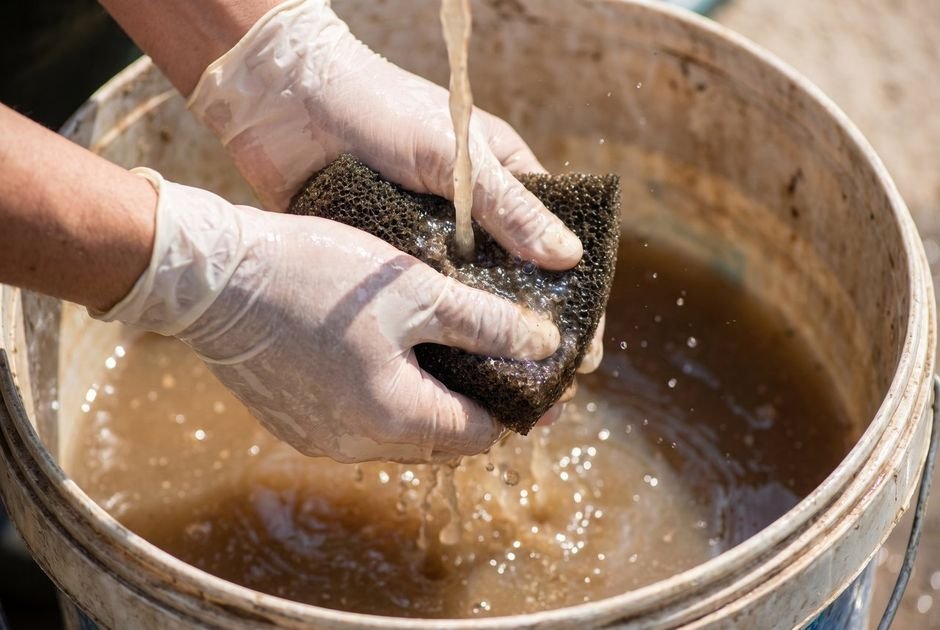
Two habits cause most post-cycling ammonia spikes: rinsing media under the tap, the tap-rinse crash, and replacing all the media at once. Chlorine kills nitrifying bacteria and the temperature shock finishes the job, which is why a tank can run flawlessly for months and then spike ammonia three days after its filter was “cleaned.” Swapping a whole cartridge for a fresh one throws out the colony and leaves you cycling with fish in the tank. Clean it this way instead:
- Unplug the filter and set aside a bucket of tank water before you open anything.
- Lift out mechanical media only: the coarse sponge and any fine pad.
- Squeeze it in the bucket of tank water until the water goes brown. No tap water, no soap, no scrubbing. Gray and grubby is what a working sponge looks like.
- Leave the biological media alone unless it is visibly clogged, and then give it one gentle swirl in the same bucket.
- Rinse the impeller and intake, where slime and gravel build up and quietly cut your flow.
- Reassemble and restart. Prime a canister if needed and check the seals seat properly.
- Replace media in stages once it falls apart: never more than a third at a time, four to six weeks apart.
Rinse mechanical media every three to four weeks, or sooner if flow weakens. Bacteria also starve of oxygen in a filter switched off for more than a couple of hours, so do not leave one unplugged overnight. If ammonia or nitrite appears in the days after a filter clean, that is the cause, and there are step-by-step instructions for getting readings back to zero.
Matching a filter to a real tank
- 5 to 10 gallon betta tank: sponge filter, or a small internal with the nozzle turned to the glass.
- 20 gallon community tank: a hang-on-back rated around 120 gph, repacked with sponge and ceramic media, with a pre-filter sponge on the intake.
- 55 gallon planted tank: a canister on a spray bar at 4 to 6x turnover.
- 40 gallon goldfish tank: 8 to 10x turnover, media rinsed every two weeks. Goldfish produce far more waste than their size suggests, so plan how heavily you can stock it before you buy.
If the choice is between a better filter and a bigger tank, take the bigger tank. Volume dilutes mistakes in a way no filter can, which is why the full tank setup starts with size. Browse the other equipment guides for heaters and lighting, and the getting-started basics for how it all fits together.
Frequently asked questions
Do I need a filter if the tank is heavily planted?
Plants take up ammonium and nitrate, and some experienced keepers run dense, lightly stocked, unfiltered tanks successfully. It is not a beginner setup. Without circulation you get dead spots and no reliable bacterial bed, so run a small sponge filter even in a jungle tank.
Can I run two filters on one tank?
Yes, and it is one of the more useful things you can do. Flow spreads more evenly, capacity is redundant if one fails, and the second filter is seeded media for starting a quarantine tank in a day.
How often should filter media be replaced?
Mechanical sponge and floss: rinse in tank water monthly, replace when it stops springing back into shape. Biological media: effectively never, and a third at a time if it crumbles. Carbon: monthly while in use, or leave it out.
Is my filter too strong for my fish?
Watch the fish, not the rating. Fish that hold position and feed at the surface without being swept away are fine. Fish pinned in a corner, or visibly working to stay still, need the flow baffled.