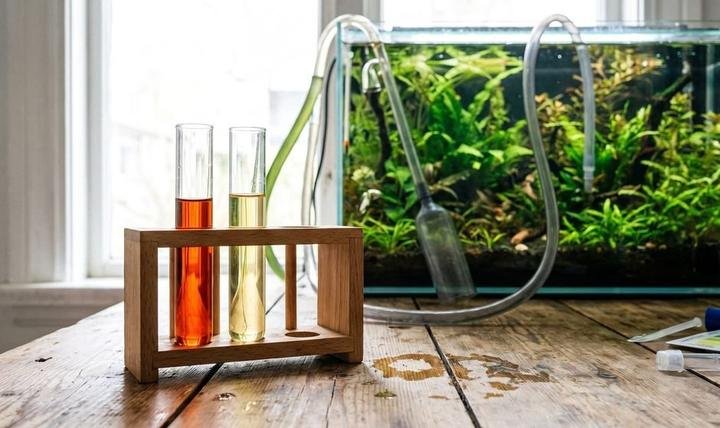
Short answer: nitrate is the end product of the nitrogen cycle, and nothing in a normal aquarium removes it at any speed. It leaves the tank three ways: water changes that dilute it, live plants that eat it, and the gravel vacuum that removes waste before it ever becomes nitrate. Aim to keep nitrate under 20 ppm measured the day before your water change. If it is past 40 ppm, act now: larger water changes to bring the number down, then fix the cause, which is almost always feeding or stocking.
Where nitrate comes from, and why it only goes up
Every gram of food you feed ends up as ammonia. The bacteria in a cycled tank convert that ammonia to nitrite and the nitrite to nitrate, and there the assembly line stops. Ammonia and nitrite are processed within hours; nitrate just accumulates, day after day, until something physically carries it out of the tank.
That difference changes how you should think about it. Ammonia and nitrite are emergencies measured in hours. Nitrate is a slow-harm parameter: it stresses fish gradually, shortens lifespans, fuels algae, and quietly reports whether your tank is overstocked. A high nitrate reading is rarely the disaster itself. It is the meter that shows the disaster forming.
The two numbers, and why they are different
This site uses two nitrate thresholds, and they answer two different questions:
- Under 20 ppm, measured the day before a water change. This is the healthy-tank target. It is deliberately measured at the dirtiest point of your week: if the water is still under 20 ppm right before you change it, your maintenance is beating your bioload.
- 40 ppm is the act-now ceiling. Past 40 ppm you stop scheduling and start correcting: bigger changes, more often, until the reading is back under control.
A tank that keeps drifting past 40 ppm between weekly changes is telling you something no product can fix: it is producing waste faster than a normal maintenance routine can export it.
Test your tap first: the nitrate floor
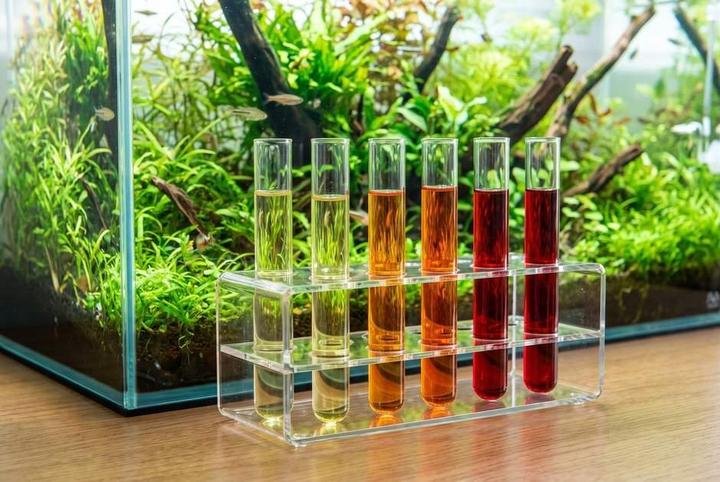
Before you blame the tank, run one test almost nobody runs: test your tap water for nitrate. Water changes work by dilution, and you cannot dilute below the level of the water you are diluting with. If your tap reads 15 ppm, your tank can never sit below 15 ppm through water changes alone. That is your floor.
This matters more in the United States than most guides admit. The federal drinking water standard allows up to 10 ppm of nitrate-nitrogen, and aquarium test kits measure the whole nitrate ion, so perfectly legal tap water can read as high as roughly 44 ppm on the kit in your hand. Agricultural areas with well water are the usual suspects. If your tap floor is high, dilution stops being your main tool: heavy plant export or blending with RO (reverse osmosis) water becomes the only way down, and your target shifts from “under 20” to “as low as my floor allows, held steady.”
The dilution planner: what a water change actually achieves
Water changes are arithmetic. Remove a quarter of the water and you remove a quarter of the nitrate; the reading drops by 25 percent, no more. The water change calculator sizes the swap from your current and target numbers. That is why a single change never rescues a neglected tank, and why two spaced changes do. Assuming tap water near 0 ppm nitrate:
| Reading now | After one 25% change | After one 50% change | After two 50% changes (spaced) |
|---|---|---|---|
| 40 ppm | 30 ppm | 20 ppm | 10 ppm |
| 60 ppm | 45 ppm | 30 ppm | 15 ppm |
| 80 ppm | 60 ppm | 40 ppm | 20 ppm |
| 100 ppm | 75 ppm | 50 ppm | 25 ppm |
Two rules keep the correction safe. First, change up to 50 percent at a time, not more: replacing nearly all the water at once shifts pH, hardness and temperature in one jump, which trades a slow stressor for a fast one. Second, space the changes: a 50 percent change today and another tomorrow gets a 100 ppm tank to 25 ppm in about a day and a half, gently. Once the number is back under control, a routine change of about 25 percent weekly holds it there in a normally stocked tank.
Plants are an export line, not a decoration
Live plants are the only thing in the tank that removes nitrate continuously. Fast growers do nearly all the work: hornwort, frogbit and Vallisneria pull nitrate all day and turn it into leaves, which you then trim and throw away. That trimming is the moment nitrate physically leaves the system. Slow growers like anubias barely register.
The honest framing from our low-maintenance plant guide still applies: plants do not replace water changes, they widen the margin between them. A heavily planted, lightly stocked tank can hold nitrate almost flat for a week. A plastic-plant tank with the same fish load cannot.
Vacuum the gravel: remove tomorrow’s nitrate today
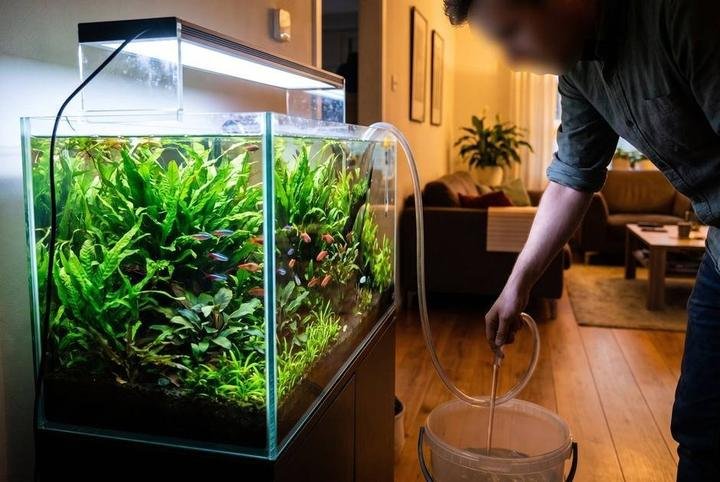
Every flake of uneaten food and every bit of waste sitting in the substrate is nitrate that has not happened yet. A gravel vacuum during your weekly change removes that material while it is still solid, before the bacteria mineralize it. This is the cheapest nitrate control there is: the same water change removes twice as much future nitrate when the hose is pushed into the gravel instead of skimming the open water.
The upstream levers: feeding and stocking
Everything above manages nitrate after it is made. The bigger wins are upstream, because nitrate production is set by exactly two things you control: how much food enters the tank and how many fish are converting it.
Feed what the fish finish in about two minutes, once or twice a day. Anything beyond that window is not feeding the fish; it is feeding next week’s nitrate reading. And use the stocking test from our 10-gallon stocking guide: if you have to change more than 25 percent of the water more than once a week just to hold nitrate down, the tank is carrying more fish than it should. No maintenance schedule outworks an overstocked tank forever.
The myth: nitrate pads and bottled removers fix high nitrate
Nitrate-absorbing filter pads and liquid “nitrate removers” are the most tempting shelf in the store when your reading is 80 ppm. Here is the problem: the pad absorbs silently, and it exhausts silently. For two or three weeks your readings improve while the cause, too much food, too many fish, not enough export, continues untouched. Then the media saturates, the number climbs again, and you are back where you started minus the cost of the pad. Bacteria-based nitrate reducers need low-oxygen conditions that a standard filter does not provide.
None of these products remove the reason the nitrate is high. Water changes, plants, the gravel vacuum and restrained feeding do. Spend the pad money on a pothos cutting or a bunch of hornwort and you get a remover that never exhausts.
Frequently asked questions
Is 40 ppm nitrate dangerous?
Not the way ammonia or nitrite is. Fish do not gasp or drop dead at 40 ppm. It is a chronic stressor: immune systems weaken, fry develop poorly, sensitive species and shrimp decline first, and algae gets a constant food supply. Treat 40 ppm as the line where nitrate stops being a log entry and becomes this week’s project.
Can I do one huge water change to fix 100 ppm?
Do not. Fish living in 100 ppm water have adapted to that water, and swapping nearly all of it at once swings pH, hardness and temperature on top of the nitrate drop. Change up to 50 percent, wait a day, change 50 percent again. The planner table above shows you land at 25 ppm with two gentle steps instead of one rough one.
Why does my nitrate never read zero?
Because a cycled tank manufactures nitrate around the clock. A low, steady reading is the signature of a working cycle, not a problem. A true, persistent zero in a tank with fish usually means one of three things: the tank is heavily planted and lightly stocked, the test was misread, or the tank has not actually cycled and ammonia is still climbing upstream. If you see zero nitrate, check ammonia and nitrite before celebrating.
Does high nitrate cause algae?
It is one of the two ingredients. Algae needs light and nutrients, and nitrate is the nutrient half of that equation in most tanks. The nitrate to phosphate calculator shows whether your two nutrients are in balance. Holding nitrate low will not kill existing algae, but it starves the next generation, which is why nitrate control is step one in our guide to getting rid of algae without chemicals.
Sources
- Southern Regional Aquaculture Center, Nitrite in Fish Ponds (SRAC 462), on the nitrogen cycle chemistry that ends at nitrate
- US EPA, National Primary Drinking Water Regulations, the 10 ppm nitrate-nitrogen standard behind the tap-floor test
- University of Florida IFAS, Ammonia in Aquatic Systems (FA031), on the nitrogen pathway from feed to nitrate