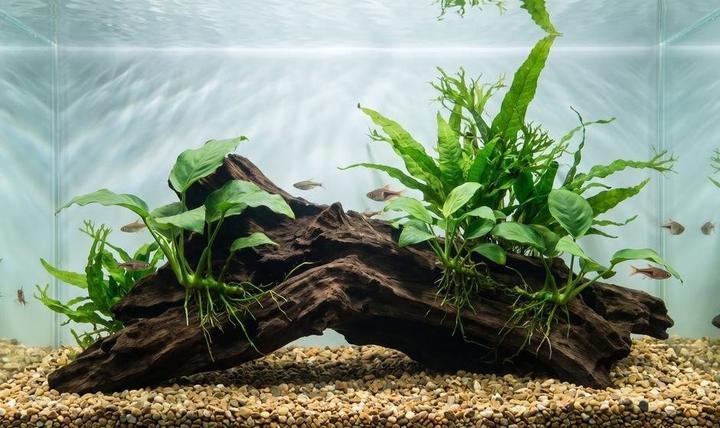
If aquarium plants have ever felt like a skill you lack, anubias and java fern are the two that do not care. They grow in any beginner tank, under any light, in any water your fish can live in — with exactly one rule attached, and it is the rule the store almost never explains. This guide covers the rhizome rule that keeps them alive, the black-spot “disease” on java fern that is actually free plants, and a trouble readout for the few things that genuinely go wrong with them.
What makes an epiphyte different
Anubias and java fern are epiphytes: in nature they grow attached to rocks and wood in streams, not rooted in soil. Their roots are grappling hooks, not mouths — the plant feeds through its leaves, straight from the water column. That single fact explains their whole reputation. They need no special substrate because they do not use substrate. They need no root tabs because they have no feeding roots. They tolerate low light because slow, tough growth is their entire strategy. Everything that makes other plants demanding, they simply opted out of — which is why they sit at the top of our low-maintenance plants list.
The rhizome rule: the one way to kill them
Both plants grow from a rhizome — the thick horizontal stem the leaves and roots both sprout from. The rhizome rule: the rhizome never goes under the substrate. Not halfway, not “just to anchor it.” Here is the mechanism, because it is worth understanding rather than memorizing: the rhizome is a stem, and stems are built for open water and light, not for the oxygen-poor world below the gravel. Buried, its tissue suffocates and rots, and because every leaf and root grows from the rhizome, rhizome rot is whole-plant death — usually announced a few weeks later by healthy-looking leaves detaching one by one from a mushy base. Nearly every “anubias just died on me” story is this, and it is 100% preventable: attach the plant instead of planting it.
Attaching them: tie, glue, or wedge
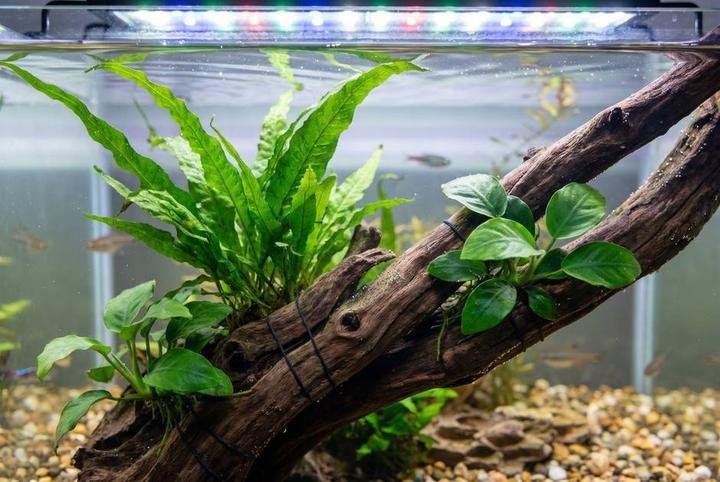
- Tie: cotton thread or fishing line around the rhizome and a piece of rock or driftwood. Cotton rots away in a month or two, by which time the roots have gripped on their own.
- Glue: a dab of cyanoacrylate super glue gel (the plain hardware-store kind) on a dry patch of rock, press the rhizome on for ten seconds, done. Fully aquarium-safe once set, and the fastest method by far.
- Wedge: push the rhizome into a crack in the hardscape and let physics hold it. Free, invisible, and how it happens in rivers.
- If you want it “in” the foreground: rest the rhizome on top of the substrate and pin the roots down with a small stone. Roots may be lightly covered — only the rhizome must stay clear. The full substrate-boundary logic is in the planting guide’s crown-line rule.
The black-spot myth: java fern’s free plants
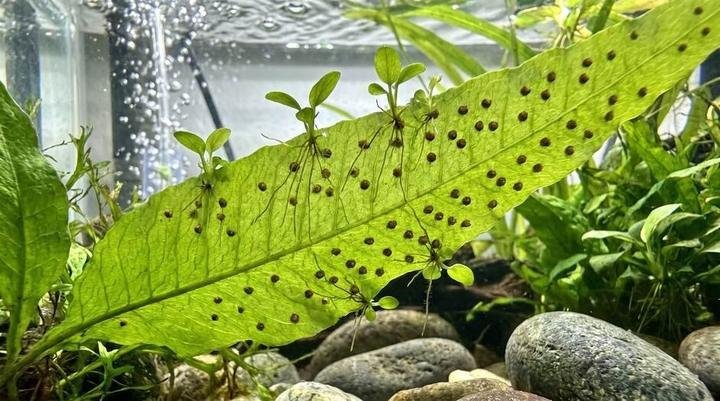
Sooner or later your java fern grows rows of black or brown bumps on the undersides of its leaves, and every beginner’s first thought is disease. It is the opposite: those are plantlets. Java fern reproduces by growing complete baby plants directly on its old leaves — the bumps swell, sprout tiny leaves and dangling roots, and eventually detach to drift off and colonize elsewhere. The mechanism is worth knowing because it changes what you do: a “diseased” leaf gets cut off and binned, while a plantlet-bearing leaf is a nursery. Leave it alone until the babies have a few leaves each, then pluck them off and glue them wherever you want more fern — free plants, forever. The lookalike to rule out is black beard algae, which grows as fuzzy tufts on leaf edges rather than orderly rows of bumps on the underside; if that is what you have, see the black beard algae guide.
The epiphyte trouble readout
When something does look wrong, the symptom points at the cause with unusual precision on these two species:
| What you see | What it means | What to do |
|---|---|---|
| Leaves detach from a soft, dark rhizome | Rhizome rot — it was buried or glued into a spot with zero flow | Cut away all mushy tissue; reattach any firm green rhizome sections, exposed to flow |
| One or two oldest leaves yellow, rest healthy | Normal old-age shedding on a slow plant | Trim the old leaf at its base; nothing is wrong |
| Many leaves pale or yellowing at once | Column nutrition has run dry — these plants eat from the water | Dose a liquid fertilizer; tabs will not help an epiphyte |
| Black fuzzy tufts on leaf edges | Black beard algae exploiting a slow-growing leaf | Treat the tank, not the plant — see the BBA guide |
| Orderly black bumps under java fern leaves | Plantlets — reproduction, not trouble | Harvest the babies or leave them be |
| Holes and ragged edges on java fern | Usually old leaves decaying naturally; occasionally a hungry fish | Trim old leaves; new growth from the rhizome is the health signal that matters |
Perfect for betta tanks (and every other beginner tank)
A single anubias on a small piece of driftwood turns a bare 5-gallon betta tank into a landscape, and its broad leaves double as betta resting platforms near the light. Both species are too tough and bitter for nearly all fish to eat, so they survive tanks that shred delicate plants. If you have been decorating with plastic or silk because live plants felt risky, these two are the honest upgrade — the same conclusion the betta care guide reaches about soft decor, with photosynthesis included.
Anubias and java fern FAQ
How fast do they grow?
Slowly — a new leaf every couple of weeks for anubias is normal and healthy. That slowness is also why algae sometimes colonizes their long-lived leaves in an unbalanced tank: the leaf sits still long enough to be real estate. Fix the tank’s algae cause, not the plant; the algae guide shows how to read which cause you have.
Do they flower underwater?
Anubias does, surprisingly often — a white hooded flower like a miniature peace lily, to which it is related. It is a sign of a content plant. Java fern never flowers; plantlets are its whole reproductive act.
Can I trim a big rhizome into pieces?
Yes — cut the rhizome with clean scissors into sections, each keeping at least three or four leaves and some roots. Every piece becomes an independent plant. This is the standard way both species are propagated, and a single healthy specimen can populate a whole tank over a year.
Do they need fertilizer?
Usually not in a stocked tank — fish waste keeps the water column stocked with enough for such slow growers. If many leaves pale at once (see the readout table), a weekly squirt of all-in-one liquid fertilizer covers it. Root tabs do nothing for them.