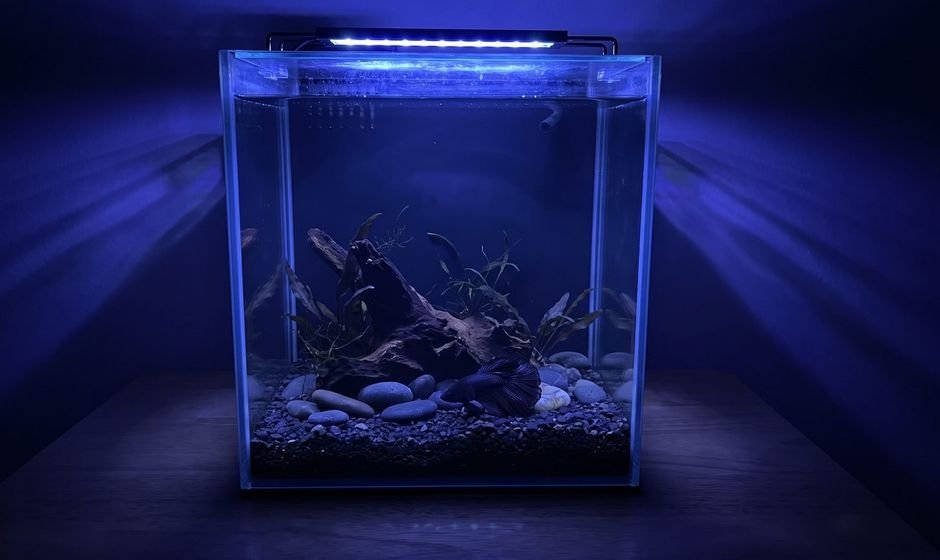
Yes, betta fish sleep. They are daytime animals that rest at night and take short naps through the day, usually draped on a leaf, settled on the gravel, or wedged into a plant near the surface. A sleeping betta often goes pale and lies dead still, which scares new owners into thinking the fish has died. Give it eight hours of real darkness and the sleep sorts itself out.
What a sleeping betta looks like
A resting betta picks a spot and parks there. The common sleep positions all look alarming until you have seen them a few times:
- Flat on the gravel, often tilted onto one side.
- Balanced on a broad leaf near the surface, where the water sits warmest.
- Curled inside a cave, behind a decoration, or tucked against the filter intake.
- Hanging nose-up or nose-down in a corner, barely moving.
Color is the part that worries people. A betta loses some of its brightness while it sleeps and gets it back within a minute of waking. Faded while resting is normal. Faded all day is not, and the warning signs of a declining betta cover the difference.
Day naps and night sleep
Bettas are diurnal, so their real sleep happens overnight once the lights go out. They nap in daylight too, and more so with age. A betta past three years old spends a solid chunk of the day resting, and heavy-finned varieties rest more than plakats because hauling those fins around is tiring.
A midday nap is not a red flag by itself. Watch what happens at feeding time. A healthy napping betta wakes, comes to the front, and eats. One that sleeps through food and keeps sleeping is telling you something else is wrong.
They sleep with their eyes open
Bettas have no eyelids, so they cannot shut their eyes. A sleeping betta looks awake, staring straight ahead, which is why so many owners never realize the fish sleeps at all. The tell is stillness plus a chosen resting spot, not closed eyes.
They do not wake gently either. Snapping a bright light on over a dark tank jolts a sleeping betta the way a camera flash jolts you. Turn on a lamp or the room light first, wait a minute, then switch the tank light on.
Give them real darkness
Sleep needs dark. A tank lit around the clock, or one sitting under a bright room every evening, keeps a betta from resting properly, and poor sleep shows up as stress, dull color, and a weaker fight against infection.
Put the tank light on a timer set to 8 to 10 hours a day and leave the rest dark. Skip the blue LED moonlight accessories sold for night viewing; bettas read them as daylight and stay restless. If the tank sits in a bright room, a genuine dark period matters even more. The betta care guide covers the light, heater, and tank setup that makes good sleep possible.
Sleeping or sick? How to tell
The two look identical for about ten seconds, then the differences surface. Run this check before you reach for medication:
- Does it wake and eat? A betta that rouses for food and swims normally is sleeping. One that refuses food for days while it rests is probably sick.
- Is the water warm enough? A betta sitting at 68°F is cold, not sleepy. Hold the tank at 78 to 80°F and a sluggish fish often perks up.
- Is the breathing calm? Slow, even gill movement means rest. Fast or labored breathing points to water or disease.
- Are the fins relaxed? Fins clamped tight to the body signal stress, not sleep.
When resting comes bundled with clamped fins, refused food, and hard breathing, test the water first. Most of these cases trace back to ammonia or a cold tank, not old age.
Betta sleep FAQ
Do betta fish sleep at the bottom of the tank?
Yes. The gravel is a normal sleeping spot, often with the fish tilted onto one side. It only signals trouble when the betta also stops eating, clamps its fins, or breathes hard. A fish that naps on the bottom and wakes to eat is fine.
Should I turn the light off for my betta at night?
Yes. Bettas need a dark stretch of at least 8 hours to sleep. Put the tank light on a timer, skip blue night-lights, and avoid flipping a bright light on over a dark tank, which startles a sleeping fish.
Why does my betta look dead when it is sleeping?
Deep sleep makes a betta go still, pale, and settle into an odd position, and because it cannot close its eyes it looks even more lifeless. Watch the gills. If they are moving, the fish is asleep.
How many hours do betta fish sleep?
Roughly 8 to 12 hours across a day, mostly overnight with daytime naps on top. Older and long-finned bettas sleep more. As long as the fish is active and eating when awake, the amount of sleep is nothing to manage.
